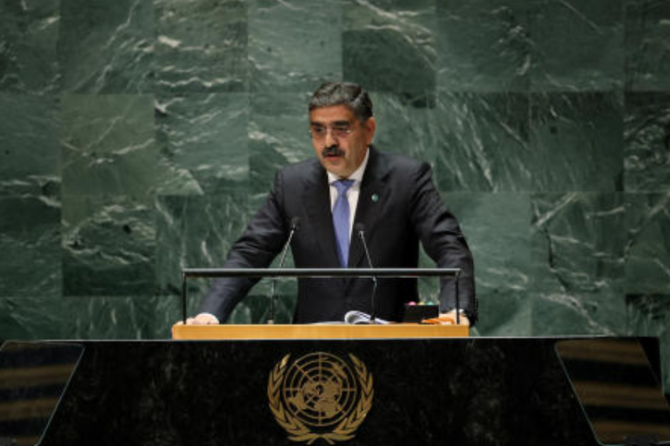
ISLAMABAD: Pakistan’s caretaker Prime Minister Anwaar-ul-Haq Kakar on Friday called for action to halt militant attacks from neighboring Afghanistan, endorsed Saudi Arabia and Iran’s diplomatic rapprochement, and advocated a two-state solution as the path to enduring peace in Palestine.
Kakar achieved a historic milestone as the first caretaker prime minister of his country to address the annual United Nations General Assembly session in New York, where he tackled global issues ranging from extremist violence and relations with India to the escalating challenges of climate change and Islamophobia.
“Pakistan’s first priority is to prevent and counter all terrorism from and within Afghanistan,” he told representatives of UN member states. “Pakistan condemns the cross-border attacks by the TTP (Tehreek-e-Taliban Pakistan), Daesh and other groups operating from Afghanistan.”
The prime minister’s statement follows a dramatic surge in militant violence in Pakistan, mainly in regions bordering Afghanistan, since the Taliban’s return to power in Kabul in August 2021.
Attacks in the first half of this year rose by 80 percent compared with the same period last year, according to statistics compiled by the Pakistan Institute for Conflict and Security Studies.
“We have sought Kabul’s support and cooperation to prevent these attacks,” the prime minister said. “We are also taking necessary measures to end this externally encouraged terrorism.”
Kakar reiterated his country’s position that peace in Afghanistan was a “strategic imperative” for Pakistan, while sharing international concerns with respect to its neighbor, particularly those related to the rights of women and girls.
“We advocate continued humanitarian assistance for the destitute Afghan population in which Afghan girls and women are the most vulnerable, as well as the revival of Afghan economy and implementation of the connectivity projects with Central Asia,” he said.
Discussing Pakistan’s relations with its nuclear-armed neighbor, the prime minister said his country desired “peaceful and productive” relations with all neighbors, including India.
“Global powers should convince New Delhi to accept Pakistan’s offer of mutual restraint on strategic and conventional weapons,” he said, adding that Kashmir provided the key to peace between the neighboring states.
Pakistan and India both rule parts of the disputed Himalayan region while claiming it in full. They have fought two wars over the mountainous territory, and their forces frequently exchange fire across a 740 km (466 mile) line of control, the de facto border separating the two parts of Kashmir.
“We must counter all terrorists without discrimination, including the rising threat posed by far-right extremist and fascist groups, such as Hindutva-inspired extremists threatening genocide against Indian Muslims and Christians,” he said.
“We also need to oppose state terrorism, address the root cause of terrorism, such as poverty, injustice and foreign occupation, and distinguish genuine freedom struggles from terrorism.”
The prime minister proposed the creation of a committee of the general assembly to oversee the balanced implementation of all “four pillars of the global counter terrorism strategy.”
He also applauded the normalization of relations between Saudi Arabia and Iran, while commenting on the overall strategic situation in the Middle East.
“Pakistan welcomes the progress made toward ending the conflicts in Syria and Yemen. In particular, we warmly welcome the normalization of relations between the Kingdom of Saudi Arabia and the Islamic Republic of Iran,” he said.
Focusing on the Palestine issue, Kakar mentioned continued “Israeli military raids, air strikes, expansion of settlements and eviction of Palestinians.”
He said: “A durable peace can be established only through a two-state solution, and establishment of a viable and contiguous Palestinian state within the pre-June 1967 borders, with Al-Quds as its capital.”
The prime minister also mentioned the “age-old phenomenon” of Islamophobia, saying the problem had grown dramatically in the wake of the Sept. 11 attacks in the US, and could be seen in the negative profiling of Muslims and public burnings of the Qur’an.
“The narratives advocating a clash of civilizations have done considerable harm to humanity’s progress,” he said. “Such ideas have bred extremism, hatred and religious intolerance, including Islamophobia.”
Kakar welcomed legislation initiated by Denmark and contemplated by Sweden to ban desecration of the Islamic scripture.
“Pakistan and the OIC (Organization of Islamic Cooperation) countries will propose further steps to combat Islamophobia, including the appointment of a special envoy, creation of an Islamophobia data center, legal assistance to victims and an accountability process to punish Islamophobic crimes,” he said.
Discussing the climate change issue, Kakar said Pakistan looked forward to fulfilling the climate commitments made at COP28 by developed countries to provide over $100 billion in annual climate finance.
“Pakistan’s triple food finance fuel challenge is a prime illustration of the impact of COVID conflict and climate on developing countries,” he said, adding that Pakistan was one of the countries worst hit by climate change.
Flooding in Pakistan last year submerged one-third of the country, killed 1,700 people, displaced over 8 million others, destroyed vital infrastructure and caused over $30 billion damage to the economy, Kakar said.
“We are gratified by the commitment of over $10.5 billion for the Pakistan’s comprehensive plan for recovery, rehabilitation, reconstruction with resilience,” he said.
“Specific projects are being submitted to ensure timely funding. I hope our development partners will accord priority to the allocation of funds for our recovery plan which costs $13 billion.”


![]()

Pakistan’s ‘first priority’ is countering terrorism from Afghanistan, PM tells UNGA
Short Url
https://arab.news/grfh5
Pakistan’s ‘first priority’ is countering terrorism from Afghanistan, PM tells UNGA
- Anwaar-ul-Haq Kakar welcomes Saudi-Iranian normalization, calls for two-state solution for Palestine
- Premier says global powers should convince India to accept offer of mutual restraint on strategic weapons
Latest updates


© 2026 SAUDI RESEARCH & PUBLISHING COMPANY, All Rights Reserved And subject to Terms of Use Agreement.