

Imran Khan’s woes set to rule him out of Pakistan election race

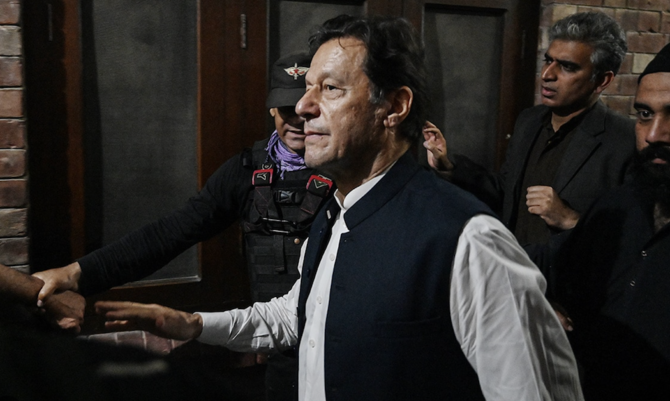
Former Pakistan's Prime Minister Imran Khan (C) leaves after appearing at the high court in Lahore on March 17, 2023. (AFP/File)
Short Url
Updated 22 September 2023
Follow

Imran Khan’s woes set to rule him out of Pakistan election race

  • Participation of Imran Khan, the main opposition leader and former prime minister, in January’s general election is doubtful
  • Khan remains in jail after being convicted in a graft case in August despite his three-year sentence being suspended by a court

ISLAMABAD: The participation of main opposition leader and former Prime Minister Imran Khan in Pakistan’s general election set for January next year remains doubtful. Khan, winner of the last election in 2018, remains in jail after being convicted in a graft case in August despite his three-year sentence being suspended by a court.

Here are some facts about the options for Khan, 70, who is the country’s most popular party leader according to independent opinion polls:

BARRED FROM PUBLIC OFFICE

Khan, 70, remains barred from holding public office for five years due to his conviction, despite the suspension of his jail sentence. The bar will remain in place until his conviction is overturned by the high court, where he has appealed, a situation that currently rules him out of the January elections.

It remains unclear if his appeal will be decided in time for the next election, but aside from this graft case, the former cricket star faces dozens of other serious cases, too, which carry sentences from five years up to a death penalty.

STATE SECRETS CASE

Khan remains in judicial custody for a case related to leaking state secrets, which is at a pre-trial stage being heard by a special court that holds proceedings at a prison where he’s detained on security grounds. This week, another court allowed police to add sedition charges against him in two cases related to abetting attacks against military installations on May 9 by his supporters to protest against his brief arrest.

KHAN’S PTI WEAKENED

Khan’s Pakistan Tehreek-e-Insaf (PTI) party can still contest the elections and will seek to tap into a sympathy vote, but it has been severely hobbled by the departure of key leaders in the aftermath of the May violence and the crackdown that ensued.

In Khan’s absence, the PTI was being led by former Foreign Minister Shah Mahmood Qureshi, but he too has been arrested in the state secrets case.

ROLE OF THE MILITARY

Analysts say the military-backed caretaker government, which has been questioned by the election commission over its credibility, wouldn’t let Khan bounce back, especially as independent polls show him to be the most popular party leader, a standing that could earn the PTI a good showing in January’s election.

Khan and his party continue to accuse the military of being behind his ousting and the crackdown.

The military, which according to analysts brought Khan to power in 2018, denies being behind his removal. His criticism of the armed forces and its top brass has not eased, and his appeals to the military to open talks with him haven’t yielded a response.

The military’s support remains key to anyone looking to attain power in Pakistan.


At OIC meeting, Pakistan calls on world to halt Israel’s annexation of West Bank

Updated 8 sec ago
Follow

At OIC meeting, Pakistan calls on world to halt Israel’s annexation of West Bank

  • Israel this month decided to approve land registration procedures in parts of the West Bank for the first time since 1967
  • FM Ishaq Dar demands end to Palestinian displacement, reconstruction of Gaza, pathway to independent Palestinian state

ISLAMABAD: Pakistan on Friday called on the international community to stop Israel from annexing the occupied West Bank, demanding a “political pathway” toward an independent Palestinian state.
Israel decided this month to approve land registration procedures in parts of the West Bank for the first time since 1967, drawing sharp criticism from Muslim nations along with several European countries, which described it as a move to ease the path for settlement expansion and annexation.

Speaking at an extraordinary ministerial session of the Organization of Islamic Cooperation (OIC), Pakistani Foreign Minister Ishaq Dar said the development carries profound implications not only for the Palestinian people but also for the credibility of international law, United Nations charter and the integrity of the multilateral system.

“Israel continues with impunity to expand illegal settlements and enforce de facto annexation in the Occupied West Bank. These actions, flagrantly violate international law including UN Charter, UN Security Council Resolution 2803 [endorsing President Donald Trump’s peace plan for Gaza], undermine all diplomatic efforts and threaten the very foundation of a just and lasting peace,” Dar said.

“These violations embolden further aggression, erode regional stability and trample on the rights and dignity of the Palestinian people. The international community must decisively act and act now to halt these violations, uphold international law and ensure delivery of the assurances made in good faith to the group of eight Arab-Islamic countries, including Pakistan.”

The West Bank is among the territories that the Palestinians seek for a future independent state. Much of it is under Israeli military control, with limited Palestinian self-rule in some areas run by the Western-backed Palestinian Authority (PA). More than 500,000 Israelis live in settlements and outposts in the West Bank, excluding Israeli-annexed East Jerusalem, alongside nearly three million Palestinians.

Dar recalled that leaders and the foreign ministers of the group of eight Arab-Islamic countries, including Pakistan, engaged with United States President Donald Trump on the sidelines of the UN General Assembly on Sept. 25 to help end the bloodshed in Gaza, ensure unimpeded humanitarian access, secure a permanent and sustainable ceasefire and advance a comprehensive peace process for the Palestinian brothers and sisters.

“During these consultations, we, the group of eight, ensured that the non-annexation of the Occupied West Bank remained firmly on the agenda and assurances were given to us in New York that the annexation of West Bank would not take place,” he said.
“In view of the serious gravity of the situation, we need to collectively ensure, first, an immediate reversal of all Israeli measures aimed at de-facto annexation of the Occupied Palestinian Territory, including West Bank, which constitutes a red line for any just resolution of the issue of Palestine.”

Pakistan is among the Group of Eight Arab Islamic countries, which also includes Saudi Arabia, Jordan, the United Arab Emirates, Qatar, Indonesia, Egypt and Türkiye. Islamabad does not have diplomatic relations with Israel and maintains a firm policy of non-recognition, rooted in its support for an independent Palestinian state in the Middle East with Al-Quds Al-Sharif as its capital.

Speaking at the meeting, Dar called for an immediate end to all “forms of displacement, democratic manipulation and collective punishment” of the Palestinians, a ceasefire in and reconstruction of Gaza as well as “a credible, irreversible and time-bound political horizon” leading to the establishment of a Palestinian state.