

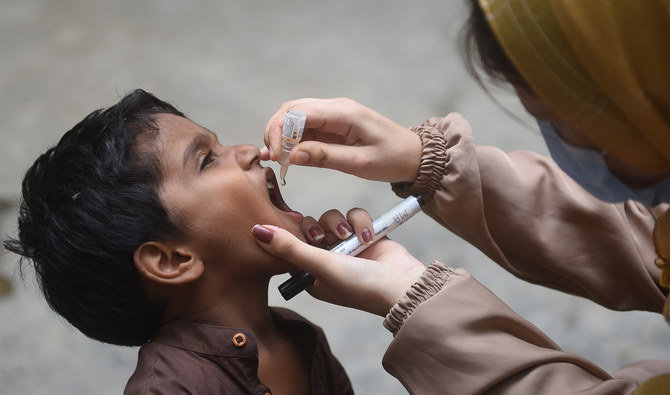

LONDON: The global effort to end polio is likely to miss two key targets this year on the path toward defeating the virus, according to an independent strategic review.
The aim in 2023 was to interrupt the transmission of wild polio in the two countries where it is still endemic, Afghanistan and Pakistan, and do the same for a variant form of polio known as “vaccine-derived” that is causing outbreaks elsewhere.
The Independent Monitoring Board, a group of polio experts who oversee the work of the UN-backed Global Polio Eradication Initiative (GPEI), said neither target would be hit this year.
The GPEI agreed on both counts, citing insecurity in key locations as one of the remaining challenges and stressing in a statement responding to the review that ending the vaccine-derived outbreaks is likely to take the most time.
Wiping out polio, a viral disease that can cause paralysis, has been a key global health aim for decades. Cases have been reduced by more than 99 percent since 1988 thanks to mass vaccination campaigns, but making polio the second infectious disease ever to be completely eradicated, after smallpox in 1980 – has proved more difficult.
“But it can be done. And we need to make sure we finish the job,” said Aidan O’Leary, director of polio eradication at the World Health Organization, a GPEI partner alongside governments and funders like the Bill and Melinda Gates Foundation.
There have only been seven cases of wild polio reported this year, five in Afghanistan and two in Pakistan.
O’Leary said interrupting transmission of this form of polio was likely to happen by early 2024, just a few months after the target.
This meant the hope of a conclusive end to polio by 2026 remained alive, at least for wild polio, he said in a phone interview with Reuters on Thursday.
However, outbreaks linked to vaccine-derived polio are more challenging, he said. This form of polio can occur when children are immunized with a vaccine containing a weakened version of the live virus. They are protected, but the weakened virus excreted by these immunized children can spread and mutate among an unvaccinated population, ultimately becoming harmful.
Such viruses have recently paralyzed nearly 50 times more children than wild poliovirus, the monitoring board review said.
The GPEI aims to focus its vaccination and surveillance efforts on the areas where these kinds of polioviruses are concentrated: the eastern part of the Democratic Republic of the Congo, north western Nigeria, south-central Somalia, and northern Yemen, O’Leary said.
“This is what is needed to shift the game,” he said. “Clearly the timelines are under review ... but we can do what has to be done.”


