

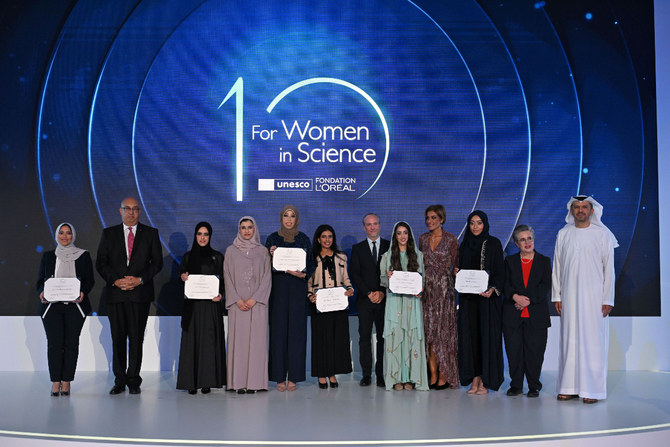

DUBAI: While only 33 percent of global researchers are women, in the Gulf Cooperation Council region, countries like the UAE boast a notable 61 percent of female university STEM students.
This trend extends to Saudi Arabia, where 60 percent of science graduates are women.
On its 10-year anniversary, the L’Oréal-UNESCO for Women in Science Middle East Regional Young Talents Program, in partnership with Khalifa University of Science and Technology, celebrates female Arab scientists changing the landscape of scientific research in the region.
“The extraordinary accomplishments and dedication of women scientists in the region have paved the way for progress in various fields, influencing everything from healthcare and technology to environment sustainability and space exploration,” said Sarah Al-Amiri, UAE minister of state for public education and advanced technology and chair of the UAE Space Agency.
This year’s award ceremony marks a decade of supporting the research efforts of 51 female Arab scientists from the GCC with endowments totalling 3.4 million dirhams ($924,695).
Investing in and increasing the visibility of women scientists contributes to advancing research and addressing the region’s pressing challenges.
“My research is highly translational, driven by real-world problems affecting people’s health and wellness both locally and globally … enabling greater accessibility to high-quality minimally invasive healthcare tools for cancer diagnosis and precision medicine,” said Dr. Dana Alsulaiman, Saudi post-doctorate researcher and L’Oréal-UNESCO award winner.
According to Alsulaiman, miniaturized and cost-effective diagnostic tools developed at the King Abdullah University of Science and Technology could transform the field of healthcare, and clinical decision making like early diagnosis, and effective therapy selection.
In August 2023, Crown Prince Mohammed bin Salman launched a new strategy for KAUST, focusing on turning research into economically beneficial innovations, including environmental sustainability research.
For Lila Ali Aldakheel, a Saudi doctoral student and L’Oréal-UNESCO award winner, whose research focuses on identifying sustainable solutions for plastic pollution, waste management and reduction of the environmental impact, “there is a noticeable deficiency in research concerning the examination of micro-plastic pollution in Middle Eastern oceans and mangrove soil, as well as its repercussions on the environment and human well-being.”
The L’Oréal-UNESCO Young Talents Program’s objective is to build a diverse and inclusive ecosystem enabling and celebrating research and scientific advancement. This year’s award ceremony recognized the achievements of women in science, from Saudi Arabia, the UAE, Qatar, Oman and Kuwait.
The program holds a unique position in the GCC. “While the program’s foundation remains the same globally, it is the distinct advancements of the GCC region concerning women in STEM that sets it apart,” declared Laurent Duffier, managing director of L’Oréal Middle East.
“The outstanding research quality and pioneering contributions of these women amplify the GCC’s leading stance. Instead of simply bridging the gender gap, the region, with the aid of our program, is setting a global benchmark for empowering women in science,” he added.
The GCC is home to what the award winners collectively highlight as key for success: access to adequate support, recognition, and the availability of opportunities to take their research beyond the lab stage.
“I’m grateful to work in a country and a region that celebrates and promotes women in sciences, particularly with Saudi Arabia’s Vision 2030 emphasizing the importance of STEM in driving innovative solutions to global problems like cancer, diabetes, and neurodegenerative diseases,” Alsulaiman told Arab News en franҫais.
The program is essential to addressing systemic gender bias by raising the profile of women scientists and supporting the growth of their careers, by providing access to resources, network, and mentorship.
“Equal representation matters because it brings diversity of perspectives, fairness and equity to the field, all of which are necessary to create a robust scientific community that can further innovation to counter societal challenges,” declared Dr. Tamara Elzein, the program’s jury president, and the secretary-general of the National Council for Scientific Research in Lebanon.
Associated to the program for the fifth consecutive year, the Khalifa University of Science and Technology underlines the essential role women play in driving scientific progress, technological innovation, and societal development.
“We need to continue creating such avenues of growth and support for (female scientists), which will lead to the long-term prosperity, security, and wellbeing in the region,” said Dr. Arif Sultan Al-Hammadi executive vice president of KU.
The program reflects the change in the regional landscape, the untapped potential of its human capital, and is an indicator of countries’ commitments to education.
“It is heartening to see the growing talent pool in the region, where women in many countries are graduating with STEM degrees at rates surpassing their US and European counterparts. We are looking to create a ripple effect, ensuring that the next decade and those beyond witness an even stronger wave of Middle Eastern women leading, innovating, and setting global standards in science,” added Duffier.
FASTFACTS
The 2023 Middle East Regional Young Talents
PhD students:
Sara Ishaq Alkhoori (UAE) — Research on examining eco-friendly biofuel production to reduce carbon emissions and tackle climate change, yielding universal benefits.
Lila Ali Aldakheel (Saudi Arabia) — Research on identifying groups of microorganisms that can break down plastic to manage waste and help the environment.
Post-Phd Researchers:
Dr. Noha Mousaad Elemam (UAE) — Research on developing early breast cancer biomarkers with the goal of understanding cancer progression and achieving better patients’ survival rates.
Dr. Dana Alsulaiman (Saudi Arabia) — Research on addressing challenges in cancer diagnosis through advanced biosensing platforms to enhance early disease detection and better prognosis globally.
Fatma H. Al-Awadhi (Kuwait) — Research on exploring the marine biodiversity in the gulf region for untapped therapeutic potential.


