

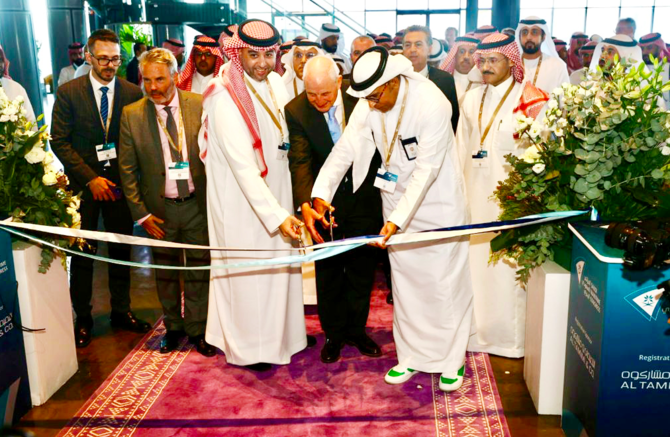

DAMMAM: Business cards were traded as fast as wheeled suitcases rolled at the Saudi Maritime Congress as thousands of key players from the industry descended on Dammam.
The fourth edition of the event saw deals struck, debates held, and networking carried out as the Kingdom drives forward with its goal of becoming a global logistics hub.
Held over two-days at the Dhahran Expo venue, this year’s gathering focused on the maritime and logistics sector throughout the Gulf Cooperation Council region – with a specific emphasis on Saudi Arabia’s economic diversification plan Vision 2030.
The event took place just days before the Kingdom was due to celebrate its 93rd National Day – a milestone which was repeated with pride numerous times by different speakers.
Omar Hariri, president of the Saudi Ports Authority, also known as Mawani, and Ahmed Al-Subaey, CEO of transportation and logistics company Bahri, delivered keynote addresses on the opening day of the event.
“The Saudi maritime sector possesses vast potentials, and this conference is an ideal platform to showcase our capabilities to the world,” said Al-Subaey, adding: “The development of the maritime and logistics sector is vital in realizing the Kingdom’s Vision 2030 objectives.
“Bahri is committed to focusing on leveraging its accumulated experience for the sector’s development within the Kingdom and across the globe.”
Arab News spoke to Chris Morley, group director of Seatrade Maritime, the organizer of the event, and he was keen to flag up how Saudi Arabia’s improvements in the logistics arena are expected to boost port revenue – an increasingly important non-oil source of growth.
He said: “By building out inland logistics hubs and enhancing rail connectivity, the Kingdom is looking to more than quadruple the country’s annual container throughput to 40 million TEU (twenty-foot equivalent units) by 2030.”
Morley noted that the Kingdom has 53,000 ships operating within its borders, and those vessels are registered in over 150 countries and carry up to 11 billion tonnes of cargo annually.
He said Saudi Arabia’s rise on global connectivity indexes shows the Kingdom is “a powerful and promising partner for more regional and global trade.”
Morley added: “The event has been really exciting and reflects the eagerness of the global industry to be part of Saudi Arabia’s commitment to developing its maritime trade and doing business on an international scale.”

UAE-based Abdulla bin Damithan, CEO and managing director at DP World GCC, traveled to Dammam for the event and spoke to Arab News about his hopes for the deepening of ties between his country and Saudi Arabia in the future.
He emphasized how his role at DP World has recently expanded to go beyond the UAE and into the entirety of the GCC, and how the Kingdom would be one of his main focuses going forward as he attempts to help support the transformation of Saudi Arabia through innovation and investment into a global logistics hub.
“With the Kingdom’s Vision 2030, maritime is one of the focuses of the future – not only between Saudi Arabia and the UAE but also between our nations as a GCC,” he said.
Bin Damithan stressed that technological developments in the sector are having wide-reaching impacts, adding: “Technology means that we're making things much easier and creating new jobs, jobs for the young nationals of the country.
“But the most important thing, I think, is including our female colleagues who are entering into this job, where it was limited before.”
Saudi Arabia and DP World operate the South Container Terminal at Jeddah Islamic Port, the largest harbor in the Kingdom and a crucial link in the world’s busy “east-west” trade routes through the Red Sea.
With an investment of $800 million, DP World has ambitions of doubling the terminal’s capacity from 2.5 million TEUs to 5 million. Set to be finalized by 2024, the project aims to propel Jeddah Islamic Port to become a global trade and a logistical services hub.

Omar Hariri, president of the Saudi Ports Authority.
As well as discussions and debates, the event saw agreements being signed by major players in the industry
Bahri signed a Memorandum of Understanding with SAIL, a subsidiary of the Saudi Investment Recycling Co., to mutually strengthen their offerings within the Kingdom.
The latter firm, owned by Public Investment Fund, was launched in June 2022 as a marine environmental services company, which will act as a regional hub when it comes to responding to oil and hazardous spills along the coastlines of Saudi Arabia.
The alliance with Bahri aims to facilitate maritime sector development and the provision of technical support, while also promoting knowledge and expertise exchange between the two companies.
Ziyad Al-Shiha, CEO of SAIL, said this agreement would play a pivotal role in shaping the future of the maritime sector to benefit from the rapid developments, and to help consolidate the Kingdom’s position as a global hub in this industry.
His equivalent in Bahri, Al-Subaey, stressed the importance of this strategic cooperation, noting that the strengths and joint expertise between the two companies would contribute to the establishment of an ecosystem that promotes innovation, and provides new job opportunities.
Another deal involved Mawani signing a partnership agreement with SIRC aimed at promoting maritime sustainability in Saudi Arabia.
The Saudi Maritime Congress was supported by founding strategic partners Bahri and Seatrade Maritime, with support from Mawani, the Transport General Authority, Saudi Aramco and IMI.
The exhibition space featured over 120 organizations representing main sectors of the maritime industry including shipping, shipbuilding, artificial intelligence, as well as port and terminal management and finance.
Firms with booths included Saudi Global Ports Co, Bass Global Marine Services, and Hong Kong Marine Department.
Last year, a record 3,757 visitors attended the event and this year’s final numbers are projected to be close to that.
Chris Hayman, chairman of Seatrade Maritime, used a speech to describe Saudi Arabia as “taking a more active role in global maritime affairs.”
According to Seatrade Maritime News, he said the conference provided one of the first opportunities for the industry to discuss the implications of the new and accelerated pathway towards decarbonisation agreed at the International Maritime Organization’s recent Marine Environment Protection Committee meeting just two months ago.
He said: “The adoption of the new technologies and the availability of zero carbon fuels needed to meet the new timetable together represent a major challenge for the global industry.
“Driven by the exciting development now unfolding here in the Kingdom, the level of support for Saudi Maritime Congress 2023 has grown substantially from last year.
“With an increase in overall attendance of more than 50 percent and a greatly expanded exhibition, this event is on track to join the elite group of world class maritime events, matching Saudi Arabia’s growing status as a global maritime hub.”


