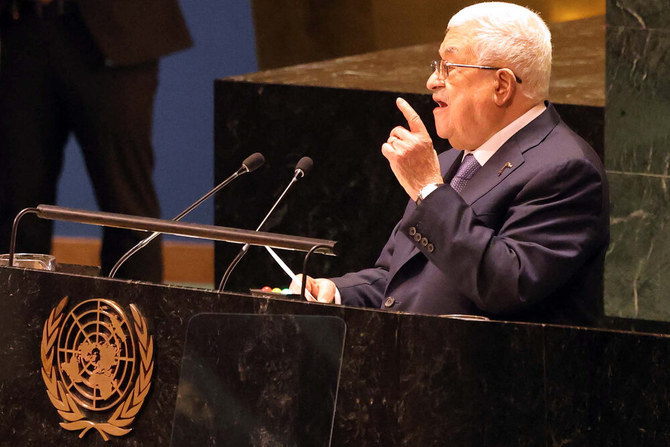
LONDON: Those who think peace can prevail in the Middle East without the Palestinian people enjoying their full rights are mistaken, Palestinian Authority President Mahmoud Abbas said on Thursday.
Addressing the UN General Assembly, he said Israel’s occupation of Palestinian territory “violates the principles of international law and legitimacy while it races against time to change the historical, geographical and demographic reality on the ground, aimed at perpetuating the occupation and entrenching apartheid.”
Abbas said his country remains hopeful that the UN will be “able to implement its resolution demanding an end to the Israeli occupation of our territory and realizing the independence of the fully sovereign state of Palestine, with East Jerusalem as its capital, on the borders of June 4, 1967.”
He added that Israel continues to attack his people, and its “army and its racist, terrorist settlers continue to intimidate and kill our people, to destroy homes and property to just steal our money and resources.”
Abbas said Israel “continues to assault our Islamic and Christian sacred sites … especially the blessed Al-Aqsa Mosque, which international legitimacy has recognized as an exclusive place of worship for Muslims alone.”
He added that Israel is digging tunnels under and around the mosque, threatening its full or partial collapse, “which would lead to an explosion with untold consequences.”
He urged the international community to assume its responsibilities in preserving the historic and legal status of Jerusalem and its holy sites.
He also requested an international peace conference in which all countries concerned with achieving peace in the Middle East would participate.
“I ask your esteemed organization and Secretary-General Antonio Guterres to call for and undertake the necessary arrangements to convene this peace conference, which may be the last opportunity to salvage the two-state solution and to prevent the situation from deteriorating more seriously, and threatening the security and stability of our region and the entire world,” Abbas said.
He also urged states that have not yet recognized the state of Palestine to do so immediately. “I call for the state of Palestine to be admitted to full membership in the United Nations,” he said.
“There are two states that the entire world is talking about: Israel and Palestine. But only Israel is recognized. Why not Palestine?
“I can neither understand nor accept that some states …are reluctant to recognize the state of Palestine, which the UN has accepted as an observer state.
“These same states confirm every day that they support the two-state solution. But they recognize only one of these states, namely Israel. Why?”

Mideast peace only possible when Palestinians get full rights, Abbas tells UNGA
Short Url
https://arab.news/rxss7
Mideast peace only possible when Palestinians get full rights, Abbas tells UNGA
- President urges states that have not yet recognized state of Palestine to do so immediately
- Calls for peace conference that ‘may be last opportunity to salvage two-state solution’
Gaza’s tiny Christian community tries to capture the holiday spirit during the ceasefire
- Gaza’s tiny Palestinian Christian community is trying to capture some of the Christmas spirit under a fragile ceasefire in the Israel-Hamas war
- One 76-year-old Christian finds hope in his faith while sheltering at Gaza’s Holy Family Church compound
GAZA: Attallah Tarazi recently received Christmas presents that included socks and a scarf to shield him against the Gaza winter, and he joined some fellow Palestinian Christians in a round of hymns.
“Christ is born,” the group sang in Arabic. “Hallelujah.”
The presents and hymns offered the 76-year-old a taste of the holiday in a devastated Gaza, where a fragile ceasefire has provided some relief, but the losses of the Israel-Hamas war and the ongoing struggles of displaced people are dampening many traditional festivities.
Tarazi and much of the rest of Gaza’s tiny Palestinian Christian community are trying to capture some of the season’s spirit despite the destruction and uncertainty that surround them. He clings to hope and the faith that he said has seen him through the war.
“I feel like our joy over Christ’s birth must surpass all the bitterness that we’ve been through,” he said. He’s been sheltering for more than two years at the Holy Family Church compound in Gaza, where a church group including choir members toured among displaced people this Christmas season, he said.
“In such a glorious moment, it’s our right to forget all that’s war, all that’s danger, all that’s bombardment.”
But for some, the toll is inescapable.
This will be the first Christmas for Shadi Abo Dowd since the death of his mother, who was among those killed in July when an Israeli attack hit the same Catholic church compound where Tarazi lives and which has been housing displaced people. Israel issued statements of regret and said it was an accident.
Abo Dowd said his son was wounded in the assault that also hurt the parish priest.
Ahead of Christmas, the Latin patriarch of Jerusalem, Cardinal Pierbattista Pizzaballa, paid a visit to the Holy Family Parish. A patriarchate statement said the visit marked the beginning of Christmas celebrations in “a community that has lived and continues to live through dark and challenging times.”
Suffering and a state of ‘no peace and no war’
Abo Dowd, an Orthodox Christian who observes Christmas on Jan. 7, said he does not plan to celebrate beyond religious rituals and prayers. “There’s no feast,” he said.
“Things are difficult. The wound is still there,” he said. “The suffering and pain are still there.”
He added: “We’re still living in a state of no peace and no war.”
Israeli strikes have decreased since the ceasefire agreement took effect in October, but deadly attackshave not entirely ended. Israel and Hamas have traded accusations of breaking the truce and the more challenging second phase has yet to be implemented.
The war began when Hamas-led militants stormed into Israel on Oct. 7, 2023, killing some 1,200 people and taking about 250 hostages.
Israel’s ensuing offensive has killed nearly 71,000 Palestinians in Gaza, according to Gaza’s Health Ministry, which does not differentiate between civilians and combatants but says around half the deaths were women and children.
The ministry, which operates under the Hamas-run government, is staffed by medical professionals and maintains detailed records viewed as generally reliable by the international community.
Israel’s offensive in Gaza has also caused widespread destruction and displaced the vast majority of the territory’s some 2 million residents. Highlighting some of the many struggles and needs of the enclave and its people was torrential rain that recently flooded displacement camps and collapsed already badly damaged buildings.
“I always tell my children, ‘God only gives the toughest battles to his strongest soldiers,’” Abo Dowd said. “We’re holding onto our Christian faith and onto our country, and we love our country.”
He and others know of many Christians among those who fled Gaza during the war and more who hope to leave if given the opportunity. He worries about the effect on the Christian presence and on Gaza’s social fabric. “It’s a tragedy,” he said.
His children would like to study abroad. “They’re young. What will they stay to do? There’s no future.”
A Christmas without many familiar faces
The departure of many relatives and friends means Christmas doesn’t feel the same for 23-year-old Wafa Emad ElSayegh.
He and family members gathered with others at Gaza’s Greek Orthodox church compound to put up decorations. But the absence of friends who escaped Gaza fueled his nostalgia.
“We used to be together in everything,” said ElSayegh, who’s now staying with his family at the home of an aunt who left Gaza during the war.
His favorite part of Christmas was the togetherness — the family gatherings, the celebratory events that he said drew Christians and some Muslims, and the excitement of children receiving gifts.
“There would be celebrations, songs and an indescribable joy that we, unfortunately, haven’t felt in a long time,” he said. And with many relatives away, he said the usual Christmas atmosphere cannot be recreated.
Joy amid the pain
Elynour Amash, 35, is trying to bring some of that cheer to her children “through decorating and lighting the tree so they can feel that joy is possible despite all pain.”
“My children feel a little bit of joy, like breathing after a long period of suffocation,” she said in written responses to The Associated Press. “They’re happy they’re celebrating without fear of a nearby explosion and because some chocolates and sweets have returned to their lives, in addition to foods that they had long been deprived of.”
She’s thankful her home is still standing, but the scenes of displaced people in tents that cannot shield them from the cold and rain often drive her to tears.
She doesn’t feel like the war has truly ended.
“The sounds of explosions and gunfire can still be heard, and the fear hasn’t left the hearts. There’s continuous worry that the ceasefire won’t last.” She sees the toll in her youngest, who trembles when he hears loud noises.
“It’s as if the war lives inside of him,” she said. “As a mother, that pain is indescribable.”
She also worries that someday Christians could disappear from Gaza. But, for now, “our presence, no matter how small, is a testimony of love, steadfastness and faith in this land,” she said.
Tarazi is determined to stay.
Early in the war, he lost a sister, who was among those killed when an Israeli airstrike hit the Orthodox church compound housing displaced people. The Israeli military said it had targeted a nearby Hamas command center. Tarazi said a brother also died after he could not get needed medical care due to the war.
He prays for peace and freedom for the Palestinian people. “Our faith and our joy over Christ’s birth are stronger than all circumstances,” he said.
“Christ is born,” the group sang in Arabic. “Hallelujah.”
The presents and hymns offered the 76-year-old a taste of the holiday in a devastated Gaza, where a fragile ceasefire has provided some relief, but the losses of the Israel-Hamas war and the ongoing struggles of displaced people are dampening many traditional festivities.
Tarazi and much of the rest of Gaza’s tiny Palestinian Christian community are trying to capture some of the season’s spirit despite the destruction and uncertainty that surround them. He clings to hope and the faith that he said has seen him through the war.
“I feel like our joy over Christ’s birth must surpass all the bitterness that we’ve been through,” he said. He’s been sheltering for more than two years at the Holy Family Church compound in Gaza, where a church group including choir members toured among displaced people this Christmas season, he said.
“In such a glorious moment, it’s our right to forget all that’s war, all that’s danger, all that’s bombardment.”
But for some, the toll is inescapable.
This will be the first Christmas for Shadi Abo Dowd since the death of his mother, who was among those killed in July when an Israeli attack hit the same Catholic church compound where Tarazi lives and which has been housing displaced people. Israel issued statements of regret and said it was an accident.
Abo Dowd said his son was wounded in the assault that also hurt the parish priest.
Ahead of Christmas, the Latin patriarch of Jerusalem, Cardinal Pierbattista Pizzaballa, paid a visit to the Holy Family Parish. A patriarchate statement said the visit marked the beginning of Christmas celebrations in “a community that has lived and continues to live through dark and challenging times.”
Suffering and a state of ‘no peace and no war’
Abo Dowd, an Orthodox Christian who observes Christmas on Jan. 7, said he does not plan to celebrate beyond religious rituals and prayers. “There’s no feast,” he said.
“Things are difficult. The wound is still there,” he said. “The suffering and pain are still there.”
He added: “We’re still living in a state of no peace and no war.”
Israeli strikes have decreased since the ceasefire agreement took effect in October, but deadly attackshave not entirely ended. Israel and Hamas have traded accusations of breaking the truce and the more challenging second phase has yet to be implemented.
The war began when Hamas-led militants stormed into Israel on Oct. 7, 2023, killing some 1,200 people and taking about 250 hostages.
Israel’s ensuing offensive has killed nearly 71,000 Palestinians in Gaza, according to Gaza’s Health Ministry, which does not differentiate between civilians and combatants but says around half the deaths were women and children.
The ministry, which operates under the Hamas-run government, is staffed by medical professionals and maintains detailed records viewed as generally reliable by the international community.
Israel’s offensive in Gaza has also caused widespread destruction and displaced the vast majority of the territory’s some 2 million residents. Highlighting some of the many struggles and needs of the enclave and its people was torrential rain that recently flooded displacement camps and collapsed already badly damaged buildings.
“I always tell my children, ‘God only gives the toughest battles to his strongest soldiers,’” Abo Dowd said. “We’re holding onto our Christian faith and onto our country, and we love our country.”
He and others know of many Christians among those who fled Gaza during the war and more who hope to leave if given the opportunity. He worries about the effect on the Christian presence and on Gaza’s social fabric. “It’s a tragedy,” he said.
His children would like to study abroad. “They’re young. What will they stay to do? There’s no future.”
A Christmas without many familiar faces
The departure of many relatives and friends means Christmas doesn’t feel the same for 23-year-old Wafa Emad ElSayegh.
He and family members gathered with others at Gaza’s Greek Orthodox church compound to put up decorations. But the absence of friends who escaped Gaza fueled his nostalgia.
“We used to be together in everything,” said ElSayegh, who’s now staying with his family at the home of an aunt who left Gaza during the war.
His favorite part of Christmas was the togetherness — the family gatherings, the celebratory events that he said drew Christians and some Muslims, and the excitement of children receiving gifts.
“There would be celebrations, songs and an indescribable joy that we, unfortunately, haven’t felt in a long time,” he said. And with many relatives away, he said the usual Christmas atmosphere cannot be recreated.
Joy amid the pain
Elynour Amash, 35, is trying to bring some of that cheer to her children “through decorating and lighting the tree so they can feel that joy is possible despite all pain.”
“My children feel a little bit of joy, like breathing after a long period of suffocation,” she said in written responses to The Associated Press. “They’re happy they’re celebrating without fear of a nearby explosion and because some chocolates and sweets have returned to their lives, in addition to foods that they had long been deprived of.”
She’s thankful her home is still standing, but the scenes of displaced people in tents that cannot shield them from the cold and rain often drive her to tears.
She doesn’t feel like the war has truly ended.
“The sounds of explosions and gunfire can still be heard, and the fear hasn’t left the hearts. There’s continuous worry that the ceasefire won’t last.” She sees the toll in her youngest, who trembles when he hears loud noises.
“It’s as if the war lives inside of him,” she said. “As a mother, that pain is indescribable.”
She also worries that someday Christians could disappear from Gaza. But, for now, “our presence, no matter how small, is a testimony of love, steadfastness and faith in this land,” she said.
Tarazi is determined to stay.
Early in the war, he lost a sister, who was among those killed when an Israeli airstrike hit the Orthodox church compound housing displaced people. The Israeli military said it had targeted a nearby Hamas command center. Tarazi said a brother also died after he could not get needed medical care due to the war.
He prays for peace and freedom for the Palestinian people. “Our faith and our joy over Christ’s birth are stronger than all circumstances,” he said.
© 2025 SAUDI RESEARCH & PUBLISHING COMPANY, All Rights Reserved And subject to Terms of Use Agreement.


