



ISLAMABAD: Caretaker Prime Minister Anwaar-ul-Haq Kakar is using his visit to New York this week to attend the UN General Assembly to meet business and thought leaders and stakeholders and make the case for improved business climate in Pakistan and its potential for foreign direct investment in a range of sectors.
Pakistan in June set up a Special Investment Facilitation Council (SIFC) — a civil-military hybrid forum — to fast-track decision making and promote investment from foreign nations, particularly Gulf countries.
The council has identified five sectors as priority, namely agriculture, mining, information technology, defense production and energy, as the South Asian country deals with a balance of payments crisis and requires billions of dollars in foreign exchange to finance its trade deficit and repay its international debts in the current financial year.
“Attracting foreign investments in all sectors of Pakistan’s economy is the government’s top priority,” Kakar was quoting as saying in a statement released after he met a delegation of the US Pakistan Business Council (USPBC), on the sidelines of the annual session of United Nations General Assembly in New York on Thursday evening.
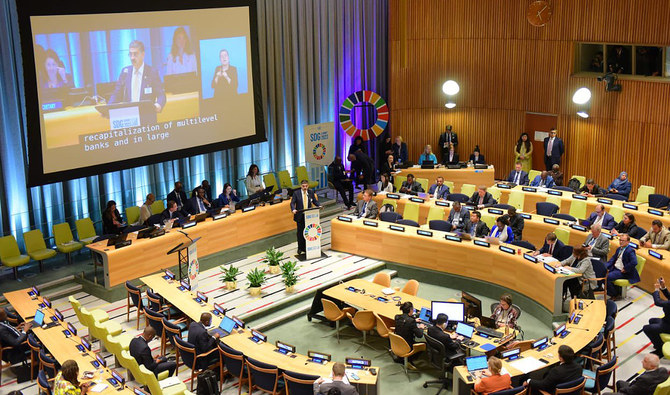
Pakistan's Caretaker Prime Minister Anwaar-ul-Haq Kakar addresses the SDG Summit Leaders Dialogue on the sidelines of the 78th UN General Assembly session at the United Nations Headquarters in New York on September 20, 2023. (Photo courtesy: PMO)
He told the group his government was focused on creating a business-friendly environment and would welcome all suggestions.
“The government believes in no-holds-barred foreign investment regime, and has constituted the Special Investment Facilitation Council (SIFC) to facilitate foreign investors, bolster their confidence and expedite project implementation in priority areas of agriculture, IT, energy and minerals and mining,” a statement from Kakar’s office said.
He said the US corporate sector “must look at ways and means” to enhance its “very long and productive” relationship with Pakistan, identifying agriculture, IT, pharmaceuticals, health and digital banking as sectors where US companies could enhance investments in Pakistan.
Esperanza Jelalian, USPBC President, told Kakar the body would “continue to engage with the government of Pakistan to seek mutually beneficial ways of enhancing cooperation.”
Speaking earlier in the day at the Council on Foreign Relations, Kakar welcomed the revival of the Pakistan-US Trade and Investment Framework Agreement (TIFA) after a gap of eight years, saying the forum should pave the way for enhanced investment in Pakistan.
“The United States is our largest export destination. Over the past year, Pakistan’s total exports to the US reached an impressive $ 8.4 billion,” Kakar said. “We need to work on US investment in Pakistan.”
As caretaker prime minister, Kakar said, he was making it a “priority” to improve Pakistan’s business climate and attract US capital and expertise.
“More than 80 US enterprises are already operating and thriving in Pakistan, contributing to our mutual prosperity. This constitutes a good infrastructure for investment on which we can build further investment partnership,” the PM added.
On Thursday, Kakar also met the CEO of Rio Tinto Group, a global leader in mining and minerals, and discussed investment opportunities in Pakistan.
He briefed Jakob Stausholm about the country’s vast untapped mineral reserves, valued at over $6 trillion, which include substantial deposits of gold, copper, and rare earth metals.
“The prime minister outlined Pakistan’s robust economic vision, emphasizing the government’s commitment to sustainable growth through efficiency enhancement, reduced business costs, regulatory improvements, increased productivity, and higher investments,” a statement from the PM’s office said.
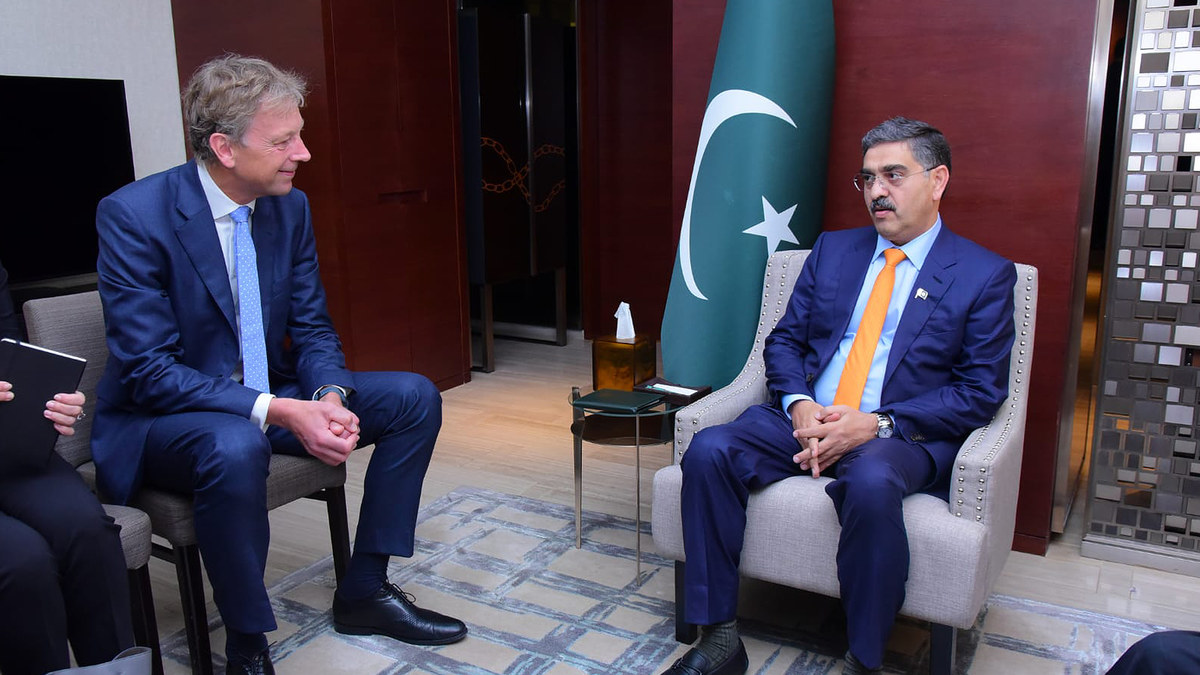
In this handout photo, taken and released by the Prime Minister's Office, Pakistan Caretaker Prime Minister Anwar-ul-Haq Kakar (left) gestures during a meeting with Rio Tinto Group head, Jakob Stausholm, on the sidelines of the 78th UNGA Summit in New York on September 21, 2023. (Photo courtesy: PMO)
“He underscored the role of the Special Investment Facilitation Council, which acted as a single-window platform, simplifying procedures and fostering an investor-friendly environment.”
The prime minister invited Stausholm and his team to visit Pakistan and explore investment opportunities further.
“CEO of Rio Tinto Group thanked the prime minister for the invitation and assured that his team would liaise with the relevant authorities to explore investment opportunities in Pakistan’s mineral and mining sector,” the statement said.



