Imaan Hammam, Loli Bahia grace Fendi show during Milan Fashion Week

Imaan Hammam walked for Fendi. (Getty Images)
Short Url
Updated 21 September 2023
Follow

Imaan Hammam, Loli Bahia grace Fendi show during Milan Fashion Week

DUBAI: Part-Arab models Imaan Hammam and Loli Bahia this week walked Kim Jones’ runway for Fendi during Milan Fashion Week.  

The show was attended by A-list supermodels and celebrities including Naomi Campbell, Linda Evangelista, Kate Moss, Demi Moore, Cristina Ricci, Gwendoline Christie and Naomi Watts, who sat front row.  

Jones’ collection for Fendi – unveiled during the first day of Milan Fashion Week – was a twist on knitwear, anchored by leather. 
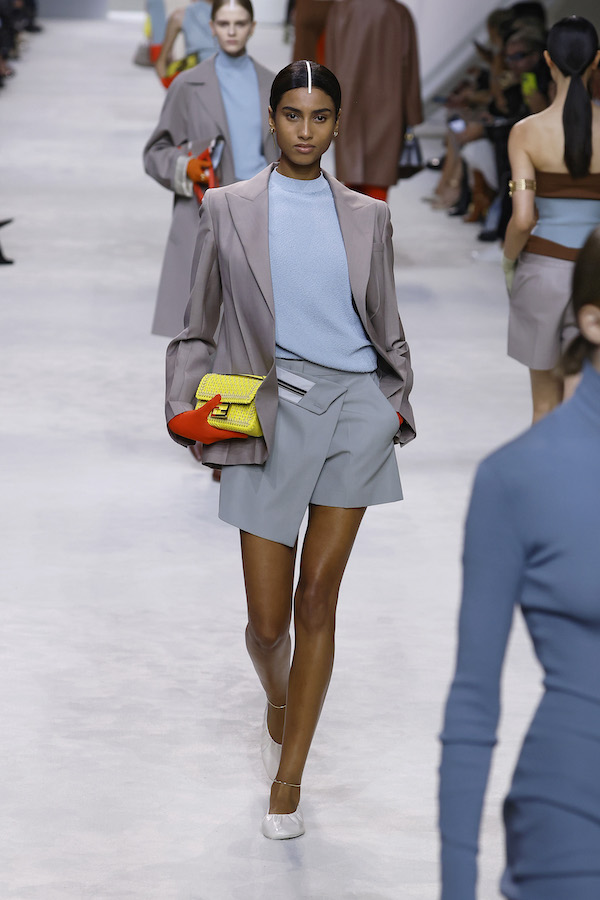


Hammam donned a baby blue knit jumper, with a grey-purple blazer and grey tailored shorts. (Getty Images)

The first look set the tone: A form-hugging color-block knit dresses in mocha, baby blue, salmon and ivory, with a double sash trailing at the waist lending drama and movement. A tri-colored clutch gave the right accent. 

Hammam donned a baby blue knit jumper, with a grey-purple blazer and grey tailored shorts that were asymmetric from the brand’s Spring/Summer 2024 collection. She held a bright yellow clutch and wore hot red gloves.  

Bahia wore a long figure-hugging grey dress, with matching gloves, and black boots.   


A post shared by Fendi (@fendi)

The collection overall was dainty: Knitwear was as a rule very fine, accented at times by thin golden chains creating details on open backs. Slinky, clinging monochrome knit dresses had peekaboo cutouts.  

The twinset trop gave way to built-in layers and sleeves that wrapped around the body, a mysterious swirl. Dresses ruched around the body, suggesting constant motion. 


A post shared by Fendi (@fendi)

A chunkier ribbed knit gave a chenille-soft appearance in a long jacket and skirt with a healthy front slit. Knit was also fashioned into a chainmail slip dress, with a coppery finish, or neon-orange wrap dress. 

Leather added substance: short color-block jackets paired with a matching knit mini-skirt.  

Contrasting gloves finished many looks. Bags were mostly held as if clutches; a tiny, flat bag dangled from gloved hands. 


Cairo book fair breaks visitor records

Updated 03 February 2026
Follow

Cairo book fair breaks visitor records

  • Strong Saudi participation underscores KSA’s prominent role in Arab cultural landscape
  • Egyptian writer Naguib Mahfouz, who was awarded the Nobel Prize in Literature in 1988, was selected as the fair’s featured personality

CAIRO: The 57th edition of the Cairo International Book Fair has attracted record public attendance, with the number of visits reaching nearly 6 million, up from a reported 5.5 million previously.

Egypt’s Minister of Culture Ahmed Fouad Hanou said: “This strong turnout reflects the public’s eagerness across all age groups to engage with the exhibition’s diverse cultural and intellectual offerings.”

Hanou said the event included “literary and intellectual activities, meetings with thinkers and creative figures, and thousands of titles spanning various fields of knowledge.”

The Egyptian writer Naguib Mahfouz, who was awarded the Nobel Prize in Literature in 1988, was selected as the fair’s featured personality, coinciding with the 20th anniversary of his death.

The exhibition’s official poster features a famous quote by Mahfouz: “Who stops reading for an hour falls centuries behind.”

A total of 1,457 publishing houses from 83 countries participated in the fair. Mahfouz’s novels occupied a special place, as Egypt’s Diwan Library showcased the author’s complete works, about 54 books.

“The pavilion of the Egyptian National Library and Archives witnessed exceptionally high attendance throughout the fair, showcasing a collection of rare and significant books.

Among the highlights was the book “Mosques of Egypt” in Arabic and English, Dr. Sherif Saleh, head of financial and administrative affairs at the Egyptian National Library and Archives, told Arab News.

The fair ended on Tuesday with a closing ceremony that featured a cultural performance titled “Here is Cairo.”

The event included the announcement of the winners of the fair’s awards, as well as the recipient of the Naguib Mahfouz Award for Arabic Fiction.

Organizers described this year’s edition as having a celebratory and cultural character, bringing together literature, art, and cinema.

Romania was the guest of honor this year, coinciding with the 120th anniversary of Egyptian-Romanian relations.

At the Saudi pavilion, visitors were welcomed with traditional coffee. It showcased diverse aspects of Saudi culture, offering a rich experience of the Kingdom’s heritage and creativity.

There was significant participation from Saudi Arabia at the event, highlighting the Kingdom’s prominent role in the Arab cultural arena.

Saudi Arabia’s participation aimed to showcase its literary and intellectual output, in alignment with the objectives of Vision 2030.

The Kingdom’s delegation was led by Saudi Arabia’s Ambassador to Egypt Saleh bin Eid Al-Hussaini. Also in attendance were Dr. Abdul Latif Abdulaziz Al-Wasel, CEO of the Literature, Publishing and Translation Commission, and Dr. Hilah Al-Khalaf, the commission’s director-general.

The King Abdulaziz Public Library placed the Encyclopedia of Saudi Arabia in a prominent position at the pavilion. The encyclopedia, consisting of 20 volumes, is organized according to the Kingdom’s culturally diverse regions.

Founded in 1980 by King Abdullah, the library was established to facilitate access to knowledge and preserve heritage collections. Over the years, it has grown into one of the Kingdom’s most important cultural institutions.

Internationally, the library has strengthened ties between Saudi Arabia and China, including the opening of a branch at Peking University and receiving the Crown Prince Mohammed bin Salman Award for Cultural Cooperation between the two nations.

Regionally, the library has played a pivotal role in the Arab world through the creation of the Unified Arabic Cataloging Project, one of the most important initiatives contributing to knowledge accessibility and alignment with global standards.