

Number of investment deals to be signed with GCC countries this month — Pakistan foreign minister

Flags of the Gulf Cooperation Council (GCC) countries fly in the streets before the 40th GCC summit in Riyadh, Saudi Arabia, on 9 December 2019. (REUTRES/File)
Short Url
Updated 21 September 2023
Follow

Number of investment deals to be signed with GCC countries this month — Pakistan foreign minister

  • Jalil Abbas Jillani says GCC country reps expected to visit Pakistan this month to sign agreements 
  • Pakistan set up SIFC in June to attract foreign investment in energy, agriculture, mining, IT, defense

ISLAMABAD: Caretaker Foreign Minister Jalil Abbas Jillani said on Thursday Pakistan would sign a “number of MOUs and agreements” with representatives of GCC countries who were set to visit Pakistan this month.

In June, Pakistan set up a Special Investment Facilitation Council (SIFC) — a civil-military hybrid forum — to attract foreign funding, particularly from GCC nations, in agriculture, mining, information technology, defense production and energy as the South Asian country deals with a balance of payments crisis and requires billions of dollars in foreign exchange to finance its trade deficit and repay its international debts in the current financial year.

Earlier this month, caretaker Prime Minister Anwaar-ul-Haq Kakar said Saudi Arabia and the UAE would invest up to $25 billion each in Pakistan over the next five years in the mining, agriculture and IT sectors.

“We are expecting representatives of GCC countries to visit Pakistan within this month, from Saudi Arabia, from UAE, from other countries and a number of MOUs and agreements are likely to be signed with GCC countries,” Jillani said in an interview to TRT, without divulging details of the deals. 

“It’s certainly going to be a great partnership between Pakistan and GCC countries.”
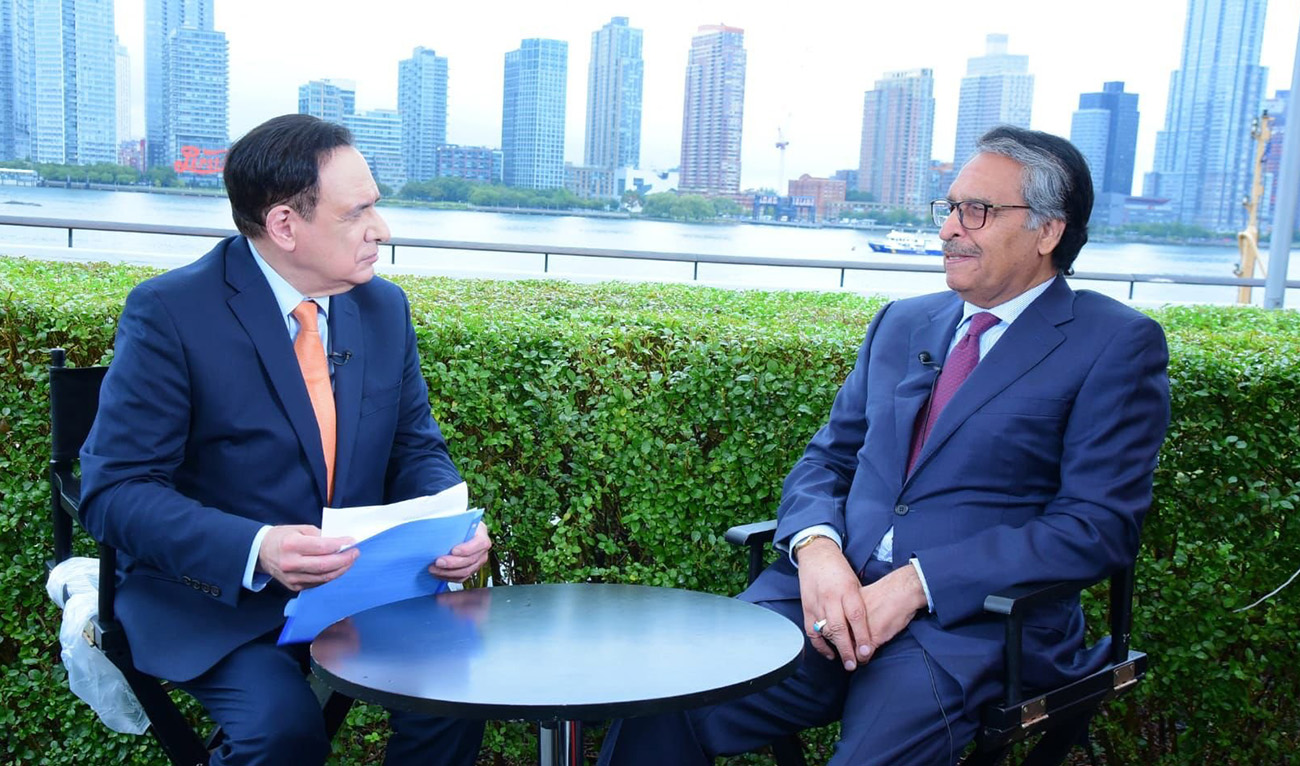


Pakistan's Foreign Minister, Jalil Abbas Jilani, during an interview with Turkish news organization, TRT world, in New York, USA on September 21, 2023. (Photo courtesy: @PakistanUN_NY/X)

He said Saudi Arabia, UAE, Qatar, Bahrain and other GCC nations were “great partners of Pakistan.”

“There are several layers of this cooperation, economic, people to people contacts, defense, we have very strong political cooperation with members of the GCC countries,” the foreign minister said.

He said the SIFC would focus on five major areas, namely agriculture, IT, mines, minerals and energy.

“As a matter of fact, we have already received expressions of interest from GCC countries about investment in energy and mines and minerals,” Jillani added.

Pakistan is embarking on a tricky path to economic recovery under a caretaker government after a $3 billion loan program, approved by the International Monetary Fund (IMF) in July, averted a sovereign debt default.

Last month Barrick Gold Corp. said it was open to bringing in Saudi Arabia’s wealth fund as one of its partners in Pakistan’s Reko Diq gold and copper mine.
Barrick considers the Reko Diq mine one of the world’s largest underdeveloped copper-gold areas and it owns a 50 percent stake, with the remaining 50 percent owned by the governments of Pakistan and the province of Balochistan.

Pakistan’s untapped mineral deposits are conservatively valued at about $6 trillion, Caretaker Prime Minister Anwaar-ul-Haq Kakar said earlier this month.


Islamabad says surge in aircraft orders after India standoff could end IMF reliance

Updated 06 January 2026
Follow

Islamabad says surge in aircraft orders after India standoff could end IMF reliance

  • Pakistani jets came into the limelight after Islamabad claimed to have shot down six Indian aircraft during a standoff in May last year
  • Many countries have since stepped up engagement with Pakistan, while others have proposed learning from PAF’s multi-domain capabilities

ISLAMABAD: Defense Minister Khawaja Asif on Tuesday said Pakistan has witnessed a surge in aircraft orders after a four-day military standoff with India last year and, if materialized, they could end the country’s reliance on the International Monetary Fund (IMF).

The statement came hours after a high-level Bangladeshi defense delegation met Pakistan’s Air Chief Marshal Zaheer Ahmed Baber Sidhu to discuss a potential sale of JF-17 Thunder aircraft, a multi-role fighter jointly developed by China and Pakistan that has become the backbone of the Pakistan Air Force (PAF) over the past decade.

Fighter jets used by Pakistan came into the limelight after Islamabad claimed to have shot down six Indian aircraft, including French-made Rafale jets, during the military conflict with India in May last year. India acknowledged losses in the aerial combat but did not specify a number.

Many countries have since stepped up defense engagement with Pakistan, while delegations from multiple other nations have proposed learning from Pakistan Air Force’s multi-domain air warfare capabilities that successfully advanced Chinese military technology performs against Western hardware.

“Right now, the number of orders we are receiving after reaching this point is significant because our aircraft have been tested,” Defense Minister Asif told a Pakistan’s Geo News channel.

“We are receiving those orders, and it is possible that after six months we may not even need the IMF.”

Pakistan markets the Chinese co-developed JF-17 as a lower-cost multi-role fighter and has positioned itself as a supplier able to offer aircraft, training and maintenance outside Western supply chains.

“I am saying this to you with full confidence,” Asif continued. “If, after six months, all these orders materialize, we will not need the IMF.”

Pakistan has repeatedly turned to the IMF for financial assistance to stabilize its economy. These loans come with strict conditions including fiscal reforms, subsidy cuts and measures to increase revenue that Pakistan must implement to secure disbursements.

In Sept. 2024, the IMF approved a $7 billion bailout for Pakistan under its Extended Fund Facility (EFF) program and a separate $1.4 billion loan under its climate resilience fund in May 2025, aimed at strengthening the country’s economic and climate resilience.

Pakistan has long been striving to expand defense exports by leveraging its decades of counter-insurgency experience and a domestic industry that produces aircraft, armored vehicles, munitions and other equipment.

The South Asian country reached a deal worth over $4 billion to sell military equipment to the Libyan National Army, Reuters report last month, citing Pakistani officials. The deal, one of Pakistan’s largest-ever weapons sales, included the sale of 16 JF-17 fighter jets and 12 Super Mushak trainer aircraft for basic pilot training.