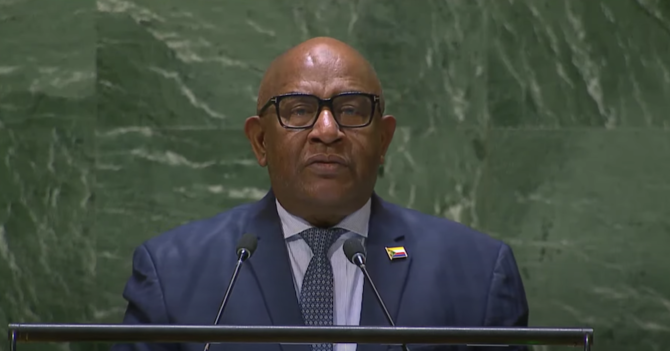
LONDON: There is an “urgent” need for the international community to strengthen efforts to stabilize the Sahel region of Africa, the president of Comoros said on Wednesday.
Addressing the UN General Assembly, Azali Assoumani added that if unrest and terror are not contained, they have the potential to spread further afield on the African continent.
“Of course, first and foremost, it’s up to Africans to implement the social and economic development plan to better combat poverty and youth unemployment, especially to make sure young people don’t become hostages to all types of extremism,” he said.
“However, it’s the duty of the international community to support Africa in this, because our efforts need to be pooled if we’re to stand a chance of being effective.”
Assoumani praised the recent integration of the African Union into the G20, calling it a victory for both sides.
He said the decision “gives (Africa) hope, especially at a time when synergy of actions is needed to get our countries out of socioeconomic stalemate.”
Like many other global leaders at this year’s event, Assoumani called for “in-depth reform” of the UN system, saying the AU should have a permanent seat at the Security Council.
He also voiced concern over how the Russia-Ukraine conflict is impacting food security in the poorest parts of the world, especially Africa.
“Despite the fact we have immense arable lands, despite the fact we have qualified and competent labor aplenty, food insecurity continues to impact millions of people,” he said.
“Climate change and the numerous conflicts on the continent compound this situation, as does the Russia-Ukraine situation, which brought in its wake disruption of supplies of grain and fertilizer and an unprecedented inflation.”
Assoumani called on Africa’s partners and the international community to support development and the implementation of “far-reaching” reforms on the continent to help it overcome the challenges it faces.


‘Urgent’ need for world to help stabilize Sahel region: Comoros president
https://arab.news/mu5ge
‘Urgent’ need for world to help stabilize Sahel region: Comoros president

- Addressing UN General Assembly, Azali Assoumani praises African Union’s integration into G20
- He calls for ‘in-depth reform’ of UN system, saying AU should have permanent seat at Security Council


Pakistan killed over 80 militants in strikes on TTP camps in Afghanistan — official
- Saturday’s airstrikes followed a series of attacks inside Pakistan amid a surge in militancy
- The Afghan Taliban authorities accuse Pakistani forces of killing civilians in the airstrikes
ISLAMABAD: Pakistan’s airstrikes in Afghanistan destroyed seven Tehreek-e-Taliban Pakistan (TTP) camps and killed over 80 militants, a Pakistani security official said on Sunday, with the Afghan Taliban accusing Pakistani forces of killing civilians in the assault.
Saturday’s airstrikes followed a series of attacks inside Pakistan amid a surge in militancy. Authorities say the attacks, particularly in Khyber Pakhtunkhwa province and the Pakistani capital of Islamabad, were carried out by the TTP and allied groups that Islamabad alleges are operating from sanctuaries in Afghanistan. Kabul denies this.
According to Pakistan’s information ministry, recent incidents included a suicide bombing at a Shiite mosque in Islamabad, separate attacks in Bajaur and Bannu, and another recent incident in Bannu during the holy month of Ramadan, which started earlier this week. The government said it had “conclusive evidence” linking the attacks to militants directed by leadership based in Afghanistan.
“Last night, Pakistan’s intelligence-based air strikes destroyed seven centers of Fitna Al-Khawarij TTP in three provinces of Nangarhar, Paktika and Khost, in which more than eighty Khawarij (TTP militants) have been confirmed killed, while more are expected,” a Pakistani security official, who spoke on condition of anonymity, told Arab News.
An earlier statement from Pakistan’s information ministry said the targets included a camp of a Daesh regional affiliate, the Islamic State Khorasan Province (ISKP), which claimed a suicide bombing at an Islamabad Shiite mosque that killed 32 people this month.
In an X post, Afghan government spokesperson Zabihullah Mujahid said Pakistani forces had violated Afghan territory.
“Pakistani special military circles have once again trespassed into Afghan territory,” Mujahid said. “Last night, they bombed our civilian compatriots in Nangarhar and Paktika provinces, martyring and wounding dozens of people, including women and children.”
The Afghan Taliban’s claims of civilian casualties could not be independently verified. Pakistan did not immediately comment on the allegation that civilians had been killed in the strikes.
In a post on X, Afghanistan’s foreign ministry said it had summoned Pakistan’s charge d’affaires to Afghanistan Ubaid-ur-Rehman Nizamani and lodged protest through a formal démarche in response to the Pakistani military strikes.
“IEA-MoFA (The Islamic Emirate of Afghanistan’s Ministry of Foreign Affairs) vehemently condemns the violation of Afghanistan’s airspace and the targeting of civilians, describing it as a flagrant breach of Afghanistan’s territorial integrity & a provocative action,” it said in a statement.
“The Pakistani side was also categorically informed that safeguarding Afghanistan’s territorial integrity is the religious responsibility of the Islamic Emirate of Afghanistan; henceforth, the responsibility for any adverse consequences of such actions will rest with the opposing side.”
Tensions between Islamabad and Kabul have escalated since the Afghan Taliban returned to power in 2021. Pakistan says cross-border militant attacks have increased since then and has accused the Taliban of failing to honor commitments under the 2020 Doha Agreement to prevent Afghan soil from being used for attacks against other countries. The Taliban deny allowing such activity and have previously rejected similar accusations.
Saturday’s exchange of accusations marks one of the most direct confrontations between the two neighbors in recent months and risks further straining already fragile ties along the volatile border.


