
NEW YORK: It is “critical” that the world “pool our efforts towards an effective response that alleviates the situation in Sudan,” Saudi Foreign Minister Prince Faisal bin Farhan said at a high-level ministerial meeting at the UN General Assembly in New York on Wednesday.
The meeting, convened at the behest of Saudi Arabia, Egypt, Qatar, the African Union, the EU and the UN High Commissioner for Refugees, outlined the deteriorating situation in Sudan, approaching its sixth month of conflict between the Sudanese Armed Forces and the paramilitary Rapid Support Forces.
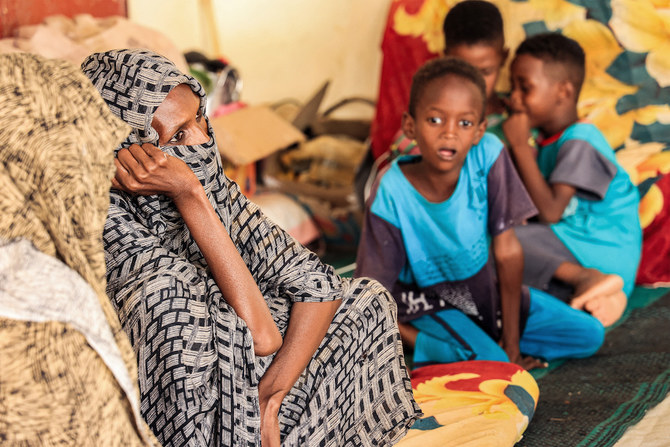
Sudan is now home to the highest number of internally displaced people in the world, attendees were told.
Rosemary DiCarlo, UN undersecretary-general for political and peace-building affairs, said while the fighting is spreading along tribal and geographic lines, neither party is close to victory, with “over 5,000 men, women and children killed.”
She added: “At least 7.1 million people, including an estimated 3.3 million children, (have been) uprooted from their homes. More than 6 million Sudanese are one step away from famine. These numbers will keep growing as long as the guns keep talking.”
DiCarlo urged the two sides to cease operations before the violence spilled out into other states in the region, to “return” to the Jeddah Declaration signed by the SAF, the RSF, Saudi Arabia and the US, which call for respecting their obligations under international humanitarian and human rights law to meet the needs of Sudanese civilians.
Prince Faisal called for an immediate end to the fighting, and told the meeting that over 1 million people had already fled Sudan to neighboring countries.
“The Kingdom’s humanitarian response has included three important elements,” he said. “In the beginning of the conflict, we worked through our Ministry of Defense for the urgent evacuation of foreign nationals to the port city of Jeddah. This large-scale initiative reflected our commitment to tackle all aspects of the crisis with a high degree of coordination with our partners.
“We followed this by offering $100 million in direct humanitarian support, and (by) launching a public donation campaign.
“The third element aims to address humanitarian access, and we’ve been working with the World Food Programme and the UN to make sure that we can facilitate access through the port of Jeddah into Sudan.”
He added: “Our consultation today … should explore ways to streamline people’s access to basic services such as water, food, fuel, healthcare and electricity.
“We are also eager to discuss with our international partners ways to safeguard humanitarian corridors, protect relief workers, and restore humanitarian services in Sudan.”
He said: “We call on our partners and international donors to redouble efforts to alleviate the suffering of the Sudanese people.
“We also stress the importance of abiding by the Jeddah Declaration … The Kingdom will stand with the people of Sudan in the hardships they face.”
Martin Griffiths, undersecretary-general for humanitarian affairs and emergency relief coordinator at the UN, warned that the scale of the “humanitarian crisis” in Sudan has reached “epic proportions,” echoing DiCarlo’s prediction that failure to address it could see it “deteriorate to engulf the entire country and then the region.”
Griffiths added that for context, in some cases it is taking aid convoys two to six weeks to reach Darfur from Port Sudan due to the difficulties on the ground, highlighting the need for greater international assistance.
Dr. Abdullah Al-Rabeeah, supervisor general of the Saudi aid agency KSrelief, said: “Based on (historical ties with Saudi Arabia), we know Sudan has very good and capable and credible local NGOs, and in order for those NGOs to work … I think that we have to build capacity, we have also to empower them.
“We should respect the Jeddah Declaration … and also we should put pressure on both parties of the conflict to improve access to those NGOs.”
He concluded with a message to the two warring sides: “Stop the fighting. We need (a) ceasefire, we need peace, and we need humanitarian corridors and access which allow us to reach those who are in need.”
Egypt’s Foreign Minister Sameh Shoukry said his country would continue to help the Sudanese people find the “dignity” they deserve.
“Egypt is connected to Sudan by historical and geographical relations, and Egypt pays special attention to the stability and security of Sudan, being part and parcel of Egypt’s security,” he added.
“Egypt has spared no effort since the war broke out in Sudan to try to end the conflict and maintain the oneness of Sudan, and communicate with all Sudanese parties as well as all international players, particularly neighboring countries of Sudan that are most affected by the conflict.”
He said through diplomatic channels, a plan had been established with Sudan’s neighbors “to deal with military and humanitarian aspects of the crisis, especially treating injured civilians, supporting the educational institutions — as well as other institutions — that present aid to those that fled the war zone to neighboring countries, and to provide warehouses with supplies to the Sudanese people inside and outside of Sudan.”
Shoukry added: “Egypt has opened its doors to the Sudanese refugees to come to Egypt — as of now, Egypt has received 310,000 Sudanese refugees.”
But he warned that Sudan’s neighbors could not continue to shoulder the burden alone, saying: “Sharing responsibility and sharing the cost is the best way to deal with the crisis, to lighten the pressure on neighboring countries, especially in the absence of a feasible solution to the conflict.”
Lolwah Rashid Al-Khater, Qatar’s minister of state for international cooperation, echoed the sentiments that more needs to done.
“Since the beginning of the pledge, in June of this year in cooperation with Saudi Arabia, the Republic of Egypt and the Republic of Germany to support the humanitarian response in Sudan … (Qatar pledged) $50 million to support the humanitarian aid in Sudan,” she said.
“Since that time, the situation has got more complicated. Despite your generous support, the humanitarian crisis in Sudan needs more support and more funding to close the financing gap.”