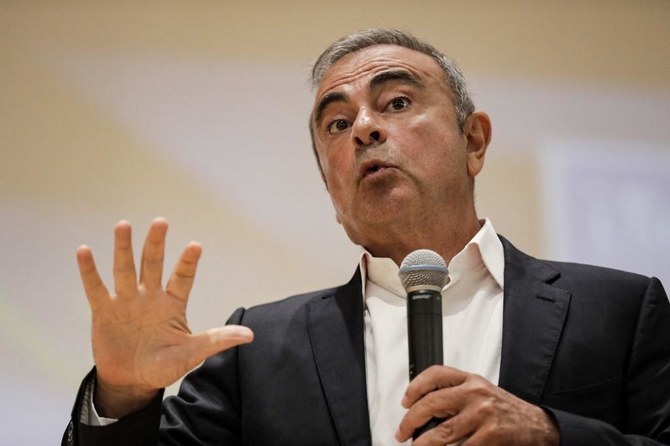
BEIRUT: Hearings in the $1 billion lawsuit filed by auto tycoon Carlos Ghosn against Nissan and other defendants started in Beirut on Monday with lawyers of both sides meeting the judge in charge of the case, judicial officials said.
The former Nissan CEO filed the case against Nissan in May in Beirut, alleging he was detained in Japan in 2018 on false charges because of what he calls the automaker’s disinformation against him. The 69-year-old Ghosn is seeking half of the $1 billion in damages and half for compensation including salary, retirement funds and stock options.
Ghosn is also seeking monetary compensation from a Nissan affiliate based in Lebanon, as well as from entities that took part in the investigation leading up to his arrest.
He was arrested in Japan in November 2018 on charges of breach of trust, misusing company assets for personal gains and violating securities laws by not fully disclosing his compensation. In December 2019, he jumped bail in Japan in a daring escape by hiding in a box spirited aboard a private jet out of the country.
He now lives in Lebanon, which has no extradition treaty with Japan and does not extradite its citizens. Renault and Nissan have both been distancing themselves from the Ghosn scandal. Ghosn has citizenship in Lebanon, France and Brazil.
In a session that lasted about four hours at the Palace of Justice in Beirut, lawyers representing Ghosn and Nissan met with Judge Sabbouh Suleiman at the Beirut prosecutor’s office, the officials said on condition of anonymity in line with regulations. None of the lawyers or the judge spoke to reporters.
A date was expected to be set for the next session.
Ghosn led Japanese automaker Nissan for two decades, rescuing it from near-bankruptcy before his 2018 arrest.
He is now wanted in Japan and France. Since he fled to Lebanon, Beirut has received three notices from Interpol based on arrest warrants for him from those countries. In France, he is facing a number of legal challenges, including tax evasion and alleged money laundering, fraud and misuse of company assets while at the helm of the Renault-Nissan alliance.
The office of Ghosn’s lawyer declined to comment on the case when contacted by The Associated Press.
Ghosn claims to be the victim of a character assassination campaign led by Nissan with the complicity of the Japanese government, aided by accomplices in France.


![]()

Hearings in $1 billion lawsuit filed by auto tycoon Carlos Ghosn against Nissan start in Beirut
Short Url
https://arab.news/y54rc
Hearings in $1 billion lawsuit filed by auto tycoon Carlos Ghosn against Nissan start in Beirut
- The former Nissan CEO filed the case against Nissan in May in Beirut, alleging he was detained in Japan in 2018 on false charges
- Ghosn is also seeking monetary compensation from a Nissan affiliate based in Lebanon


Latest updates





© 2026 SAUDI RESEARCH & PUBLISHING COMPANY, All Rights Reserved And subject to Terms of Use Agreement.