ISLAMABAD: Pakistani politicians and legal experts on Tuesday lauded the live broadcast of Supreme Court proceedings on national television, calling it a vital step to ensure transparency and while seeking the continuation of the practice in cases of public interest to strengthen the justice system and democracy in the country.
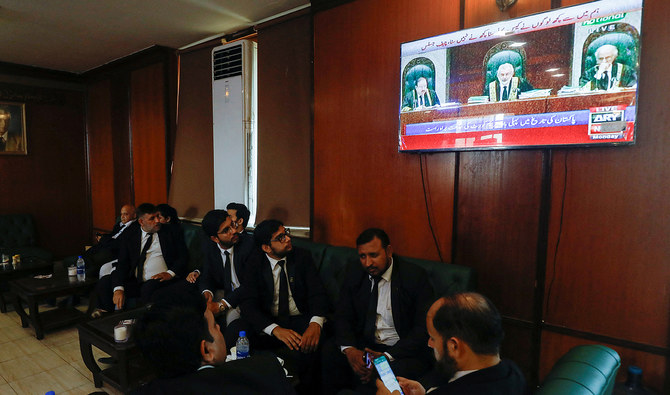
In a first, the country’s top court live streamed a hearing of multiple petitions against a legislation curtailing the chief justice’s discretion to take up any legal matter for hearing on his own and entrust cases to fellow judges without seeking their input.
The law, which was passed by the country’s outgoing parliament in April but was struck down by the top court the same month, proposes a three-member committee led by the chief justice to decide on such matters with majority vote.
The live proceedings on Monday marked the beginning of the tenure of new Chief Justice Qazi Faez Isa after he was sworn into the office on Sunday following the retirement of his predecessor, Justice Umar Ata Bandial.
“This is a good and positive development that will help ensure transparency since I believe everyone should be aware of what is happening [at the Supreme Court], especially in such cases of public interest,” Anwar Mansoor Khan, Pakistan’s former attorney general, told Arab News.
He said live streaming offered a valuable learning experience for legal professionals who could not attend the apex court’s proceedings in person, adding it also upheld the public’s right to know about the details of the court’s proceedings.
“However, this is not a general public forum,” he added. “Therefore, instead of broadcasting live on television, these hearings should be streamed on the Supreme Court’s website or through a dedicated mobile application, allowing interested individuals to access and observe the proceedings.”
Sabahat Rizvi, Lahore High Court Bar Association’s secretary, called it a commendable practice which should be maintained in cases of public interest.
“All cases of public interest litigation should be live streamed online,” she told Arab News.
Rizvi sad there was no harm in live broadcasting such cases, especially when decisions that impact people’s lives were at stake.
“The transparency of the process will leave a lasting impression on people,” she continued.
“Individuals have the right to see how judges and their counsels handle cases, how their rights are defended, and how issues related to them are addressed,” she said, adding that private matters should not be open to the general public unless it was required.
Irfan Qadir, who served Shehbaz Sharif’s administration as special assistant to the prime minister, said judges should also feel accountable to the nation, adding that people must have the ability to scrutinize court proceedings for transparency.
“Open trial should never be avoided in political matters,” he told Arab News.
Faisal Karim Kundi, central information secretary of the Pakistan Peoples Party, praised the new chief justice for live streaming the proceeding, adding the top court and parliament should have their own dedicated web channels.
“Live streaming of court proceedings takes place in different countries through dedicated web channels,” he said, adding that the recent broadcast was done on the national television and watched by the entire nation.
“Creating a dedicated Supreme Court web channel could be a more favorable option than television broadcasting,” he continued, adding it should be implemented for all public interest cases and not be limited to a specific one.


Legal experts say live broadcast of Supreme Court proceedings can bolster democracy, justice system
https://arab.news/ndcbx
Legal experts say live broadcast of Supreme Court proceedings can bolster democracy, justice system

- In a first, Pakistan’s top court live streamed hearing of petitions against a legislation curtailing chief justice’s powers
- Legal experts urge to continue the practice in matters related to public interest through a dedicated Internet channel

Pakistan’s president defends ongoing strikes in Afghanistan, urges Kabul to dismantle militants
- Afghanistan on Thursday launched attacks in retaliation for Pakistani airstrikes the previous Sunday
- Pakistan’s military says it is only targeting Afghan military installations to avoid civilian casualties
ISLAMABAD: Pakistan’s president on Monday defended his country’s ongoing military strikes in neighboring Afghanistan, saying Islamabad tried all forms of diplomacy before targeting militants operating from Afghan territory, and called on the Taliban government in Kabul to disarm groups responsible for attacks in Pakistan.
Pakistan earlier said it is in “open war” with Afghanistan, alarming the international community. The border area remains a stronghold for militant organizations including Al-Qaeda and the Daesh (Islamic State) group.
“(The Afghan Taliban) must choose to dismantle the terror groups that survive on conflict and its war economy,” Asif Ali Zardari said during a speech to lawmakers, adding that “no state accepts serial attacks on its soil.”
Afghanistan on Thursday launched attacks in retaliation for Pakistani airstrikes the previous Sunday. Since then, Pakistan has carried out operations along the border, with Information Minister Attaullah Tarar claiming the killing of 435 Afghan forces and the capture of 31 Afghan positions.
Kabul has denied such claims.
In Afghanistan, the deputy government spokesman Hamdullah Fitrat said Pakistan’s military fired mortar shells at a refugee camp in eastern Kunar province, killing three children and injuring three others.
Afghanistan’s defense ministry said Afghan forces carried out strikes targeting a Pakistani military facility near Paktia province, causing “substantial losses and heavy casualties.”
Pakistan’s military did not respond to questions. It has said Pakistan is only targeting Afghan military installations to avoid civilian casualties.
Pakistan has witnessed a surge of violence in recent months and blames it on the outlawed Pakistani Taliban, known as Tehreek-e-Taliban Pakistan or TTP. It operates both inside Pakistan and from Afghan territory.
Islamabad accuses Afghanistan’s Taliban government of providing safe havens for the TTP, which Kabul denies.
The latest cross-border fighting ended a ceasefire brokered by Qatar and Turkiye in October. The two sides failed to reach a permanent agreement during talks in Istanbul.
Zardari reiterated Pakistan’s call for talks, saying, “We have never walked away from dialogue.”
The Pakistani leader again accused Afghanistan of acting as a proxy for India by sheltering militant groups.
“Stop being used by another country as a battlefield for their ambitions,” he said.
Zardari cited a recent report from the United Nations Security Council’s monitoring team that described the presence of militant groups in Afghanistan as an extra-regional threat.


