

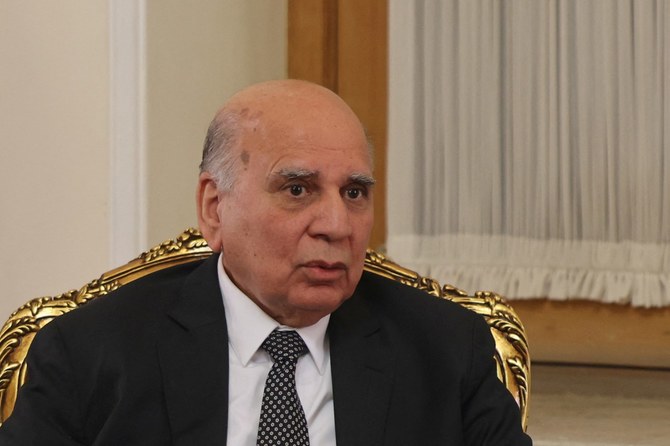

NEW YORK: Iraq’s Foreign Minister Fuad Hussein has told Iran’s president Ebrahim Raisi that any threat of violence against the Kurdistan Region or violation of Iraqi sovereignty is unacceptable to the government in Baghdad.
“The threat of attack or violence against the Kurdistan region and the violation of Iraqi sovereignty is unacceptable, a fact we have explicitly mentioned in Tehran. (The) Kurdistan Regional Government and (the) Kurdistan Region have adhered to the security agreement,” Hussein said in an interview with Al Arabiya’s Diplomatic Avenue.
“Therefore, we need Iran to adhere to the agreement and not use violence against Iraqi sovereignty.
“I do not expect any Iranian attack and I wish for even violent language not to be directed towards Iraq.”
He said he had attended separate meetings with Raisi and the Iranian Foreign Affairs Minister Hossein Amir-Abdollahian, in which they discussed the security agreement between the two countries, made to prevent any cross-border clashes in the future.
Iraq, Hussein said, had upheld its part of the agreement.
“It is clear that the federal government and the Kurdistan Regional Government have taken the necessary measures towards the implementation of the security agreement, including the return of those who were in the border regions to camps, for whom five camps were established to live in,” Hussein said, adding that the task was completed in less than a week.
“Iran is well aware of this matter,” he added. “Second, we let them (the Kurds) choose between leaving, staying as refugees in the camps, or benefiting from the Iranian amnesty and returning there.”
He said the Iraqi contingent had invited the representatives of the Iranian Embassy and Tehran’s consulate in Erbil, in addition to Iranian, Iraqi and international media representatives, to visit the sites to witness first-hand what happened during the process and in the campsite.
Hussein said another meeting had been scheduled with Raisi in New York, during the UN General Assembly.
On relations with Kuwait, he said efforts would be made for a meeting in New York between Iraqi Prime Minister Mohammed Shia Al-Sudani and Kuwaiti Prime Minister Ahmad Nawaf Al-Ahmad Al-Sabah to clarify the situation over access to the Khor Abdullah waterway.
The estuary is Iraq’s only entrance to the Gulf, through which most of its oil exports and imported goods are shipped.
Iraq and Kuwait had previously struck a maritime border deal where the two countries shared access to the Khor Abdullah.
The deal drew a line down the middle of the estuary, stipulating that each country would exercise its sovereignty over the part which lay within their territorial waters.
But critics say the agreement is unfair and that Kuwait has no right to control any part of Khor Abdullah, which was historically Iraqi.
In 2013, the Iraqi Parliament approved the shared waterway agreement with a simple majority.
But earlier this month the deal was struck down by the Iraqi Federal Supreme Court, which annulled the law ratifying the 2012 agreement. The judges ruled the 2013 law was unconstitutional and would have required two thirds majority in the Iraqi Parliament instead of a simple majority.
“The federal court is an independent entity and its decisions stem from this independence,” Hussein said.
“However, its decisions in general, and this decision in particular, will be revised in all aspects, namely the legal and political aspects, as well as revising the agreement relevant to these decisions.
“I believe that the correct way to resolve the problems between the two countries is dialogue as we have no other options,” he explained.
He said negotiations would be resumed.
“Our policy lies in building distinguished relationships with our neighboring countries. If problems emerge, we have no way to overcome them except through dialogue and negotiations.”
Hussein reiterated his commitment to peaceful resolution.
“This government and all Iraqi governments, after the changes, stress the fact that enjoying distinguished relations with the neighboring countries is the priority, namely those it went through wars and conflicts with. If issues arose back then, and some problems now exist, I believe they could be resolved through dialogue and negotiations.”
He said the policy adopted by the government was non-violent, “as we have no intention of going back to the old policies that have been buried. We are about to resolve all problems through negotiations and dialogues.”
Hussein conceded that Iraq had problems both internally and with its neighbors, though.
“The internal problem resides in the presence of the PKK (Kurdistan Workers’ Party) in Iraq, whereas the Iraqi constitution prohibits the presence of such operatives or categories on Iraqi territory and the use of weapons against a neighboring country,” he said.
“This is part of the Iraqi constitution to which we adhere. However, this has been the case since 1991 or 1992. Nonetheless, this does not give the neighboring country Turkiye the right to military intervention and violation of Iraqi sovereignty.
“Once again, regarding Turkiye, we are holding a continuous dialogue and we will also be meeting here with the (Turkish) minister of foreign affairs to ensure the continuity of the discussions regarding the issue to resolve it.”


