KARACHI: Muhammad Amir Khan, a driver with a private company, has been in despair since last month when he received an electricity bill of Rs28,457 ($95.99).
With a monthly salary of Rs27,000 ($91.7) — his only source of income to support a seven-member household — Khan had no option but to default on paying the bill.
Now he waits for the inevitable: the power supply company to turn the lights off.
Khan is not alone.
Pakistan saw nationwide protests and trader strikes all of August over rising electricity prices and brisk inflation, as citizens and businessmen came out to burn electricity bills in a show of defiance and despondency. A $3 billion loan program, approved by the International Monetary Fund (IMF) in July, averted a sovereign debt default in Pakistan but reforms linked to the bailout have fueled annual inflation running at 27.4 percent.
Pakistan increased its power tariffs in July under the IMF deal, part of moves to reduce unsustainable public debt in the power and gas sectors. Tens of thousands of Pakistanis thus received steep electricity bills during August for power units consumed in July. To make matters worse, Pakistan last Friday also announced a record rise in petrol and diesel prices, the second big increase in two weeks.
“My electricity bill [last month] was so high that I could not pay it, because do I pay the bill or buy food or provide for my children?” Khan told Arab News.
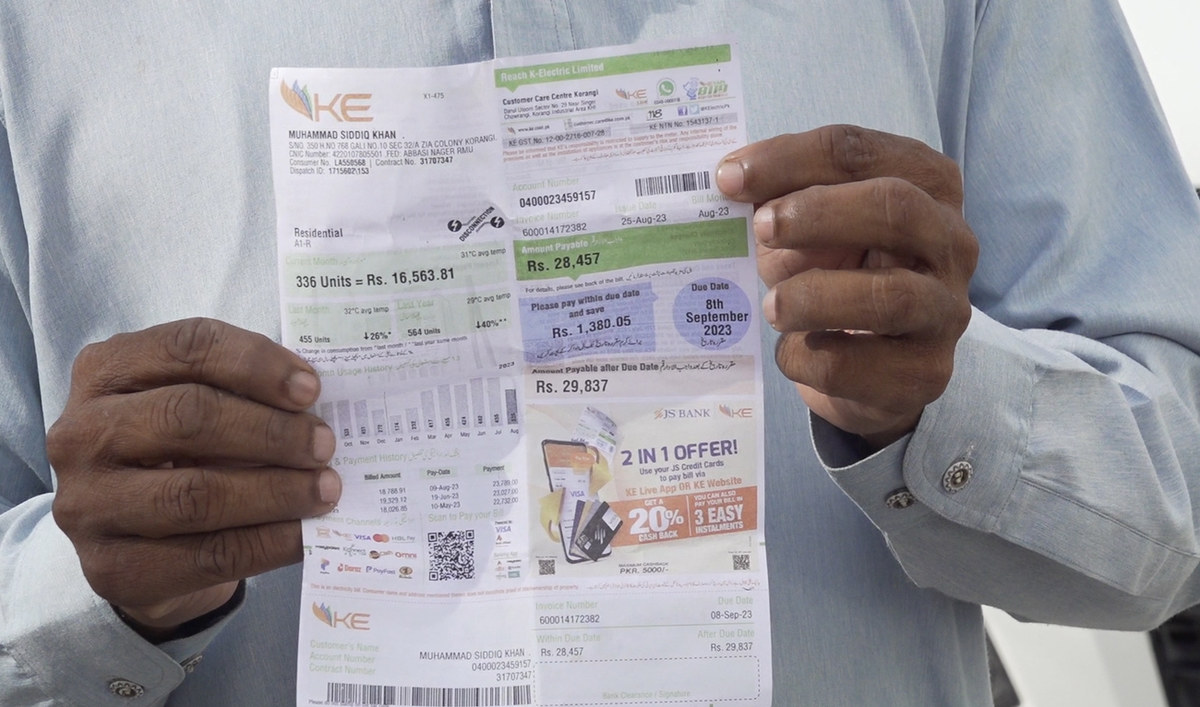
Muhammad Amir Khan, a driver with a private company, holds his electricity bill of Rs28,457 ($95.99) on September 18, 2023, in Karachi, Pakistan. (AN Photo)
“And in case of non-payment of the bill, if my electricity is disconnected then I will be forced to live in the darkness because I don’t have any other resources.”
“How can I carry on with an income that is less than the electricity bill I’ve been handed?”
Inflationary pressures are hitting the masses hard. August data from Pakistan’s statistics bureau showed a slight easing from July’s 28.3 percent inflation rate, but food inflation remained elevated at 38.5 percent.
Financial expert Ali Nawaz said low-income groups across the country were unable to make ends meet as food inflation and record power bills had increased their cost of living significantly.
“Higher electricity bills have reduced their disposable income to a very large extent, which has been impacting their livelihood,” Ali said. “They are unable to fund their daily living, they are unable to fund their health care expenditure, they are unable to fund their food-related expenses.”
“We should focus on reducing electricity prices as soon as possible by focusing more on alternative energy sources so we can give some relaxation to the common people,” Ali added.
But what is driving electricity prices in Pakistan?
One is the cost of non-renewable fuel resources such as gas, furnace oil, diesel and coal while the other is the rising value of the US dollar and the depreciating rupee.
Energy purchases account for most of Pakistan’s import bill. As the rupee withers against the dollar, imported fuel has become costlier.
The IMF deal-mandated hike in electricity prices has not helped.
The lender had pointed out that liquidity conditions in the power sector were acute, with a buildup of arrears and frequent power outages. The arrears — a form of public debt that builds up due to subsidies and unpaid bills — were a major issue in the eight months of negotiations between the IMF and Islamabad before a deal was reached in June.
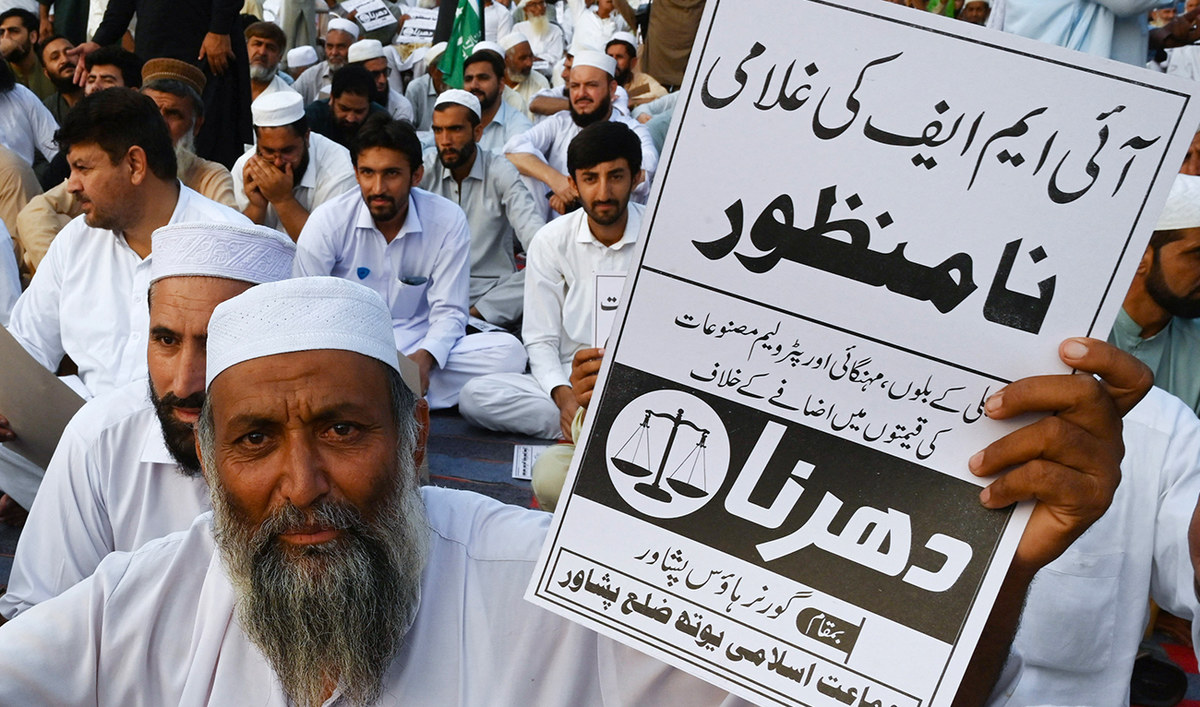
An activist of Pakistan's right wing religious party Jamaat-e-Islami holds a placard reading, "withdraw the additional electricity bills and the government should end the patronage of IPPs contracts" during a demonstration against the surge in electricity prices in Peshawar on September 18, 2023. (AFP/File)
Debts to power generation companies have accumulated to nearly 2.6 trillion rupees ($9.04 billion), according to official figures, which show a separate government debt of around 1.6 trillion rupees ($5.56 billion) to the gas sector. The power sector is also beset by theft, which needs to be overcome.
With the recent tariff hikes, the per unit price of electricity has gone up to Rs35.57 for off-peak electricity hours and Rs41.89 for on-peak hours. Previously, the rates were Rs19.66 for off=peak hours and Rs25.98 for on-peak times. The per unit rates, with the addition of various taxes, have increased to Rs53-63 for different consumer categories.
Another reason for the high cost of electricity is “capacity payments” to Independent Power Producers (IPPs), private entities that own facilities to generate electric power for sale to end users. Pakistan’s energy mix consists of 58.8 percent thermal power, which means the country is heavily dependent on IPPs. But contracts entered into with the independent producers are widely believed to be skewed in favor of the companies.
Among major criticisms of IPP contracts is that they require the government to make capacity payments even when power generated is not fully utilized. Experts say the arrangement leads to a high cost of electricity which augments the production costs of factories and industrial units. IPPs have also been accused of making exorbitant profits and dividends on capital invested under existing contracts and of over-invoicing and misreporting, while experts and politicians have called for a heat rate audit.
Representatives from the Power Division told Senate last month capacity payments to IPPs for the current fiscal year had reached a staggering Rs1.3 trillion.
In a briefing to journalists earlier this month, caretaker Prime Minister Anwaar-ul-Haq Kakar admitted problems with IPP agreements and said his government was “thoroughly” discussing its contractual obligations with the producers.
“We are on a course where we feel that we should find some sort of resolution, as everyone feels that they are uneven contracts,” the PM said, adding that he would share more details in due course of time.