



ISLAMABAD: As proceedings from Pakistan’s Supreme Court were broadcast live on Monday by state television for the first time, divisions between 15 judges of the top court became apparent over a law passed earlier this year that curtails the powers of the chief justice.
The live proceedings marked the beginning of the tenure of new Chief Justice Qazi Faez Isa, sworn in on Sunday upon the retirement of his predecessor Justice Umar Ata Bandial. Isa’s first order of business was to open for live broadcast hearings in multiple petitions against the Supreme Court (Practice and Procedure) Act 2023, which curtails the discretion of the chief justice to take up any legal matter directly, commonly known as suo moto action, hear appeals, as well as his powers to entrust cases to his fellow judges. It instead proposes a three-member committee led by the chief justice to decide on such matters with majority vote.
The law was passed by Pakistan’s outgoing parliament in April but was struck down by the Supreme Court the same month. It had pitted the outgoing coalition government of Prime Minister Shehbaz Sharif against CJ Isa’s predecessor.
After taking oath on Sunday, CJ Isa constituted a full court bench, comprising all 15 judges of the apex court, to hear the petitions challenging the law. He told the court on Monday it was a “majority consensus decision” to telecast the proceedings live.
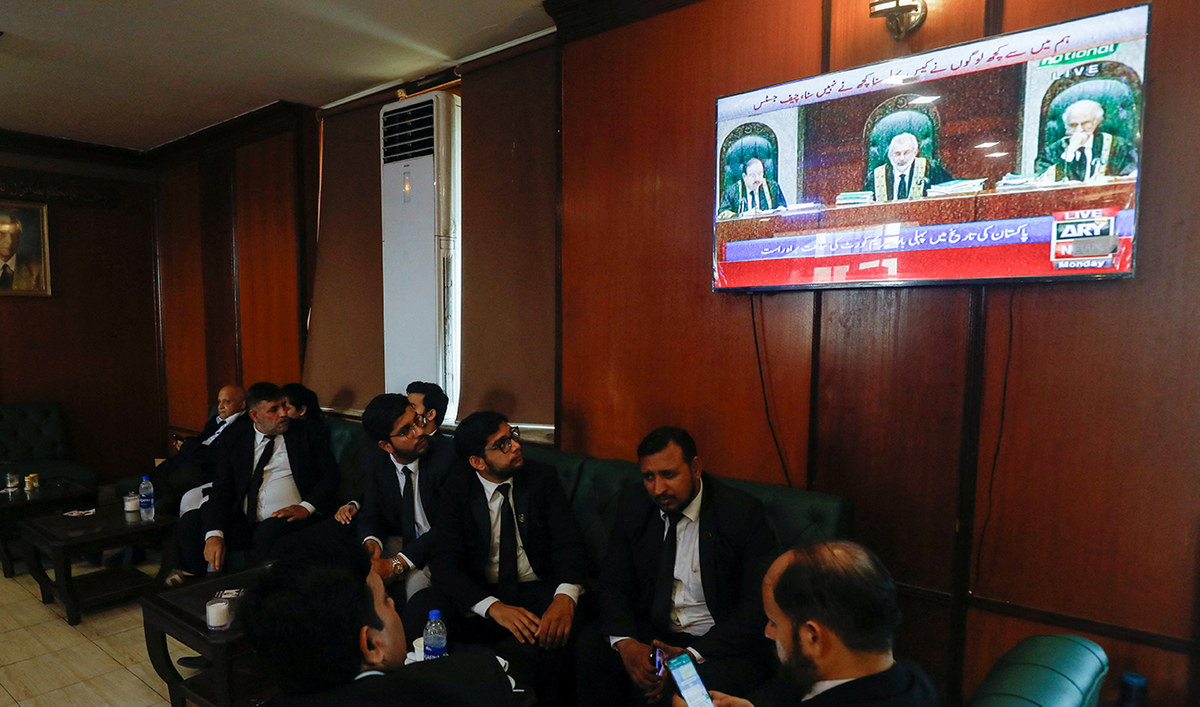
Lawyers, some of them look on television screen, dispaying the live broadcast of the proceeding from the Supreme Court of Pakistan, at the Sindh High Court Bar Association in Karachi, Pakistan September 18, 2023. (Reuters)
“There is a difference between liking a law and its constitutionality as many laws I don’t like either, but that doesn’t mean they are wrong,” CJ Isa, who is believed to support checks on the chief justice’s powers, said during the hearing, adding that the case did not relate to an individual’s rights but rather to the constitution and the rights of the Pakistani people.
Justice Mansoor Ali Shah, another judge on the bench, also argued that the law had bolstered the judiciary’s independence.
“Nowhere in the world does a chief justice have such powers and the powers of the chief justice should not be seen as the independence of the judiciary,” Justice Shah said, arguing that parliament, as it represented the people of Pakistan, had the right to legislate.
Justice Athar Minallah also questioned whether it was right to give unlimited powers to the chief justice to form benches without consulting others.
“The old system of bench formation vests all powers in one person,” he noted.
However, other judges like Muneeb Akhtar questioned parliament’s role in judicial and administrative matters of the Supreme Court.
“Can the parliament legislate regarding administrative and judicial matters of the Supreme Court and isn’t it against the doctrine of division of powers of institutions,” Justice Akhtar asked.
Justice Ijaz Ul Ahsan also spoke about parliament “infringing” upon judicial powers, warning that such interference could undermine the judiciary’s independence.
“If the parliament interferes with the powers of the judiciary, then the independence of the judiciary will be destroyed,” he remarked.
The hearing of the case was adjourned until October 3.
Live proceedings of Monday’s Supreme Court Session are being seen as a curtain raiser to CJ Isa’s tenure, whose elevation has garnered nationwide interest given his reputation as a maverick judge and his hard-hitting judgments criticizing the role of the country’s powerful military in politics.
Among widely-discussed judgments during his judicial career, a ruling by CJ Isa in 2019 posed scathing questions about the role of the military and its Inter-Services Intelligence (ISI) spy agency in brokering a deal between religious activists and the then government.
Former Prime Minister Imran Khan, who was close to the then chief of the ISI Faiz Hameed, attempted to have Isa removed as a judge on charges of financial impropriety in 2018 — a charge that was thrown out in 2019 for want of evidence by his fellow judges.


