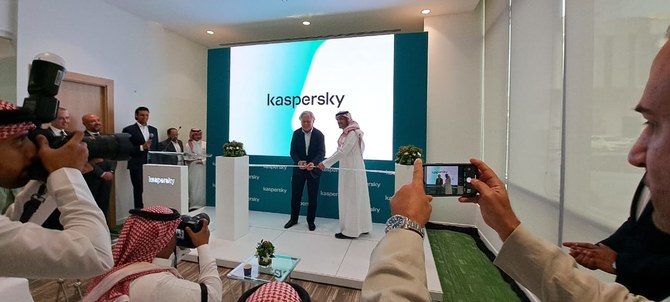


RIYADH: As part of its global initiative aimed at building trust and assuring the integrity of its solutions and processes, Kaspersky opened its first Transparency Center in Riyadh on Sunday.
It is the first-of-its-kind facility the multinational cybersecurity company has launched in the Middle East.
Saudi Arabia’s Vice Minister of Communications and Information Technology Haitham bin Abdul Rahman Al-Ohali inaugurated the facility at a ceremony attended by officials of his ministry, the IT company, and other industry players.
In an interview with Arab News, Eugene Kaspersky, founder and CEO of Kaspersky, said the new center aims to prove instrumental in advancing the Kingdom’s digital transformation initiatives.
Kaspersky CEO elaborated that as Saudi Arabia undergoes development, the company is well-positioned to play a crucial role in maintaining cybersecurity across various technologies, including enterprise systems, the Internet of Things, manufacturing systems, and monitoring environments.
He said the increasing use of smart devices in homes will further amplify the necessity for robust cybersecurity measures in the future.
Visitors to the center in Riyadh can review the source code of all of Kaspersky’s on-premise solutions. The whole review process depends on the level of sophistication and follows “piste” skiing classification color codes — “blue,” “red,” and “black.”
“Blue piste” offers a general overview of the security development processes of Kaspersky products and services, as well as data management procedures. “Red piste” allows a review of the most critical aspects of source code, assisted by the company’s specialists, and provides a targeted analysis of a particular functionality.
“Black piste” enables visitors to conduct the most comprehensive source code review, with the help of Kaspersky’s experts.
“This year we celebrate the five-year anniversary of our ‘Global Transparency Initiative.’ As true pioneers in advancing digital trust, we are pleased to celebrate the arrival of this initiative in the Middle East region, which is witnessing rapid digital transformation,” Kaspersky stated.
“In order to enhance our partners’ confidence in the services we provide to them, we are pleased to welcome them to the newly opened Transparency Center in Riyadh to answer any questions about the nature of our work and our solutions,” he added.
Kaspersky further elaborated that the cybersecurity company selected Riyadh as the venue for its first such facility in the Middle East to closely align with the goals of Vision 2030.
“I see that Saudi Arabia has a lot of plans and is already on the way to building a new cybernation with a lot of research development in cyber including IoT devices and systems. So we will be very happy to work together on cyber immunity,” Kaspersky added.
He noted that Saudi Arabia is among the company’s most significant markets, contributing substantially to its overall growth.
Vision 2030 aims to promote the Kingdom’s position as the hub for technology and innovation and has transformed the country into a destination to attract international companies to establish their regional headquarters in Riyadh.
The company is also committed to fostering awareness and cultivating young talent within the Kingdom. To this end, they have implemented training initiatives designed to bolster both local and global cybersecurity efforts. The most recent initiative is the “Cyber Generation” training — an internship program that accommodates young talent both with and without a background in IT or cybersecurity. It aims at increasing cybersecurity awareness, and enabling skills and knowledge sharing to defend against evolving cyberthreats.
Speaking to Arab News, Mohamad Hashem, general manager of Kaspersky Saudi Arabia and Bahrain, stated that the company has been working with the Saudi government to boost cybersecurity for almost five years.
“We already have a lot of initiatives with the Saudi government targeting students in schools and universities,” Hashem stated.
“We have a partnership with the Saudi Federation for Cyber Security and Programming where we have been working closely with them for the past five years. We have (organized) cybersecurity boot camps and training programs that aim to support Saudi students. Plus, we have our transparency centers which is our own way to provide more support to the Saudi students on preparing them for the market with cybersecurity expertise,” he added.