

Kaspersky expands regional presence with opening of 1st Transparency Center in Riyadh

1 / 2
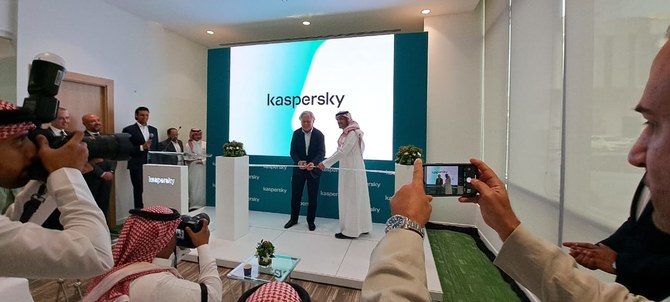
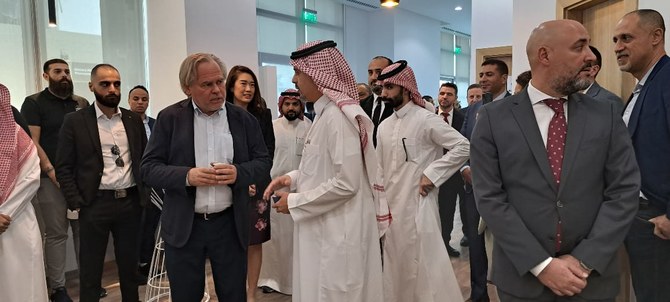
Saudi Arabia’s Vice Minister of Communications and Information Technology Haitham bin Abdul Rahman Al-Ohali inaugurated the facility at a ceremony attended by officials of his ministry, the IT company, and other industry players. AN photo
2 / 2
Saudi Arabia’s Vice Minister of Communications and Information Technology Haitham bin Abdul Rahman Al-Ohali inaugurated the facility at a ceremony attended by officials of his ministry, the IT company, and other industry players. AN photo
Short Url
Updated 18 September 2023
Follow

Kaspersky expands regional presence with opening of 1st Transparency Center in Riyadh

RIYADH: As part of its global initiative aimed at building trust and assuring the integrity of its solutions and processes, Kaspersky opened its first Transparency Center in Riyadh on Sunday.

It is the first-of-its-kind facility the multinational cybersecurity company has launched in the Middle East.

Saudi Arabia’s Vice Minister of Communications and Information Technology Haitham bin Abdul Rahman Al-Ohali inaugurated the facility at a ceremony attended by officials of his ministry, the IT company, and other industry players.

In an interview with Arab News, Eugene Kaspersky, founder and CEO of Kaspersky, said the new center aims to prove instrumental in advancing the Kingdom’s digital transformation initiatives.

Kaspersky CEO elaborated that as Saudi Arabia undergoes development, the company is well-positioned to play a crucial role in maintaining cybersecurity across various technologies, including enterprise systems, the Internet of Things, manufacturing systems, and monitoring environments.

He said the increasing use of smart devices in homes will further amplify the necessity for robust cybersecurity measures in the future.

Visitors to the center in Riyadh can review the source code of all of Kaspersky’s on-premise solutions. The whole review process depends on the level of sophistication and follows “piste” skiing classification color codes — “blue,” “red,” and “black.”

“Blue piste” offers a general overview of the security development processes of Kaspersky products and services, as well as data management procedures. “Red piste” allows a review of the most critical aspects of source code, assisted by the company’s specialists, and provides a targeted analysis of a particular functionality.

“Black piste” enables visitors to conduct the most comprehensive source code review, with the help of Kaspersky’s experts.

“This year we celebrate the five-year anniversary of our ‘Global Transparency Initiative.’ As true pioneers in advancing digital trust, we are pleased to celebrate the arrival of this initiative in the Middle East region, which is witnessing rapid digital transformation,” Kaspersky stated.

“In order to enhance our partners’ confidence in the services we provide to them, we are pleased to welcome them to the newly opened Transparency Center in Riyadh to answer any questions about the nature of our work and our solutions,” he added.

Kaspersky further elaborated that the cybersecurity company selected Riyadh as the venue for its first such facility in the Middle East to closely align with the goals of Vision 2030.

“I see that Saudi Arabia has a lot of plans and is already on the way to building a new cybernation with a lot of research development in cyber including IoT devices and systems. So we will be very happy to work together on cyber immunity,” Kaspersky added.

He noted that Saudi Arabia is among the company’s most significant markets, contributing substantially to its overall growth.

Vision 2030 aims to promote the Kingdom’s position as the hub for technology and innovation and has transformed the country into a destination to attract international companies to establish their regional headquarters in Riyadh.

The company is also committed to fostering awareness and cultivating young talent within the Kingdom. To this end, they have implemented training initiatives designed to bolster both local and global cybersecurity efforts. The most recent initiative is the “Cyber Generation” training — an internship program that accommodates young talent both with and without a background in IT or cybersecurity. It aims at increasing cybersecurity awareness, and enabling skills and knowledge sharing to defend against evolving cyberthreats.

Speaking to Arab News, Mohamad Hashem, general manager of Kaspersky Saudi Arabia and Bahrain, stated that the company has been working with the Saudi government to boost cybersecurity for almost five years.

“We already have a lot of initiatives with the Saudi government targeting students in schools and universities,” Hashem stated.

“We have a partnership with the Saudi Federation for Cyber Security and Programming where we have been working closely with them for the past five years. We have (organized) cybersecurity boot camps and training programs that aim to support Saudi students. Plus, we have our transparency centers which is our own way to provide more support to the Saudi students on preparing them for the market with cybersecurity expertise,” he added.


AI will never replace human creativity, says SRMG CEO 

Updated 30 January 2026
Follow

AI will never replace human creativity, says SRMG CEO 

  • Speaking to Maya Hojeij, senior business anchor at Asharq with Bloomberg, Jomana R. Alrashid expressed pride in SRMG platforms that had absorbed and adopted AI

RIYADH: Jomana R. Alrashid, CEO of Saudi Research and Media Group, highlighted how AI cannot replace human creativity during a session at The Family Office’s “Investing Is a Sea” summit at Shura Island on Friday. 

“You can never replace human creativity. Journalism at the end of the day, and content creation, is all about storytelling, and that’s a creative role that AI does not have the power to do just yet,” Alrashid told the investment summit. 

“We will never eliminate that human role which comes in to actually tell that story, do the actual investigative reporting around it, make sure to be able to also tell you what’s news or what’s factual from what’s wrong ... what’s a misinformation from bias, and that’s the bigger role that the editorial player does in the newsroom.”

Speaking on the topic of AI, moderated by Maya Hojeij, senior business anchor at Asharq with Bloomberg, the CEO expressed her pride in SRMG platforms that had absorbed and adopted AI in a way that was “transformative.”

“We are now translating all of our content leveraging AI. We are also now being able to create documentaries leveraging AI. We now have AI-facilitated fact-checking, AI facilities clipping, transcribing. This is what we believe is the future.”

Alrashid was asked what the journalist of the future would look like. “He’s a journalist and an engineer. He’s someone who needs to understand data. And I think this is another topic that is extremely important, understanding the data that you’re working with,” she said.

“This is something that AI has facilitated as well. I must say that over the past 20 years in the region, especially when it comes to media companies, we did not understand the importance of data.”


The CEO highlighted that previously, media would rely on polling, surveys or viewership numbers, but now more detailed information about what viewers wanted was available. 

During the fireside session, Alrashid was asked how the international community viewed the Middle Eastern media. Alrashid said that over the past decades it had played a critical role in informing wider audiences about issues that were extremely complex — politically, culturally and economically — and continued to play that role. 

“Right now it has a bigger role to play, given the role again of social media, citizen journalists, content creators. But I also do believe that it has been facilitated by the power that AI has. Now immediately, you can ensure that that kind of content that is being created by credible, tier-A journalists, world-class journalists, can travel beyond its borders, can travel instantly to target different geographies, different people, different countries, in different languages, in different formats.”

She said that there was a big opportunity for Arab media not to be limited to simply Arab consumption, but to finally transcend borders and be available in different languages and to cater to their audiences. 


The CEO expressed optimism about the future, emphasizing the importance of having a clear vision, a strong strategy, and full team alignment. 

Traditional advertising models, once centered on television and print, were rapidly changing, with social media platforms now dominating advertising revenue.

“It’s drastically changing. Ultimately in the past, we used to compete with one another over viewership. But now we’re also competing with the likes of social media platforms; 80 percent of the advertising revenue in the Middle East goes to the social media platforms, but that means that there’s 80 percent interest opportunities.” 

She said that the challenge was to create the right content on these platforms that engaged the target audiences and enabled commercial partnerships. “I don’t think this is a secret, but brands do not like to advertise with news channels. Ultimately, it’s always related with either conflict or war, which is a deterrent to advertisers. 

“And that’s why we’ve entered new verticals such as sports. And that’s why we also double down on our lifestyle vertical. Ultimately, we have the largest market share when it comes to lifestyle ... And we’ve launched new platforms such as Billboard Arabia that gives us an entry into music.” 

Alrashid said this was why the group was in a strong position to counter the decline in advertising revenues across different platforms, and by introducing new products.

“Another very important IP that we’ve created is events attached to the brands that have been operating in the region for 30-plus years. Any IP or any title right now that doesn’t have an event attached to it is missing out on a very big commercial opportunity that allows us to sit in a room, exchange ideas, talk to one another, get to know one another behind the screen.” 

The CEO said that disruption was now constant and often self-driving, adding that the future of the industry was often in storytelling and the ability to innovate by creating persuasive content that connected directly with the audience. 

“But the next disruption is going to continue to come from AI. And how quickly this tool and this very powerful technology evolves. And whether we are in a position to cope with it, adapt to it, and absorb it fully or not.”