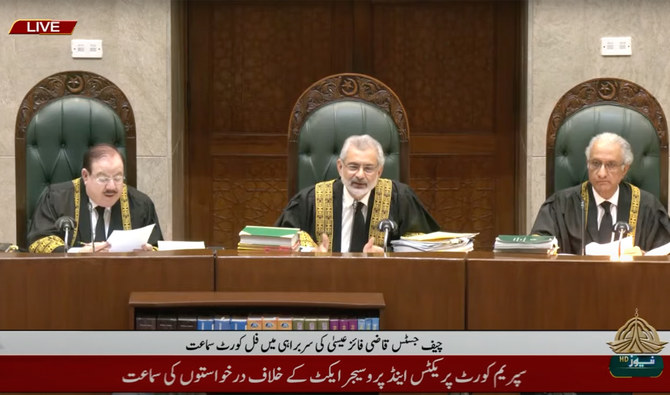

ISLAMABAD: In a first for Pakistan, the Supreme Court on Monday began live-streaming hearing of multiple petitions against a law that curtails the powers of the country’s top judge, a day after a new chief justice widely believed to be an activist judge took office.
The law, the Supreme Court (Practice and Procedure) Act 2023, deprived the office of the Chief Justice of Pakistan of powers to take suo motu notices in individual capacity, hear appeals and assign cases to other judges. It proposed a three-member committee led by the chief justice to decide on the matters with a majority vote.
The outgoing government of Prime Minister Shehbaz Sharif had tabled the draft law in parliament amid a tussle with the apex court, particularly former chief justice Umar Ata Bandial, after he had initiated proceedings through a suo motu notice for snap elections in the Punjab and Khyber Pakhtunkhwa provinces.
The court ruled that snap polls should be held in both provinces within 90 days of the dissolution of assemblies in January, but the Sharif-led government defied the ruling by refusing to provide funds and security for polls in Punjab. The Pakistan parliament passed the Supreme Court (Practice and Procedure) Act 2023 in April, curtailing the top judge’s powers, but it was suspended shortly afterwards by the outgoing chief justice.
After taking oath on Sunday, Chief Justice Qazi Faez Isa constituted a full court, comprising all 15 judges of the Supreme Court, to hear the petitions challenging the Supreme Court (Practice and Procedure) Act 2023 on Monday. The decision to broadcast the case proceedings, the first in the country’s history, came after a full court meeting this morning.
“Some of us have heard this matter and some of us are going to hear for the first time,” Chief Justice Isa said in his remarks at the outset of the hearing.
“There was a question because since the bench no longer, one member of the bench has retired, to constitute it. The question also had a reason whether I should be a part of the bench, then the related question would arise should the other two members (two senior judges apart from the chief justice who were part of the committee) be part of the bench... so, I think the best way to resolve it was to constitute a full court.”
Advocate Khawaja Tariq Rahim, one of the petitioners, contended that parliament was not “omnipotent” and it had to go according to certain constitutional limitations.
To which, Chief Justice Isa responded by asking the counsel to not insert words which were not written in the law. “This law doesn’t say that parliament is omnipotent,” he said.
Rahim called the law an “intrusion” by parliament into the affairs of the Supreme Court, which he said prompted him to come forward and file a petition against it.
“I feel every institution must remain within its own domain,” he said.
At this Justice Athar Minallah asked Rahim if he could formulate his exact legal proposition.
To which, the petitioner replied, “My legal proposition is this that this power of forming the benches etc is the domain of the Supreme Court itself.”
Rahim’s contentions were followed by arguments from another counsel of the petitioners, Imtiaz Siddiqui, before the court adjourned for a break at around 230pm.
Ahead of the hearing on Monday, Attorney General for Pakistan (AGP) Mansoor Usman Awan submitted the federal government’s response in the matter, requesting the court to reject the petitions against the law.
The full court comprised Chief Justice Isa, Justice Sardar Tariq Masood, Justice Ijazul Ahsan, Justice Syed Mansoor Ali Shah, Justice Munib Akhtar, Justice Yahya Afridi, Justice Aminuddin Khan, Justice Sayyed Mazahar Ali Akbar Naqvi, Justice Jamal Khan Mandokhel, Justice Muhammad Ali Mazhar, Justice Ayesha A. Malik, Justice Minallah, Justice Syed Hasan Azhar Rizvi, Justice Shahid Waheed and Justice Musarrat Hilali.
During the previous hearing in June, similarities between the Supreme Court (Review of Judgments and Orders) Act 2023, which relates to the right to appeal in suo motu cases, and the Supreme Court (Practice and Procedure) Act 2023 were discussed, with Attorney General for Pakistan (AGP) Mansoor Usman Awan saying that parliament could look into “harmonizing” the two laws.
Welcoming the proposal, the then-chief justice had said the federal government should take the top court into consideration, when making any legislation related to the judiciary.