

Baghdad ups financial support for Iraqi Kurdistan

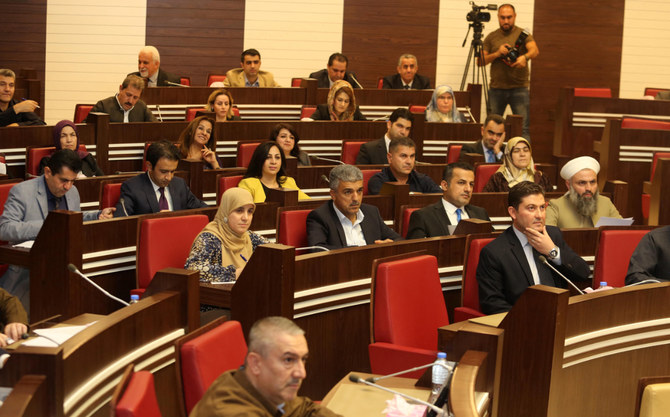
A general view of Kurdish MPs sitting during a session of Kurdistan's regional parliament in Arbil, the capital of the autonomous Kurdish region of northern Iraq. (AFP file photo)
Short Url
Updated 18 September 2023
Follow

Baghdad ups financial support for Iraqi Kurdistan

  • Iraqi Kurdistan has long accused Baghdad of not sending the necessary funds to pay civil servants

BAGHDAD: The federal government in Baghdad on Sunday agreed to increase funds allocated to Iraqi Kurdistan that are desperately needed to pay salaries in the northern autonomous region.
The decision came after thousands of people took to the streets of Dohuk, the third-biggest city in the region, in early September over unpaid civil service salaries which they blamed on Baghdad.
On Sunday the federal government said in a statement it would disburse annually to Iraqi Kurdistan two trillion and one hundred billion dinars to be paid in three equal instalments of 700 billion dinars (more than $530 million).

I thank our compatriots for their patience, their determination and their unshakable trust in the government.

Masrour Barzani

The funds will be loaned by three state-banks and reimbursed by the finance ministry in Baghdad, the statement said.
This mechanism aims to “cover employee salaries, social welfare recipients, and retirees,” it added, and the funds will be available from September.
Authorities in Baghdad and in Kurdistan have a month to “conduct an audit of the employee, social welfare recipient, and retiree numbers in the Kurdistan Region of Iraq,” it said.
Iraqi Kurdistan has long accused Baghdad of not sending the necessary funds to pay civil servants.
Previously the region, thanks to its oil exports, had independent funding that partly covered salaries.
Since the end of March it has been deprived of this resource because of a dispute with Baghdad and Turkiye, through which oil was exported.
In principle, Iraqi Kurdistan and Baghdad later agreed that sales of Kurdish oil would pass through the federal government. In exchange, 12.6 percent of the federal budget is allocated to Iraqi Kurdistan.
Earlier this month, Baghdad unblocked a package of 500 billion dinars (about $380 million) for the region’s salaries, but the government of Iraqi Kurdistan said it was not enough.
Masrour Barzani, the region’s prime minister, welcomed Sunday’s decision, calling it a “fruitful agreement” to “cover (civil servant) salaries.”
“I thank our compatriots for their patience, their determination and their unshakable trust in the government,” Barzani said in a statement.
He also telephoned Iraqi Prime Minister Mohamed Shia Al-Sudani to thank him for his “support.”


UN food agency shutting down in Houthi-held northern Yemen

Updated 10 sec ago
Follow

UN food agency shutting down in Houthi-held northern Yemen

  • World Food Program officials said 365 staff members will lose their jobs
  • Houthis have cracked down on UN workers and aid groups in areas under their control
CAIRO: The United Nations food agency is shutting down its operations in northern Yemen, following restrictions imposed by Houthi militants and harassment from the Iranian-backed group, UN officials said Thursday.
The World Food Program’s move is likely to worsen the dire humanitarian conditions in the impoverished country amid the Houthis’ crackdown on UN workers and aid groups in areas under their control, as well as funding shortages.
Yemen descended into a devastating civil war in 2014, when the Houthis pushed from their northern stronghold of Saada province and seized the capital of Sanaa, forcing the internationally recognized government out and to the south, and eventually into exile.
The Houthis now control most of the country’s north, including Sanaa, while the internationally recognized government, which is backed by a Saudi-led coalition, rules the south.
According to the UN officials, the WFP’s 365 staff members in northern Yemen will lose their jobs by the end of March. One official blamed the “insecure operating environment” in the Houthi-controlled areas and lack of sufficient funding for the WFP decision.
Over the last few years, the Houthis have cracked down on the UN in their areas of control, detaining dozens of UN staffers as well as workers for nongovernmental and civil society groups, and staffers of diplomatic missions.
The group has escalated its crackdown in recent months, forcibly entering and occupying UN premises in Sanaa and other elsewhere. They have claimed, without offering evidence, that detained UN staff and employees of other organizations and embassies are spies, which the UN has denied.
The crackdown severely restricted humanitarian operations in the Houthi-held areas, which account to around 70 percent of humanitarian needs in the country, according to the UN
Ramesh Rajasingham, who directs humanitarian operations in Yemen, told the UN Security Council earlier this month that more than 18 million people in Yemen could face acute food insecurity in the coming month, with tens of thousands at risk of slipping into “catastrophic hunger” and facing famine-like conditions.
The UN Office for the Coordination of Humanitarian Affairs, or OCHA, said humanitarian operations in Yemen in 2025 were just 25 percent funded. The gap, OCHA said in a Jan. 4 report, forced UN agencies and aid groups to scale back life-saving services across all sectors, particularly health and protection programs.
This left “millions of people without essential care and exposed to heightened risks,” the agency said.