

Dire hygiene spells new threat for Morocco quake survivors

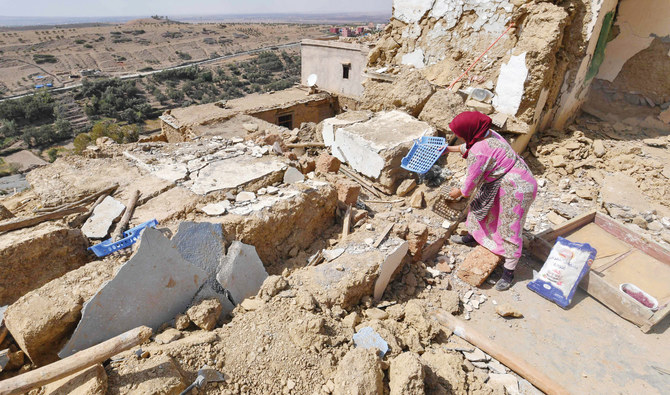
A woman salvages belongings from the rubble of her house in the village of Afella Igir in the Amizmiz region. The magnitude 6.8 earthquake flattened entire villages on Sept. 8. (AFP)
Short Url
Updated 17 September 2023
Follow

Dire hygiene spells new threat for Morocco quake survivors

  • The disaster killed nearly 3,000 people and injured thousands more

AMIZMIZ, Morocco: In her earthquake-hit Moroccan town, Zina Mechghazzi has improvised a sink by placing a pink bucket and a bar of soap on the dusty ground amid the ruins.

“I haven’t taken a shower in seven days,” said the woman from Amizmiz at the foot of the High Atlas range, about 60 km southwest of Marrakech.

“I’ve only washed my armpits and changed my clothes.”

Over a week since a 6.8-magnitude quake devastated parts of central Morocco, many worry that the dire living conditions and poor hygiene spell new threats for the survivors.

The disaster killed nearly 3,000 people and injured thousands more when it hit in Al-Haouz province, south of the tourist hub Marrakech, on Sept. 8.

Many survivors have stayed close to their ravaged villages and now sleep in improvised shelters and simple tents provided by Morocco’s civil protection service.

Later, Mechghazzi was kneading dough to make bread, sitting on a stool next to a stove out in the open.

When she was finished, she washed the flour off her hands with untreated water from a dirty 5-liter jug, shrugging that “we have to adapt.”

With only a few houses left standing and habitable in Amizmiz, functioning bathrooms and toilets have become a luxury, and they are often overcrowded.

Mechghazzi pointed to an empty lot nearby where a stand of olive trees now provide the only, limited privacy as a child was relieving himself behind a tent.

During the day, temperatures in Amizmiz still top 30 degrees Celsius, but nights bring biting cold and damp in the mountain area.

“Winter is coming, the situation is difficult, especially with the children,” said Rabi Mansour, holding a four-month-old baby, her fourth child.

“Problems caused by rain and cold will be a challenge.”

A pregnant woman, who only gave her first name, Hassna, and who is just days away from giving birth, said she was terrified.

“I never thought I would give birth in these conditions,” she said.

“I don’t have much water, it’s hard to go to the bathroom, and I’d rather not even think about how I’m going to manage. It stresses me out so much.”

A few tents away, first aid was being provided to people with injuries or sickness.

“We have a foot infection, a tooth abscess, a stomach problem, and others are here for medication,” said one responder, working under an awning serving as a clinic.

For those villagers who were badly injured or disabled in the quake, the question of hygiene facilities and health services is especially important.

Said Yahia has been in a hospital in Marrakech since he lost both of his legs, after a rock crushed them while he tried to save his son from their home.

“I live in a remote place in the mountains,” he said from his hospital bed, dreading the thought of going back home.

“I don’t know what will become of me.”

Morocco is expected to request more aid soon from the United Nations to help it recover and rebuild, UN aid chief Martin Griffiths told reporters in Geneva on Friday.

An especially pressing need will be the provision of clean water, which was already in short supply in some areas before the quake.

Contaminated water is “a major vector of disease, with a whole range of water-related illnesses from diarrhea to cholera,” said Philippe Bonnet, the director of emergencies for French charity Solidarites Internationales.

Poor hygiene can also leads to skin problems, and the cold brings respiratory diseases like bronchitis, he said.

The charity has sent a team to Morocco with equipment to test the water, among other things.

Some latrines have already been constructed by organizations in Tafeghaghte, 7 km south of Amizmiz, and charities have said they may also send mobile latrines.

Bonnet stressed the urgent need for emergency latrines.

“If the water is unfit for consumption because the source has been contaminated, which is a risk with open-air latrines, the impact is very significant,” he said.


Lebanese man flees hometown, months after repairing home damaged in last war

Updated 3 sec ago
Follow

Lebanese man flees hometown, months after repairing home damaged in last war

  • Lebanese man rebuilt home four times but fled new war
  • Many in Lebanon ‌were still recovering from 2024 conflict
HAZMIEH: Just days ago, Hussain Khrais was proudly showing off his newly restored home in south Lebanon, fixed up after ​being badly damaged in 2024 clashes between Israel and Hezbollah. But a new war has since erupted and his home is in the line of fire again.
Khrais fled his hometown of Khiyam, about five km (three miles) from the border with Israel, as Israel pounded Lebanon with heavy airstrikes last week in retaliation for Iran-backed group Hezbollah’s rocket and drone fire into Israel.
“Is the house I worked so hard to build, or the business I started, still there? Or is it all gone?” Khrais told Reuters from a relative’s home near the capital Beirut where he and his family are now staying.
“The feeling is ‌very, very upsetting, ‌because we still don’t know if we’ll go back or not.”
’WHAT ​KIND ‌OF ⁠LIFE IS ​THAT?’
It ⁠wasn’t Khrais’ first time — or even his second. The 66-year-old has been displaced at least four times in the last four decades by Israeli incursions and airstrikes, each time returning to a town in ruins and rebuilding patiently.
Last year, he spent months and around $25,000 repairing the damage from the last war between Hezbollah and Israel, which ended 15 months ago. Hezbollah started firing at Israel after the United States and Israel launched airstrikes against Iran on February 28.
“It really bothers me to think this is the life I’ve lived,” Khrais told Reuters. “Once ⁠again, displacement, return, rebuilding, restoration — then again displacement, return, rebuilding. What kind of life ‌is that?“
With no support from the Lebanese state and ‌little coming from Hezbollah’s social welfare program, most Lebanese whose homes were ​damaged or destroyed in the 2024 war have ‌used their own private funds to rebuild.
Reconstruction has placed a huge burden on affected Lebanese families, still ‌struggling to access their savings in commercial banks after a financial collapse in 2019.
Two weeks ago, Khrais had told Reuters he was scared that a new war would start. “I’m at an age where I can’t start all over again. That’s it,” he said.
’WORTH THE WORLD’S TREASURES’
The new war has dealt Lebanese another blow. About 300,000 people have ‌been displaced over the last week by Israel’s strikes and by the Israeli military’s evacuation orders, which encompass around 8 percent of Lebanese territory.
Khrais is staying ⁠with around 20 other ⁠displaced relatives, some displaced from Khiyam and others from Beirut’s southern suburbs, which have been hit hard by Israeli strikes.
He is glued to the television, where news bulletins have reported on Israeli troops and tanks pushing deeper into his hometown.
“I’ve been in Beirut for four days now, and these four days feel like 400 years,” Khrais said.
He misses his house dearly.
“Maybe the thing I’m most attached to, is when I open the door to my children’s bedrooms and see the pictures of their children hanging on the walls,” he said.
“That sight is worth the world’s treasures — to see my grandchildren’s pictures in Khiyam.”
Khrais has no news on the state of his home. He said he remains hopeful but that if it has been destroyed, he’ll still do what he’s always done.
“The big shock would be if I ​came back and didn’t find it. But my ​feeling says no, God willing, it will remain. And like I said, even if we don’t find the house, we’ll go back and rebuild,” he said.