ISLAMABAD: Pakistan’s video game industry has gained international recognition by developing award-winning products, though it has not found it easy to generate foreign exchange or create jobs for young developers in the absence of government support and international payment gateways like PayPal, as admitted by leading industry players this week.
The gaming studios in the country contributed $171.3 million to the national economy last year, reflecting its minuscule share in the over $300 billion global market.
Pakistan’s video game industry employs nearly 8,500 people who help local companies create products for different platforms, including cellphones, desktops, Mac devices, and consoles like PlayStation and Xbox.
Speaking to Arab News, Chairman of the Pakistan IT Industry Association, Muhammad Zohaib Khan, maintained that the country could employ 3,000 more developers annually to achieve a 30 percent year-on-year growth in the industry’s foreign remittances, provided it invested in human resources and skills development programs.
“We need to invest in the game development and animation skills of our youth to get a fair share in the global gaming industry,” he said. “Our designers and professionals will have to be trained to compete at the international level by developing quality products.”

A video game designer draws character sketches on a digital tablet at weRplay, a game development company based in Islamabad, Pakistan, on September 14, 2023. (AN Photo)
Fawad Asghar, the chief technology officer of weRplay, an award-winning game development company based in Islamabad, concurred with him.
“Pakistan does not even have one percent [share of the global gaming industry],” he said while mentioning lack of training opportunities in game development at Pakistani universities along with the absence of government support for the industry.
Asghar’s company was launched in 2010 and employs nearly 250 people. It has created about 40 games in all these years, including “Lost Twins 2” that won international awards on the basis of its demo released on iOS, Android, PC, Mac, and Nintendo etc.
The organization plans to release the game on all platforms within the next few months.
“We hope it will be a big win for us,” he said, saying that developers in his company took up about four years to develop the game. “It will be, I guess, the biggest game so far for weRplay.”
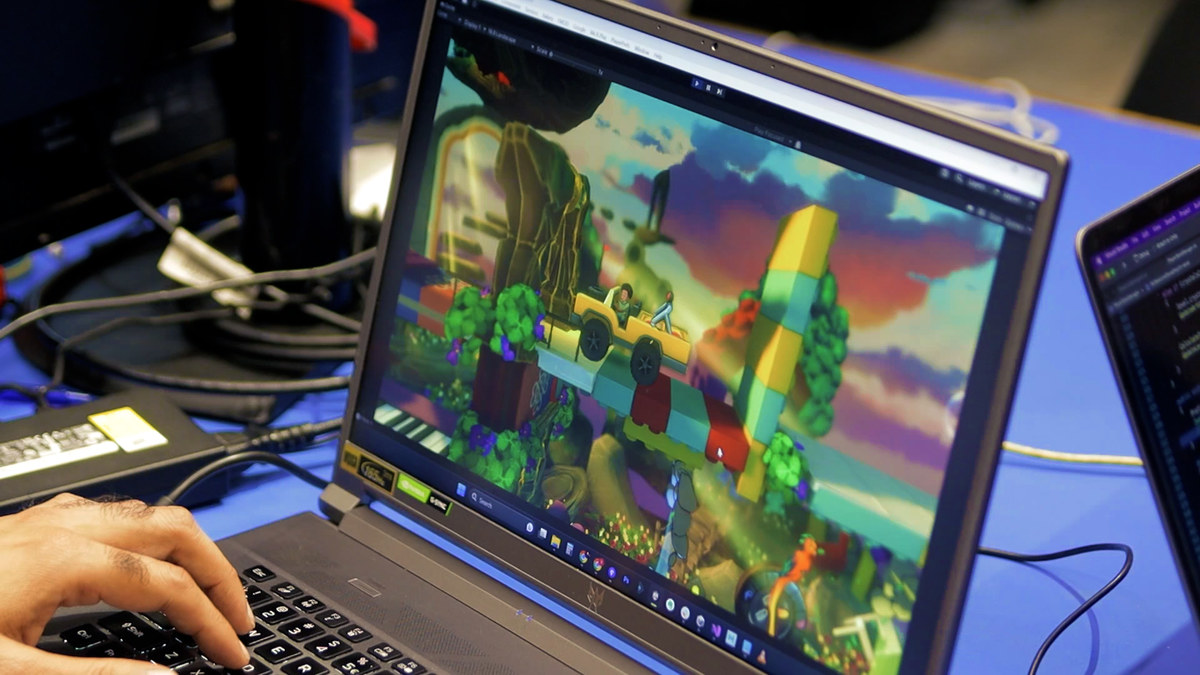
A video game developer at weRplay, a game development company based in Islamabad, Pakistan, develops animations for video games on September 14, 2023. (AN Photo)
Responding to a question about the company’s revenue stream and target audience, Asghar said about 90 percent of the income was made through downloads and ads, and much of it came from the United States.
Another game produced by the company, “Run Sheeda Run,” had one million downloads in Pakistan, though he said it was really difficult to make revenue here.
Explaining the reasons behind the low revenue of video games in Pakistan, co-founder of tecHouse Games in Lahore Sanwal Nawaz said the cost per ad impression rate in the country for 1,000 was just Rs30 to Rs40 ($0.1 to $0.13) while it was $15 to $20 in the US and European markets.
“We don’t have a good economy,” he told Arab News. “Therefore, those who play games in Pakistan don’t go for in-app purchases which keeps our revenue negligible.”
Nawaz pointed out the developers in Pakistan lacked capital to market and promote their games online to capture greater market in the western countries since they would have to pay a minimum $300 per day for the purpose after the game was launched.
“If you don’t invest in marketing, it means your game will not be doing good in terms of revenue,” he continued, adding the industry was getting tough for those with minimum capital since Google had recently changed its algorithm to promote only paid ads.
Additionally, Nawaz pointed out Pakistani universities were not offering animation and gaming degrees unlike the developed world, saying this made it difficult for developers to compete at the international level with just certificate courses in game development.
“There is no shortcut in this industry,” he said. “Your product will sell only if it meets the international standards.”

The screengrab taken on September 14, 2023, from a video game shows the start screen of the game 'Explottens'. (AN Photo)
Discussing the impediments to the industry’s growth, Khizar Javed, director of business operations at weRplay, said it was not easy to pay employs working for the company from other countries.
“We have to go through the hassle of withdrawing money before depositing it in [employee] accounts through other channels that are not so cheap,” he said, adding the authorities should bring payment gateways like PayPal and Stripe in Pakistan since they were “pretty convenient and cost effective for money transfers.”
Despite all the odds, he noted that weRplay had produced award-winning games.
Huda Mahmood Khan, who worked on “Lost Twins 2” and “Explottens” for the company, described Hayao Miyazaki, a Japanese animator and filmmaker, as her inspiration.
“If you see them, they have a very immersive but a bit unrealistic world which we have created,” she said.
Khan specifically mentioned “Explottens,” saying it was selected in the top 30 games from across the world and subsequently did very well.
She said it was an action arcade game that revolved around “cats that are flying on planes and have their own world.”
“We built that world and the whole game around [that concept],” she added.