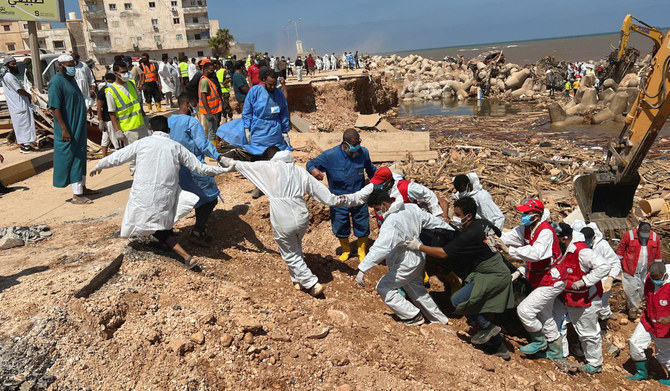

TRIPOLI: Libya’s deadly floods have sparked a surge of solidarity and transcended political differences in a country wracked by division ever since the 2011 revolution that overthrew Muammar Qaddafi.
“As soon as we heard about this awful tragedy, people began a spontaneous campaign in Tajoura to help, with no state backing at all,” said Mohannad Bennour in the eastern suburb of Tripoli, the capital.
He said that since Monday, donations of “nearly 70,000 dinars (13,500 euros) have been sent in, more than 20,000 dinars on Friday alone.”
“People are handing in food, cleaning and hygiene products, towels, medicine... everything necessary for babies and women, and also clothing,” the 30-year-old added.
After Storm Daniel hit the east of the country on Sunday, two dams upstream from Derna burst, sending a wall of water into the wadi or dry riverbed that divides the port city of 100,000 people.
The devastation was apocalyptic. Entire neighborhoods and those who lived there were swept into the Mediterranean.
Othman Abdeljalil, the health minister in the administration that runs eastern Libya, has put the provisional death toll at 3,166. But the final number is likely to be far higher.
Many survivors of the disaster now find themselves homeless, and those who can have left the area.
The International Organization of Migration puts the number of people in eastern Libya displaced by the floods at 38,000 — 30,000 in Derna alone.
“Getting lifesaving supplies to people and preventing a secondary health crisis is essential,” Martin Griffiths, UN Under-Secretary-General for Humanitarian Affairs and Emergency Relief Coordinator, posted on X, formerly Twitter.
But getting aid to those who need it most is made more complicated by the east-west political split in Libya.
The country today has two rival administrations, one in the capital Tripoli in the west, the UN-recognized government of Prime Minister Abdelhamid Dbeibah, and another in the east, affiliated with military strongman Khalifa Haftar.
Setting their differences aside, ordinary Libyans are mobilizing in the face of the tragedy. Across the country fundraising is under way, and volunteer aid workers have rushed to the disaster area.
Many of those volunteers are hoping that the sense of solidarity will last.
In the Hay Al-Andalous district of Tripoli, Bader Marii came to drop off packs of water on the esplanade of the Ben Fadel Mosque, where two large trucks were already almost full.
Aid for the stricken population of Derna must keep on coming, because the country’s split means “it will take double the time it would take in normal conditions” to rebuild in the disaster area, he said.
“Governments have a habit of letting time go by with no one calling them to account,” added the Tripoli native in his fifties.
“It’s like that in Libya. May God help us,” he said, raising his hands skywards.
In the city center, culture ministry employee Nouri el-Makhlou, 43, has been coordinating aid donations for a convoy due to leave for the east on Sunday morning.
The aid on board has been donated “by families from all over Libya who contacted us wanting to help.”
This spontaneous outpouring of solidarity comes against a backdrop of chaotic mobilization by the rival authorities in east and west which are already apportioning blame for the tragedy.
The prosecutor general visited Derna on Friday and pledged that those responsible for the disaster would be held to account.
Civil society groups that have struggled to keep going amid official harassment acted quickly and are already on the scene to help in the aftermath.
“The political elite on all sides has systematically and deliberately shut down civil society organizations and persecuted its members,” said Elham Saudi, director of the group Lawyers For Justice in Libya.
She said that to the politicians “civil society is a threat. It exposes their shortcomings and fills the deficit they create.”
Saudi believes civil society will ensure that those responsible for the tragedy in Derna are judged.
“It is important that this moment marks the end of the culture of impunity in Libya,” she said.