

Comedian Russell Brand denies allegations of sexual assault published by three UK news organizations

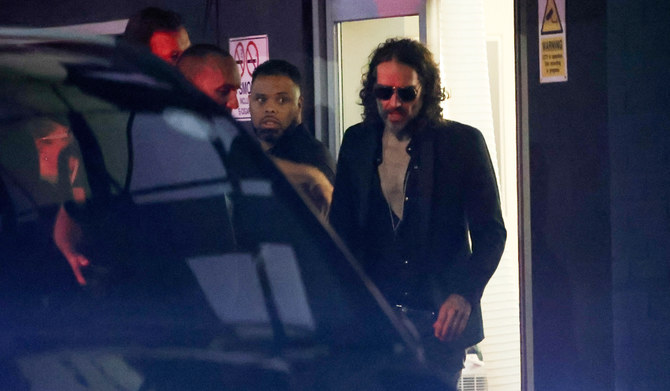
British comedian and actor Russell Brand walks outside the Wembley Park Theatre, in northwest London, Britain, September 16, 2023. (REUTERS)
Short Url
Updated 17 September 2023
Follow

Comedian Russell Brand denies allegations of sexual assault published by three UK news organizations

  • The women said that they only felt ready to tell their stories after being approached by reporters, with some citing Brand’s newfound prominence as an online wellness influencer as a factor in their decision to speak

LONDON: Three British news organizations reported Saturday that comedian and social influencer Russell Brand has been accused of rape, sexual assault and abuse based on allegations from four women who knew him over a seven-year period at the height of his fame.
Brand denied the allegations and said that all of his relationships have been consensual.
The Sunday Times, The Times of London and Channel 4’s “Dispatches” said that one woman alleged she had been raped, while three others accused him of sexual assault. One of the women also said he had been physically and emotionally abusive.
The women said that they only felt ready to tell their stories after being approached by reporters, with some citing Brand’s newfound prominence as an online wellness influencer as a factor in their decision to speak.
Before the stories were published, Brand posted a video online denying the allegations, which had been outlined in two “extremely disturbing letters” from a “mainstream media” television company and a newspaper. He didn’t identify the news organizations by name.
“Amidst this litany of astonishing, rather baroque attacks are some very serious allegations that I absolutely refute,” he said. “These allegations pertain to the time when I was working in the mainstream, when I was in the newspapers all the time, when I was in the movies and, as I have written about extensively in my books, I was very, very promiscuous.”
“Now during that time of promiscuity the relationships I had were absolutely, always consensual,” he added. “I was always transparent about that then, almost too transparent, and I am being transparent about it now as well.”
Brand also suggested that the reports were part of a coordinated attack designed to discredit him because of his views. Brand has been criticized for expressing skepticism about COVID-19 vaccines and interviewing contentious podcasters like Joe Rogan.
“To see that transparency metastasized into something criminal, that I absolutely deny, makes me question is there another agenda at play,” Brand said.
Brand rose to fame as a stand-up comic in Britain in the early 2000s, which led to starring roles on Channel 4 and later BBC Radio, where he capitalized on a reputation for outrageous behavior and risque banter.
He later made the jump to Hollywood, appearing in films such as “Forgetting Sarah Marshall” in 2008 and the remake of “Arthur” in 2011. Brand was married to US pop star Katy Perry from 2010-2012.
In recent years, he transformed himself into a political commentator and influencer posting YouTube videos on subjects such as personal freedom and the COVID-19 pandemic.


How Netflix won Hollywood’s biggest prize, Warner Bros Discovery

Updated 59 min 55 sec ago
Follow

How Netflix won Hollywood’s biggest prize, Warner Bros Discovery

  • Board rejected Paramount’s $30 a share bid amid funding concerns, sources say
  • Warner Bros board met daily before accepting Netflix’s binding offer

LOS ANGELES/NEW YORK: What started as a fact-finding mission for Netflix culminated in one of the biggest media deals in the last decade and one that stands to reshape the global entertainment business landscape, people with direct knowledge of the deal told Reuters. Netflix announced on Friday it had reached a deal to buy Warner Bros Discovery’s TV, film studios and streaming division for $72 billion. Although Netflix had publicly downplayed speculation about buying a major Hollywood studio as recently as October, the streaming pioneer threw its hat in the ring when Warner Bros Discovery kicked off an auction on October 21, after rejecting a trio of unsolicited offers from Paramount Skydance .
Details of Netflix’s plan and the Warner Bros board’s deliberations, based on interviews with seven advisers and executives, are reported here for the first time.
Initially motivated by curiosity about its business, Netflix executives quickly recognized the opportunity presented by Warner Bros, beyond the ability to offer the century-old studio’s deep catalog of movies and television shows to Netflix subscribers. Library titles are valuable to streaming services as these movies and shows can account for 80 percent of viewing, according to one person familiar with the business.
Warner Bros’ business units — particularly its theatrical distribution and promotion unit and its studio — were complementary to Netflix. The HBO Max streaming service also would benefit from insights learned years ago by streaming leader Netflix that would accelerate HBO’s growth, according to one person familiar with the situation. Netflix began flirting with the idea of acquiring the studio and streaming assets, another source familiar with the process told Reuters, after WBD announced plans in June to split into two publicly traded companies, separating its fading but cash-generating cable television networks from the legendary Warner Bros studios, HBO and the HBO Max streaming service.
Netflix and Warner Bros did not reply to requests for comment.
The work intensified this autumn, as Netflix began vying for the assets against Paramount and NBCUniversal’s parent company, Comcast.
Warner Bros kicked off the public auction in October, after Paramount submitted the first of three escalating offers for the media company in September. Sources familiar with the offer said Paramount aimed to pre-empt the planned separation because the split would undercut its ability to combine the traditional television networks businesses and increase the risk of being outbid for the studio by the likes of Netflix.
Around that time, banker JPMorgan Chase & Co. was advising Warner Bros Discovery CEO David Zaslav to consider reversing the order of the planned spin, shedding the Discovery Global unit comprising the company’s cable television assets first. This would give the company more flexibility, including the option to sell the studio, streaming and content assets, which advisers believed would draw strong interest, according to sources familiar with the matter.
Executives for the streaming service and its advisory team, which included the investment banks Moelis & Company, Wells Fargo and the law firm Skadden, Arps, Slate, Meagher & Flom, had been holding daily morning calls for the past two months, sources said. The group worked throughout Thanksgiving week — including multiple calls on Thanksgiving Day — to prepare a bid by the December 1 deadline.
Warner Bros’ board similarly convened every day for the last eight days leading up to the decision on Thursday, when Netflix presented the final offer that sources described as the only offer they considered binding and complete, sources familiar with the deliberations said.
The board favored Netflix’s deal, which would yield more immediate benefits over one by Comcast. The NBCUniversal parent proposed merging its entertainment division with Warner Bros Discovery, creating a much larger unit that would rival Walt Disney. But it would have taken years to execute, the sources said.
Comcast declined to comment.
Although Paramount raised its offer to $30 per share on Thursday for the entire company, for an equity value of $78 billion, according to sources familiar with the deal, the Warner Bros board had concerns about the financing, other sources said.
Paramount declined comment.
To reassure the seller over what is expected to be a significant regulatory review, Netflix put forward one of the largest breakup fees in M&A history of $5.8 billion, a sign of its belief it would win regulatory approval, the sources said. “No one lights $6 billion on fire without that conviction,” one of the sources said.
Until the moment late on Thursday night when Netflix learned its offer had been accepted — news that was greeted by clapping and cheering on a group call — one Netflix executive confided that they thought they had only a 50-50 chance.