

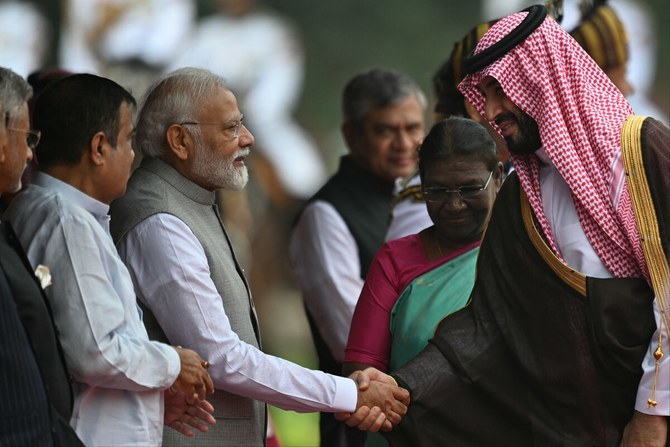

NEW DELHI: The newly announced Saudi-backed India-Middle East-Europe Economic Corridor is likely to be a “game changer” for New Delhi, providing unprecedented access to global markets, experts say.
A deal establishing the IMEC was signed by Saudi Arabia, the US, the EU, India, the UAE, France, Germany, and Italy last week, and announced by Crown Prince Mohammed bin Salman on the sidelines of the G20 Summit in New Delhi.
The new 4,800-km trade route is intended to stimulate economic development and integration. It comprises two separate routes — an east corridor linking India to the Arabian Gulf and a northern corridor connecting Gulf states to Europe.
The rail and sea route will enable not only the transit of goods and services, but also electric and digital connectivity, as well as pipes for the export of clean hydrogen.
HIGHLIGHT
The rail and sea route will enable not only the transit of goods and services, but also electric and digital connectivity, as well as pipes for the export of clean hydrogen.
“It’s an actual game changer. It’s a historic agreement,” Manish Mohan, senior director for international affairs at the Confederation of Indian Industry, told Arab News. “The corridor provides alternative trade routes to the thriving markets of the Middle East and Europe but also extends India’s reach to North Africa and North America.”
The ship-to-rail transit system is expected to slash shipping costs and expedite transit times.
“This will help in the cross-border movement of goods and services. It’s quite ambitious and this will be a huge project,” Mohan said. “It is completely integrating the region, so, basically, we are talking about a global value chain. It’s going to benefit not just one country but the whole region.”
According to Subhrakant Panda, president of the Federation of Indian Chambers of Commerce and Industry, the IMEC “promises to revolutionize” trade and pave the way for clean energy and digital innovation.
“(It) will be instrumental in stimulating economic growth, creating jobs, and reducing greenhouse-gas emissions,” he said. “This is more than infrastructure. It’s a blueprint for a more connected, sustainable, and economically vibrant future. It will also be a great opportunity for Indian and Saudi businesses to collaborate and benefit.”
Saudi-Indian relations are already strong and have gained momentum during India’s presidency of G20 this year. The new trade route is expected to further boost them, along with India’s ties to its other Gulf ally and top trade partner, the UAE.
“For India and the Middle East, the IMEC signifies a deepening relationship, with the convergence of the Middle East and South Asia into West Asia. India’s trade ties with Saudi Arabia and the UAE are already substantial, and this corridor could further strengthen their economic integration. It may also offer new opportunities for India in terms of trade, energy, and infrastructure development,” said Mohammed Soliman, strategic technologies director at the Middle East Institute in Washington, D.C.
“For Saudi Arabia and the UAE, it represents a diversification of partnerships beyond their roles as energy producers. Overall, the IMEC underscores the growing economic and strategic convergence between India and the Middle East,” he continued.
Given that the IMEC’s eight signatories account for about half of the world’s economy, the transcontinental project is also poised to have geopolitical implications.
“Economically, it seeks to enhance trade and infrastructure connectivity across the Eurasian rimland,” Soliman told Arab News. “Geopolitically, it aims to reshape the balance of power in Eurasia.”
Due to its infrastructure and connectivity focus, some commentators have been comparing the IMEC with China’s multi-trillion-dollar Belt and Road Initiative — a global infrastructure development project adopted by Beijing in 2013 to recreate the ancient Silk Road and connect it to Southeast Asia, South Asia, Central Asia, Russia and Europe. But for Soliman, the IMEC is not a direct challenge to the Chinese plan.
“The key difference lies in the autonomy it offers participating countries and the absence of a strict binary choice between China and the United States,” he said. “Saudi Arabia and the UAE, integral to the IMEC, maintain strong ties with China. Alongside India, the three nations are also members of BRICS Plus. Therefore, the IMEC should be seen as a distinct initiative — one that aims to provide an alternative model for connectivity, with a focus on autonomy and diversified partnerships.”


