

Currency dealers, financial experts attribute Pakistani currency’s stability to army-backed measures

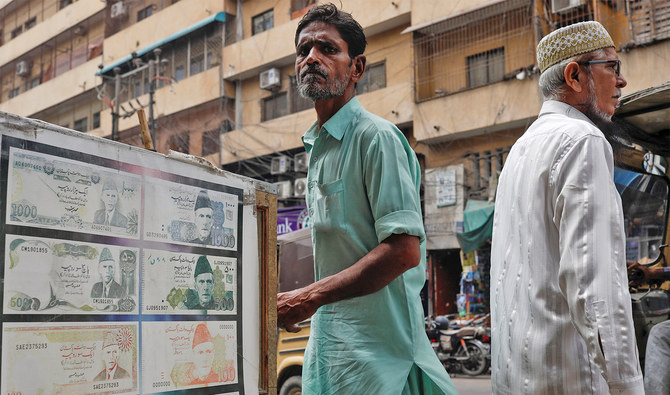
People walk past a sidewalk money exchange showcase, which is decorated with pictures of currency notes, in Karachi, Pakistan on September 12, 2023. (REUTERS)
Short Url
Updated 16 September 2023
Follow

Currency dealers, financial experts attribute Pakistani currency’s stability to army-backed measures

  • Pakistani rupee has appreciated by over 3% in interbank and 10% in open market since a crackdown against hoarders, smugglers
  • Financial experts call for other measures, such as increased exports, to ensure long-term results in the currency market

KARACHI: Pakistan’s national currency has seen a significant resurgence recently, with the rupee gaining over three percent value in interbank and about 10 percent in the open market against the US dollar, following the army chief’s meeting with top business leaders on September 4.

General Asim Munir assured the business community the state would deal with foreign currency hoarders and smugglers with an iron fist, promising “transparency in dollar exchange and interbank rates.”

His assertions were followed by a widespread crackdown in the country, resulting in the rupee gaining Rs10.25 in value in the interbank market, where it closed at Rs296.85 on Friday, and surging by Rs32 in the open market to hit Rs297, according to central bank data.

“We had requested the country’s top army brass to take action against hoarders and individuals involved in illegal currency trade,” said Malik Bostan, chairman of the Exchange Companies Association of Pakistan (ECAP), speaking to Arab News.

He mentioned that black market traders had become so audacious they were enticing potential customers to official exchange companies by offering rates higher than those prevailing in the market.

“We lost over 90 percent of our customers,” he said, adding that supplies had been restored after law enforcement agencies took action and made arrests.

“Our trade has increased from $5 million to $15 million per day,” he continued. “And this has happened due to the army’s efforts against criminals.”

The ECAP chief called for the continuation of action against those involved in the illegal currency trade.

Pakistani financial experts also acknowledged the positive outcome of the crackdown, saying it had helped stabilize the currency market.

“The approach of wielding the stick has produced some positive results,” said Ikram-ul-Haq, a Lahore-based economist.

However, he added that it remained to be seen if it would lead to long-term stabilization of the Pakistani rupee.

“The administrative measures have closed loopholes related to illicit outflows, hoarding, speculative transactions, and smuggling, which were caused by weak monitoring along with regulatory and border controls,” he said.

The Pakistani authorities have resorted to multiple crackdowns in the past to artificially stabilize the currency market, although they led to a massive devaluation of the rupee.

Former finance minister Ishaq Dar attempted a similar approach in the recent past, hoping to bring back the US dollar at Rs200. However, it did not happen and led to a significant depreciation in January 2023.

“The same fate may befall the recent crackdown if it is not accompanied by concerted and consistent efforts to control money supply, which is the root cause of the existing crisis,” Haq added.

He pointed out if the country failed to improve the ratio of Net Foreign Assets (NFA) to Net Domestic Assets (NDA), the rupee might undergo yet another phase of devaluation, rendering the current crackdowns meaningless.

Ali Nawaz, another financial expert and the chief executive officer of Chase Securities, a brokerage firm, called for measures to control currency devaluation by increasing exports, remittances, and attracting investments.

“We also need to crack down on smugglers to keep food prices in check and generate economic activity to create more jobs for people,” he added. “By doing all of this, we can control inflation, and the masses can benefit from it.”


Traders say Karachi plaza fire caused $54 million losses as death toll climbs to 71

Updated 5 sec ago
Follow

Traders say Karachi plaza fire caused $54 million losses as death toll climbs to 71

  • Rescuers work through unstable debris as identification continues, compensation announced
  • Rising death toll underscores scale of the disaster and the challenges now facing forensic teams

ISLAMABAD: A deadly fire at a major shopping plaza in Pakistan’s largest city of Karachi has killed at least 71 people and caused estimated losses of up to Rs15 billion ($53.6 million), traders and officials said on Friday, as recovery teams continue searching unstable debris and families await identification of victims.

The fire broke out on Jan. 17 at Gul Plaza, a densely packed commercial complex in the heart of Karachi that housed more than 1,200 shops. The blaze burned for over 24 hours before being brought under control, trapping workers and shoppers inside and leaving large sections of the building structurally unsafe.

Deadly fires are a recurring problem in Karachi, a city of more than 20 million people, where overcrowded markets, aging infrastructure, illegal construction and weak enforcement of safety regulations frequently contribute to disasters. Officials say a blaze of this scale is rare.

“We have processed 71 sets of remains, of which 20 have been identified,” chief police surgeon Dr. Summaiya Syed said on Friday, underscoring the scale of the disaster and the challenges facing forensic teams.

Identification has been significantly slowed by the condition of the remains recovered from the site, Syed said, noting that many bodies were found in fragments, complicating DNA analysis and prolonging the process for families waiting for confirmation.

Tanveer Pasta, president of the Gul Plaza Market Association, said all shops in the plaza were destroyed, estimating total losses at up to Rs15 billion ($53.6 million).

“There were big importers sitting here,” he told Arab News on Thursday. “Just three days before this fire, 31 [shipping] containers were unloaded.”

Relatives of dozens of missing persons have remained near the destroyed plaza and at hospitals even after submitting DNA samples, with some families expressing frustration over the pace of recovery and identification.

Karachi Mayor Murtaza Wahab said the city administration remained focused on rescue operations and on returning victims’ remains to their families as quickly as possible. His remarks came after he visited the homes of several victims, according to a statement from his office.

“Rescue personnel of the Karachi Metropolitan Corporation are still engaged in the rescue operation, while the administration is making every effort to hand over [remains] of the victims, loved ones to their families at the earliest,” Wahab was quoted as saying.

Earlier this week, the Sindh provincial government announced compensation of Rs10 million ($35,720) for the family of each person killed in the blaze and said affected shopkeepers would also receive financial assistance.

Authorities have not yet confirmed the cause of the fire. Police have said preliminary indications point to a possible electrical short circuit, though officials stress conclusions will only be drawn after investigations are completed.