

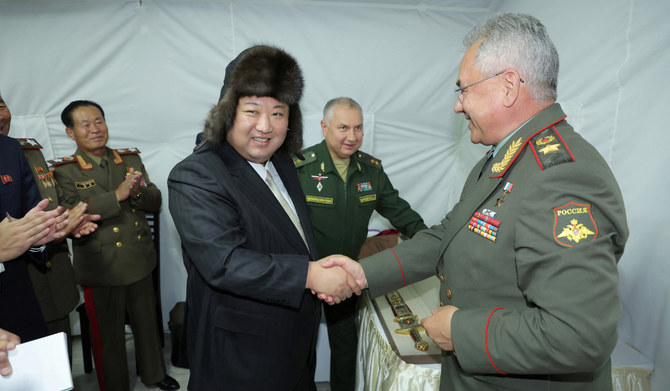
North Korean state media says Kim Jong Un discussed arms cooperation with Russian defense minister

1 / 3
North Korean leader Kim Jong Un shakes hands with Russia's Defence Minister Sergei Shoigu, as he visits Vladivostok, Russia, September 16, 2023 released by the Korean Central News Agency on September 17, 2023. (REUTERS)
2 / 3
North Korean leader Kim Jong Un, center right, listens to Russian Defense Minister Sergei Shoigu, left, as he inspects Russian warplanes at the Vladivostok International airport in Vladivostok on Sept. 16, 2023. (Russian Defense Ministry Press Service via AP)
3 / 3
North Korean leader Kim Jong Un inspected a sanctioned fighter jet plant in Russia on Friday as part of a rare visit that the United States and its allies fear could strengthen Russia's military in Ukraine and bolster Pyongyang's missile program. (REUTERS)
Short Url
Updated 17 September 2023
Follow

North Korean state media says Kim Jong Un discussed arms cooperation with Russian defense minister

  • North Korean leader Kim Jong Un’s rare trip out of his isolated country has fanned fears among Western countries

SEOUL, South Korea: North Korean leader Kim Jong Un held discussions with Russia’s defense minister on strengthening “strategic and tactical coordination” between the countries’ militaries, the North’s state media said Sunday, as Kim continued a visit to Russia’s Far East that has raised concerns about an arms alliance that would fuel Moscow’s war on Ukraine.
The talks with Defense Minister Sergei Shoigu came after Kim on Friday was shown some of Russia’s most advanced weapons systems deployed for its war on Ukraine, including nuclear-capable bombers and hypersonic missiles, and a key warship of its Pacific fleet, the Korean Central News Agency said.
Kim’s trip, highlighted by a summit with Russian President Vladimir Putin on Wednesday, has underscored how their interests are aligning in the face of separate, intensifying confrontations with the West. US and South Korean officials have said North Korea could provide badly needed munitions for Putin’s war on Ukraine in exchange for sophisticated Russian weapons technology that would advance Kim’s nuclear ambitions.
While his predominant focus is on military cooperation, Kim also appears to be using his trip to encourage broader exchanges between the countries as he tries to break out of diplomatic isolation.
The governor of Russia’s Primorye region, which includes Vladivostok, said he plans to meet with Kim on Sunday. Gov. Oleg Kozhemyako said on his messaging app channel they would discuss exchange programs for schoolchildren to attend summer camps in one another’s country and other ways to cooperate in sports, tourism and culture. Russian media said Kim may also visit food industry businesses in Primorye.
A day after visiting an aircraft plant in Komsomolsk-on-Amur that produces Russia’s most powerful fighter jets, Kim on Saturday traveled to an airport near the port city of Vladivostok, where Shoigu and other senior military officials gave him an up-close look at Russia’s strategic bombers and other warplanes.
All the Russian warplanes shown to Kim were among the types that have seen active use in the war in Ukraine, including the Tu-160, Tu-95 and Tu-22 bombers that have regularly launched cruise missiles.
During Kim’s visit, Shoigu and Lt. Gen. Sergei Kobylash, the commander of the Russian long-range bomber force, confirmed for the first time that the Tu-160 had recently received new cruise missiles with a range of more than 6,500 kilometers (over 4,040 miles).
Shoigu, who had met Kim during a rare visit to North Korea in July, also showed Kim another of Russia’s latest missiles, the hypersonic Kinzhal, carried by the MiG-31 fighter jet, that saw its first combat during the war in Ukraine.
Kim and Shoigu later traveled to Vladivostok, where they inspected the Admiral Shaposhnikov frigate. Russia’s navy commander, Adm. Nikolai Yevmenov, briefed Kim on the ship’s capabilities and weapons, which include long-range Kalibr cruise missiles that Russian warships have regularly fired at targets in Ukraine.
KCNA, which has reported Kim’s activities in Russia a day late while crafting the details to meet government propaganda purposes, said Kim was accompanied on Saturday’s visits by his top military officials, including his defense minister and the top commanders of his air force and navy.
Following a luncheon, Kim and Shoigu talked about the regional security environment and exchanged views on “practical issues arising in further strengthening the strategic and tactical coordination, cooperation and mutual exchange between the armed forces of the two countries,” KCNA said.
In their July meeting, Kim gave Shoigu a similar inspection of North Korean weapons systems before inviting him to a massive parade in the capital, Pyongyang, where he rolled out his most powerful intercontinental ballistic missiles designed to target the United States.
Kim’s visits to military and technology sites this week possibly hint at what he wants from Russia, perhaps in exchange for supplying munitions to refill Putin’s declining reserves as his invasion of Ukraine becomes a drawn-out war of attrition.
Kim’s meeting with Putin was held at Russia’s main spaceport, a location that pointed to his desire for Russian assistance in his efforts to acquire space-based reconnaissance assets and missile technologies.
Experts have said potential military cooperation between the countries could include efforts to modernize North Korea’s outdated air force, which relies on warplanes sent from the Soviet Union in the 1980s.
Kim in recent months has also refocused on strengthening the country’s navy, which analysts say could be driven by ambitions to obtain Russia’s sophisticated technologies for ballistic missile submarines and nuclear-propelled submarines as well as to initiate joint naval exercises between Russia and North Korea.
Later Saturday, Kim visited a local theater to watch Pyotr Tchaikovsky’s Sleeping Beauty ballet performance. KCNA said Kim received a rousing ovation by people at the theater and expressed “deep thanks to the performers and the theater for their impressive and elegant ballet of high artistic value.”
Russia’s RIA Novosti state news agency said Kim left after the first act.


Epstein files reveal links to cash, women, power in Africa

Updated 26 February 2026
Follow

Epstein files reveal links to cash, women, power in Africa

  • Documents attest to Epstein’sclose ties with Karim Wade, son of former Senegalese president Abdoulaye Wade
  • They also reveal his ties to Nina Keita, niece of Ivorian president Alassane Ouattara

PARIS: Jeffrey Epstein built close ties with powerful figures in Senegal and Ivory Coast, files released by the US government last month show, detailing the late sex offender’s influence network across Africa.
Emails, scheduled meetings, investment projects, and loans reviewed by AFP attest to the disgraced New York financier’s close relationship with Karim Wade, son of former Senegalese president Abdoulaye Wade.
They also reveal his ties to Nina Keita, niece of Ivorian president Alassane Ouattara.
Wade and Epstein met in 2010 through Emirati businessman Sultan Ahmed bin Sulayem, who recently resigned as CEO of port giant DP World after mounting pressure over his close friendship with Epstein.
The pair quickly struck up a rapport.
“Thanks for coming. I think there are many things to consider... I feel confident that we will have fun,” Epstein wrote to Wade on November 15, 2010 after their first meeting in Paris.
“Have a safe trip back to your paradise Island,” Wade replied.
While Wade’s exchanges show no link to Epstein-related sex trafficking crimes, they do reveal conversations on potential business ventures in various sectors, such as finance and energy.
Nicknamed the “Minister of Heaven and Earth” for the multiple portfolios he held including international cooperation, energy, and air transport, Wade was a powerful figure in Senegal until April 2012, when his father’s bid for a third term sparked deadly riots.
Epstein saw him as “one of the most important players in africa” and invited him to meet close contacts such as Ehud Barak, then Israel’s defense minister.
He also put him in touch with Chinese businessman Desmond Shum to discuss “offshore banking.”
The US Department of Justice documents show Shum and Wade met in Beijing on May 9, 2011.
That same month, Wade planned an African tour through Senegal, Mali, and Gabon for Epstein.

‘You will not suffer’ 

Epstein and Wade’s relationship became even more apparent after the latter’s fortunes reversed when his father left office in 2012.
That autumn, Epstein proposed that his “friend” — under the Dakar authorities’ scrutiny over his assets — use his house in Florida.
“You and your family are welcome to use my house in palm beach, staff is there, pool etc. you will not suffer,” Epstein wrote.
“Txs a lot Brother for the advise,” Wade replied a few weeks later to another email, in which Epstein urged him to “stay mentally strong.”
Numerous files suggest Epstein became financially involved on Karim Wade’s behalf after his arrest in 2013 and his 2015 sentencing to six years in prison for corruption.
Karim Wade’s lawyer, Mohamed Seydou Diagne, sent two invoices in May 2014 and July 2015 of $500,000 to one of Epstein’s companies.
Contacted by AFP on Monday, Diagne said he “did not consider it useful to comment.”
Other archives suggest that Epstein covered at least $50,000 in fees for the US lobbying firm Nelson Mullins, hired by Wade’s entourage to secure his release.
Epstein regularly exchanged emails with Robert Crowe, a partner at the firm who kept him informed of their efforts in the US and Senegal.
In a June 16, 2016 email thread where Epstein and Crowe discussed whether then Senegalese president Macky Sall would pardon Wade, Crowe writes: “He has told my friends high up at State that he was going to do it. They have been putting pressure on him!“
Karim Wade was released from prison eight days later, on June 24, and went into exile in Qatar, which he credited for efforts toward his release.
Jeffrey Epstein was told by Sultan Ahmed bin Sulayem and Nina Keita.

‘A very interesting person!’

The DOJ documents show Nina Keita was close to both Epstein and Karim Wade and that she acted as a regular intermediary while Wade was in prison.
Keita also helped put Epstein in contact with her uncle, president of Ivory Coast since May 2011, and his team.
“He thought you were a very interesting person! ... they were all very happy to have you here,” she wrote on January 20, 2012, after the financier’s visit to Abidjan.
She had booked him the “ministerial suite” of the luxury Hotel Ivoire for that trip.
Ahead of the visit, Epstein had said he hoped to see “very pretty girls there, as well as interesting places.”
“You will!” Keita replied.
Emails show Keita, a former model, at least once sent photos and the phone number of a young woman to Epstein.
He then met this woman at the Ritz hotel in Paris on August 31, 2011.
“ask sadia to send pictures of her sister. i prefer under 25,” Epstein wrote to Keita after the meeting.
Now the deputy general director of Ivorian petroleum stocks company GESTOCI, Keita also appears in a February 2019 will in which Epstein requested that debts owed to him by a number of people be canceled upon his death.
AFP received no response to its requests for comment from both Keita and the Ivorian presidency, or from Karim Wade, who was contacted through his entourage.
The mere mention of a person’s name in the Epstein files does not in itself imply wrongdoing.