

Bangladesh stun India for consolation Asia Cup win

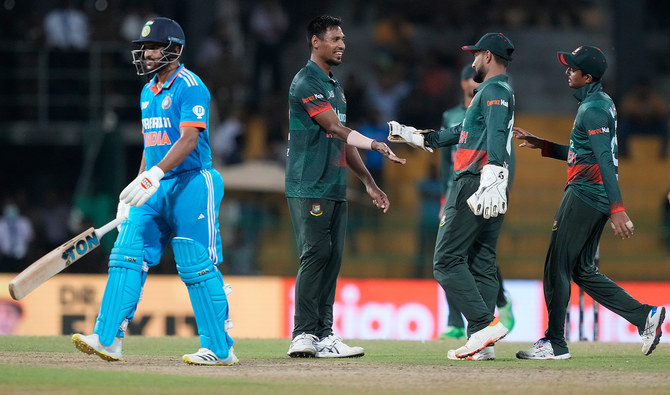
Bangladesh's Mustafizur Rahman celebrates the wicket of India's Shardul Thakur with teammates during the Asia Cup cricket match between Bangladesh and India in Colombo, Sri Lanka, on September 15, 2023. (Photo courtesy: AP)
Short Url
Updated 15 September 2023
Follow

Bangladesh stun India for consolation Asia Cup win

  • India have already booked a meeting with Sri Lanka in Sunday’s final in Colombo
  • India faltered in their chase of 266 despite a valiant 121 by opener Shubman Gill

COLOMBO: Skipper Shakib Al Hasan’s 80 and inspired bowling led Bangladesh to a consolation six-run win over India in the final Super Four clash of the Asia Cup on Friday.

India, who had already booked a meeting with Sri Lanka in Sunday’s final in Colombo, faltered in their chase of 266 despite a valiant 121 by opener Shubman Gill.

Mustafizur Rahman took three wickets while debutant Tanzim Hasan Sakib and Mahedi Hasan claimed two each as Bangladesh bowled out India for 259 to end their tournament on a high ahead of the upcoming ODI World Cup.

India rested their key players including Virat Kohli and pace spearhead Jasprit Bumrah in the inconsequential clash.

Skipper Rohit Sharma elected to bowl first to test their batting under lights, which has been difficult in the Sri Lanka leg of the tournament hosted by Pakistan.

Bangladesh slipped to 59-4 before a 101-run stand between Shakib and Towhid Hridoy, who made 54, rebuild the innings and with lower-order contribution posted 265-8 in 50 overs.

Hridoy and Shakib hit back with regular boundaries before pace bowler Shardul Thakur returned for a second spell and got Shakib bowled.

Ravindra Jadeja soon got his 200th ODI wicket, but Hridoy kept up the charge and reached his fifty with a boundary before falling to Shami.

Nasum Ahmed, a left-arm spinner who is known to slog with the bat, also contributed with 44 while Mahedi added 29.

Thakur took three wickets while Shami returned figures of 2-32.

In reply, India lost Rohit in the first over as he got caught out off Taskina, a 20-year-old fast bowler, who struck again to put India in trouble at 17-2.

Gill stood firm and put on key partnerships with KL Rahul (19) and then Suryakumar Yadav (26) but Bangladesh bowlers kept chipping away with wickets.

Gill, who hit eight fours and five sixes in his 133-ball knock, reached his hundred off Tanzim and bowed to the dressing room.

He kept up the charge as he hit Mahedi for a huge six over mid-wicket but the bowler had his revenge on the next ball to get the batsman caught out.

Axar Patel attempted to pull off the chase in his 34-ball 42 but fell to Mustafizur and the innings soon ended in 49.5 overs.

Bangladesh ended the tournament with two wins including one in the group stage against Afghanistan.

Babar Azam’s Pakistan crashed out of the tournament after losing a knockout Super Four contest to Sri Lanka at the same venue.


From concrete walls to open skies: Meet Chile’s first rugby team created inside a prison

Updated 1 sec ago
Follow

From concrete walls to open skies: Meet Chile’s first rugby team created inside a prison

VALPARAISO: At first, the tackles, rucks and mauls were merely survival tactics within the harsh world of prison. But what began as a workshop behind barbed wire has transcended the walls of the Valparaíso Penitentiary Complex to become Chile’s first official rugby team formed behind bars.
The routine is intense. Three days of field training, two days in the gym, and matches every weekend. It mirrors the schedule of a professional league, but this is Rugby Unión Libertad — a sports club officially registered in mid-January with a mission that goes far beyond the pitch: preparing inmates for social reintegration after they serve their sentences.
“Rugby freed me; it healed my soul,” Alex Javier Silva, 48, who has been incarcerated since 1999, told The Associated Press. “Here you have no heart, no mind — you’re not at peace with anything. You’re like an animal.”
Rugby Unión Libertad began to take shape in 2016 as part of a workshop inside the prison walls. Led by the Addiction Treatment Center, the classes initially sparked the interest of around 50 inmates, who began to play with the “pill” — rugby’s oval ball — as a way to ease the weight of their time inside.
Over the years, the workshop evolved into Rugby Unión Libertad, a club that gained enough momentum to face the Chilean national team, Los Cóndores, in 2024.
Off the field, the team became the cornerstone of the Fundación Libertad, or Freedom Foundation. The nonprofit was established in November by a collective of former inmates, educators, psychologists and coaches, and it supports released prisoners through a mix of rugby, training, counseling and therapy.
Rugby as anger management
Three times a week, two coaches enter Valparaíso prison — about 120 kilometers (75 miles) from the capital Santiago — to lead training sessions for Unión Libertad. For two hours, the team’s 27 players practice the strategies, passes and kicks that characterize the sport.
This is precious time spent tasting freedom despite the barbed wire and watchful guards. It is here, on a tiny dirt field surrounded by guard towers, that the players release their anger and frustration that come with life behind bars.
“Violence is rampant here,” said Jorge Henríquez, 42. “There’s a lot of rage; sometimes you explode for no reason, and so (with rugby) you regulate that, you start to distance yourself from conflicts so that rage doesn’t resurface.”
Like many other correctional facilities in Chile, the one in Valparaíso is overcrowded. With 3,351 inmates crammed into a space built for 1,919, it operates at nearly double its capacity, leading to precarious hygiene and health conditions and ultimately fueling a surge in internal violence.
Coach Leopoldo Cerda, a teacher and volunteer who has spearheaded the project since its beginning, explained that playing rugby — a demanding sport by nature — is especially difficult in prison.
“People sleep poorly, eat poorly, and yet they have the physical and mental strength to overcome many obstacles that this sport presents,” he noted, adding that the changes in the players’ attitudes have been remarkable.
“The first thing is discipline, mastering self-control and anger management, since there’s a lot of physical contact in rugby,” said Cerda. “And they’ve managed to overcome that.”
The team has also become a role model for other inmates who hope to join Unión Libertad. “New guys keep arriving. They see from the cellblocks how they train and start preparing, even improving their behavior so they can train,” said Gonzalo Delgado, another coach.
In order to be part of the project, inmates need to have good behavior and cultivate teamwork.
“Many crimes are committed because people don’t know how to use their free time properly,” said the head of the Valparaíso Penitentiary Complex, Isaac Falcón Espinace. Thus, rugby gives inmates the opportunity to “not use it for actions that go against society once they’re free.”
Touching the sky
Guillermo Velásquez, 42, was one of the nearly 50 inmates who participated in the first rugby workshop a decade ago, quickly becoming a fan of this unfamiliar sport.
After a short period of freedom, poor choices landed him back in prison in 2019. To cope with drugs and constant fights, Velásquez began developing the idea of ​​founding a rugby team inside the prison.
The dream finally came true in 2022, when he and half a dozen fellow inmates obtained permission to use the prison’s gym after several unsuccessful attempts.
Rugby Unión Libertad was born.
The first practices were very basic, but the group gradually won the support of other inmates and the trust of the prison guards. Sessions moved outdoors, the players gained their own rugby field and volunteers embraced the project.
“Rugby saved my life,” said Velásquez, who left prison seven months ago. “If the Libertad team hadn’t existed inside the prison, society would have had one more criminal.”
The same year it was founded, Unión Libertad entered its first tournament, but in 2024, they truly touched the sky: The players left Valparaíso prison for the first time to face Los Cóndores, the very same Chilean national team that will compete in the 2027 Rugby World Cup in Australia.
“It was an epic battle,” recalled Silva. “Nobody has ever done that in Chile. And there we were, some mere prisoners, playing against them. Everyone was watching, we were on TV.”
The match — held at another prison in the north of Santiago — was a turning point. The project gained scope, visibility and more supporters.
Hope beyond the walls
Since its inception, Freedom Foundation has used rugby as the catalyst for social reintegration, providing support including therapy, professional training and partnering with potential employers to help with the process.
“They want to change,” said psychologist and former national rugby player Cynthia Canales, president of the foundation. “We also want to show that there is a lack of opportunities, that we have to address the stigma.”
Reintegration can be complex though, as it depends not only on personal will but on the availability of opportunities outside prison. Very often, the stigma of a criminal record undermines efforts to change.
“Often, many of these men have the desire to change, but all they find are closed doors,” said coach Cerda. “Society remains deeply prejudiced.”
Thanks to the work of the Freedom Foundation, former inmates can keep their intense training routine once out of prison. Now, instead of a tiny, dirt field under constant surveillance, the men train on the vast grass fields of Valparaíso. They no longer play behind bars but for “All Free” — the former inmates’ branch of Unión Libertad.