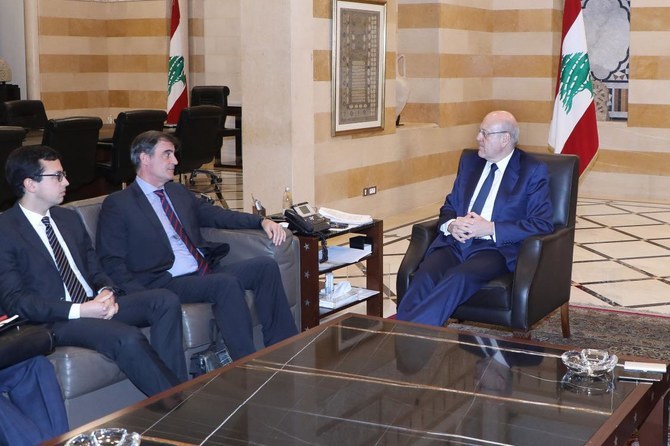
BEIRUT: The International Monetary Fund renewed its criticism of Lebanon Friday for failing to enact reforms demanded by creditors in return for releasing billions of dollars in emergency bailout loans.
“Lebanon has not undertaken the urgently needed reforms, and this will weigh on the economy for years to come,” said the IMF’s Ernesto Ramirez Rigo in a statement at the end of a visit to Beirut.
since late 2019, Lebanon has been mired in an economic crisis the World Bank has described as one of the worst in recent world history, pushing most of the population into poverty.
In April 2022, Lebanon and the IMF reached conditional agreement on a $3-billion-dollar loan pacakage to bail out the economy.
But politicians have yet to enact the painful reforms demanded to begin the 46-month financing program.
A seasonal uptick in tourism has increased foreign currency inflows, Ramirez Rigo said. Most tourists are Lebanese expatriates returning home for the summer holidays.
“It gives the impression that the economy has bottomed out of the crisis and is leading to complacency. However, receipts from tourism and remittances fall far short of what is needed,” he said.
The IMF deal is conditional on a series of measures, including passing a 2024 budget, unifying Lebanon’s multiple exchange rates, restructuring the banking sector and implementing formal capital controls.
Lebanon has taken some steps, including a belated 2023 budget, but the IMF has said repeatedly that they are not enough.
On July 31, Lebanon’s former central bank chief Riad Salameh, who is wanted for alleged financial crimes in several European countries, left office with no designated successor in place.
First vice-governor Wassim Manssouri has taken over on a temporary basis, but divided politicians have failed to agree on a permanent replacement, creating another power vacuum in a country that also has no president and is ruled by a caretaker government.
In late June, the IMF warned that Lebanon’s failure to implement reforms could have “irreversible” consequences for its economic and social stability.

IMF criticizes Lebanon for failure to adopt reforms
Short Url
https://arab.news/zec2c
IMF criticizes Lebanon for failure to adopt reforms
- “Lebanon has not undertaken the urgently needed reforms, and this will weigh on the economy for years to come,” said the IMF’s Ernesto Ramirez Rigo
- A seasonal uptick in tourism has increased foreign currency inflows, Ramirez Rigo said
Lebanese man flees hometown, months after repairing home damaged in last war
- Lebanese man rebuilt home four times but fled new war
- Many in Lebanon were still recovering from 2024 conflict
HAZMIEH: Just days ago, Hussain Khrais was proudly showing off his newly restored home in south Lebanon, fixed up after being badly damaged in 2024 clashes between Israel and Hezbollah. But a new war has since erupted and his home is in the line of fire again.
Khrais fled his hometown of Khiyam, about five km (three miles) from the border with Israel, as Israel pounded Lebanon with heavy airstrikes last week in retaliation for Iran-backed group Hezbollah’s rocket and drone fire into Israel.
“Is the house I worked so hard to build, or the business I started, still there? Or is it all gone?” Khrais told Reuters from a relative’s home near the capital Beirut where he and his family are now staying.
“The feeling is very, very upsetting, because we still don’t know if we’ll go back or not.”
’WHAT KIND OF LIFE IS THAT?’
It wasn’t Khrais’ first time — or even his second. The 66-year-old has been displaced at least four times in the last four decades by Israeli incursions and airstrikes, each time returning to a town in ruins and rebuilding patiently.
Last year, he spent months and around $25,000 repairing the damage from the last war between Hezbollah and Israel, which ended 15 months ago. Hezbollah started firing at Israel after the United States and Israel launched airstrikes against Iran on February 28.
“It really bothers me to think this is the life I’ve lived,” Khrais told Reuters. “Once again, displacement, return, rebuilding, restoration — then again displacement, return, rebuilding. What kind of life is that?“
With no support from the Lebanese state and little coming from Hezbollah’s social welfare program, most Lebanese whose homes were damaged or destroyed in the 2024 war have used their own private funds to rebuild.
Reconstruction has placed a huge burden on affected Lebanese families, still struggling to access their savings in commercial banks after a financial collapse in 2019.
Two weeks ago, Khrais had told Reuters he was scared that a new war would start. “I’m at an age where I can’t start all over again. That’s it,” he said.
’WORTH THE WORLD’S TREASURES’
The new war has dealt Lebanese another blow. About 300,000 people have been displaced over the last week by Israel’s strikes and by the Israeli military’s evacuation orders, which encompass around 8 percent of Lebanese territory.
Khrais is staying with around 20 other displaced relatives, some displaced from Khiyam and others from Beirut’s southern suburbs, which have been hit hard by Israeli strikes.
He is glued to the television, where news bulletins have reported on Israeli troops and tanks pushing deeper into his hometown.
“I’ve been in Beirut for four days now, and these four days feel like 400 years,” Khrais said.
He misses his house dearly.
“Maybe the thing I’m most attached to, is when I open the door to my children’s bedrooms and see the pictures of their children hanging on the walls,” he said.
“That sight is worth the world’s treasures — to see my grandchildren’s pictures in Khiyam.”
Khrais has no news on the state of his home. He said he remains hopeful but that if it has been destroyed, he’ll still do what he’s always done.
“The big shock would be if I came back and didn’t find it. But my feeling says no, God willing, it will remain. And like I said, even if we don’t find the house, we’ll go back and rebuild,” he said.
Khrais fled his hometown of Khiyam, about five km (three miles) from the border with Israel, as Israel pounded Lebanon with heavy airstrikes last week in retaliation for Iran-backed group Hezbollah’s rocket and drone fire into Israel.
“Is the house I worked so hard to build, or the business I started, still there? Or is it all gone?” Khrais told Reuters from a relative’s home near the capital Beirut where he and his family are now staying.
“The feeling is very, very upsetting, because we still don’t know if we’ll go back or not.”
’WHAT KIND OF LIFE IS THAT?’
It wasn’t Khrais’ first time — or even his second. The 66-year-old has been displaced at least four times in the last four decades by Israeli incursions and airstrikes, each time returning to a town in ruins and rebuilding patiently.
Last year, he spent months and around $25,000 repairing the damage from the last war between Hezbollah and Israel, which ended 15 months ago. Hezbollah started firing at Israel after the United States and Israel launched airstrikes against Iran on February 28.
“It really bothers me to think this is the life I’ve lived,” Khrais told Reuters. “Once again, displacement, return, rebuilding, restoration — then again displacement, return, rebuilding. What kind of life is that?“
With no support from the Lebanese state and little coming from Hezbollah’s social welfare program, most Lebanese whose homes were damaged or destroyed in the 2024 war have used their own private funds to rebuild.
Reconstruction has placed a huge burden on affected Lebanese families, still struggling to access their savings in commercial banks after a financial collapse in 2019.
Two weeks ago, Khrais had told Reuters he was scared that a new war would start. “I’m at an age where I can’t start all over again. That’s it,” he said.
’WORTH THE WORLD’S TREASURES’
The new war has dealt Lebanese another blow. About 300,000 people have been displaced over the last week by Israel’s strikes and by the Israeli military’s evacuation orders, which encompass around 8 percent of Lebanese territory.
Khrais is staying with around 20 other displaced relatives, some displaced from Khiyam and others from Beirut’s southern suburbs, which have been hit hard by Israeli strikes.
He is glued to the television, where news bulletins have reported on Israeli troops and tanks pushing deeper into his hometown.
“I’ve been in Beirut for four days now, and these four days feel like 400 years,” Khrais said.
He misses his house dearly.
“Maybe the thing I’m most attached to, is when I open the door to my children’s bedrooms and see the pictures of their children hanging on the walls,” he said.
“That sight is worth the world’s treasures — to see my grandchildren’s pictures in Khiyam.”
Khrais has no news on the state of his home. He said he remains hopeful but that if it has been destroyed, he’ll still do what he’s always done.
“The big shock would be if I came back and didn’t find it. But my feeling says no, God willing, it will remain. And like I said, even if we don’t find the house, we’ll go back and rebuild,” he said.
© 2026 SAUDI RESEARCH & PUBLISHING COMPANY, All Rights Reserved And subject to Terms of Use Agreement.



