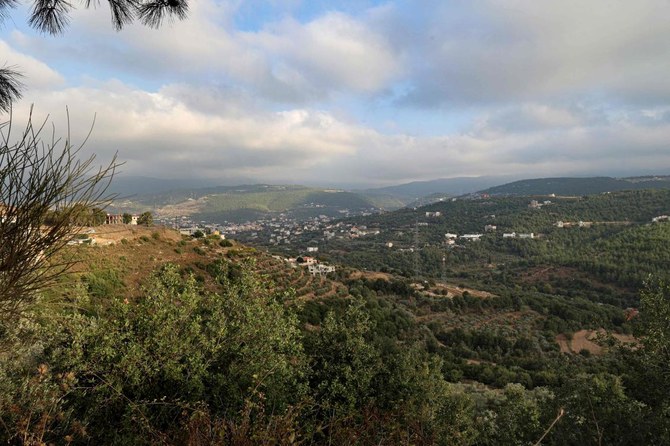
KOBAYAT, Lebanon: Heatwaves, low rainfall and the threat of wildfires are compounding the woes of people in the forested north of Lebanon, a country where economic pain has long taken prominence over environmental concerns.
After a blistering and dry summer, residents of the mountainous Akkar region near the Syrian border are voicing fears about climate change and water scarcity.
Farmer Abdullah Hammud, 60, has spent his life in the green hills of Akkar, growing everything from tomatoes to figs, but says environmental problems are now hurting his livelihood.
“I’ve never seen it this hot,” Hammud said, looking at a field where he was planning to grow cabbage. “We lost part of the crops.”
With Lebanon’s mains water supply unreliable at best, he depends on a nearby spring for irrigation, but worries that the supply is falling.
Because trucking in water for his house and farm is not an option, he said, “if the water ran out, we would have to leave.”
Rainfall has been below average this year in Lebanon, Mohamad Kanj from the meteorological department told AFP.
A 13-day heatwave last month was “the most severe recorded in terms of the number of days, the area affected and the exceptional temperatures.”
Akkar was already one of Lebanon’s most disadvantaged regions before the national economy imploded in late 2019, plunging much of the population into poverty.
A report from the American University of Beirut last year found the region also has only low-to-moderate resilience to climate change.
Devastating forest fires raged two years ago near the town of Kobayat, where houses are nestled among the trees in surrounding hills.
A 15-year-old died while helping to battle the flames.
“The fires affected us a lot,” said Najla Chahine, 58, a former teacher. “We feared for our lives.”
Since those fires, “there’s more awareness,” said Chahine, noting however that the local community needs to work harder to face environmental threats because “the state is absent.”
She and her son Sami were on a hike as part of a recent local festival.
Several dozen people clambered up and down tree-covered slopes carpeted with dry pine needles and cones.
Sami Chahine, 13, said he has tried to “raise awareness as much as possible” about environmental issues among his friends.
He expressed worry about fires, but also other ecological threats such as pollution, in a country where people often burn trash at informal dump sites and recycling is sporadic.
The hike passed several local springs, one reduced to just a trickle, another totally dry.
Antoine Daher, head of the local non-governmental Council of Environment — Kobayat, blamed the water shortages on both a lack of rain and rising demand, urging people to reduce consumption.
Daher said his association set up Lebanon’s first fire watchtower some 25 years ago and had sought to educate people on ecological topics.
Despite Lebanon’s devastating economic crisis, he said, “we mustn’t see the environment as a luxury.”
Fires remain a major threat, and Khaled Taleb from the Akkar Trail association was training a group on how to prevent and fight them.
“We are currently at the peak of the fire season,” he said, warning that the risk only abates in late October.
His association, which now counts 15 volunteers, turned to firefighting in 2020 after major blazes hit the Akkar region.
The area is covered with 200 square kilometers (77 square miles) of forest and home to 73 out of Lebanon’s 76 tree species, he said.
The fires near Kobayat in 2021 alone “destroyed more than 1,800 hectares (4,450 acres),” he said, recalling that water access was a major problem for his team.
In October 2019, the Beirut government’s failure to contain devastating wildfires was among the triggers of an unprecedented, nationwide anti-government protest movement.
Lebanon “doesn’t have the logistical capabilities to deal with a huge fire,” said Taleb, whose group works alongside the civil defense and other first responders.
However, he expressed optimism at the local community’s willingness to pitch in.
“We weren’t born firefighters,” he said, adding that until three years ago, “we didn’t know anything about firefighting.”
“But our main priority now is to protect the forest from all threats.”


![]()

Heat, drought, fires threaten Lebanon’s northern forests
Short Url
https://arab.news/496bz
Heat, drought, fires threaten Lebanon’s northern forests
- Rainfall has been below average this year in Lebanon
- A 13-day heatwave last month was “the most severe recorded in terms of the number of days, the area affected and the exceptional temperatures”


Latest updates



© 2026 SAUDI RESEARCH & PUBLISHING COMPANY, All Rights Reserved And subject to Terms of Use Agreement.