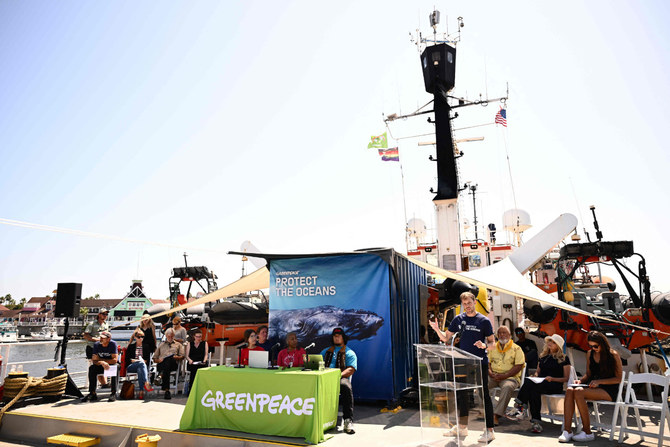
SINGAPORE: Governments have no time to lose when it comes to implementing a new global ocean treaty to protect the high seas as threats from human activities intensify, a report by environmental group Greenpeace said on Thursday.
In March, more than 100 countries completed a groundbreaking treaty to protect the high seas after years of negotiations. It was adopted at the United Nations in June and states can signal their intent to ratify it at the UN General Assembly on Sept. 20.
The treaty will create ocean sanctuaries that are off-limits to fishing and other human activities. Environmental groups said the agreement was a crucial part of efforts to meet a goal enshrined in last year’s global biodiversity accord to protect at least 30 percent of the world’s land and seas by 2030 — a target known as “30 by 30.”
The high seas, or international waters, constitute more than 60 percent of the world’s oceans but have not been under any protection. While the treaty addresses a major regulatory gap, it still needs to be ratified at a national level before it goes into effect.
Greenpeace said fishing hours on the high seas increased by 8.5 percent from 2018 to 2022, and were up 22.5 percent in areas that need special protection.
Unsustainable practices have also risen, including longlines that ensnare marine mammals or seabirds. Species like Pacific Bluefin tuna have lost more than 90 percent of their population in 30 years, the report said.
Sea temperatures hit a record 21.1 degrees Celsius (70 degrees Fahrenheit) in April and are driving ocean acidification and deoxygenation. The problems of plastic, oil and noise pollution have still not been brought under control, according to the environmental group.
Greenpeace warned that “new industries wait in the wings,” including the mining of minerals in the seabed as well as ocean carbon removal technology, which are not yet properly regulated.
The UN treaty will only go into effect when it has been ratified by 60 countries. Greenpeace said that needs to happen before 2025 if there is any hope of achieving the “30 by 30” target. Funding the treaty could be the next challenge.
“We believe over 60 countries intend to sign the Treaty (at the UN General Assembly) on Sept. 20, which would send a very strong signal of continued global unity and momentum toward ratification,” said Chris Thorne of Greenpeace’s Protect the Oceans campaign.
“Reaching 30 by 30 means protecting more than 11 million square kilometers (4.3 million square miles) every year from now to 2030, so there is hardly any time to waste.”


No time to lose on ocean treaty as threats to high seas rise — Greenpeace
https://arab.news/b4mzg
No time to lose on ocean treaty as threats to high seas rise — Greenpeace

- Over 100 countries completed a groundbreaking treaty to protect the high seas after years of negotiations
- The treaty will create ocean sanctuaries that are off-limits to fishing and other human activities


Venezuela advances amnesty bill that could lead to mass release of political prisoners
- Such an amnesty is a central demand of the country’s opposition and human rights organizations with backing from the United States
CARACAS: Venezuela’s legislature on Thursday advanced an amnesty bill proposed by acting President Delcy Rodríguez that could lead to the release of hundreds of opposition leaders, journalists and human rights activists detained for political reasons.
Such an amnesty is a central demand of the country’s opposition and human rights organizations with backing from the United States. But the contents of the bill have not been released publicly, and rights groups have so far reacted with cautious optimism — and with demands for more information.
The bill, introduced just weeks after the US military captured then-President Nicolás Maduro, still requires a second debate that has yet to be scheduled. Once approved, it must be signed by Rodríguez before it can go into effect.
In announcing the bill late last month, Rodríguez told a gathering of justices, magistrates, ministers, military brass and other government leaders that the ruling party-controlled National Assembly would take up the legislation with urgency.
“May this law serve to heal the wounds left by the political confrontation fueled by violence and extremism,” she said in a pre-taped televised event. “May it serve to redirect justice in our country, and may it serve to redirect coexistence among Venezuelans.”
Rights groups, fearing some political detainees will be excluded, want more details about the requirements for amnesty before any final vote.
The Venezuelan Program for Education-Action in Human Rights, or PROVEA, issued a statement emphasizing that the bill must be made public urgently due to its potential impact on victims’ rights and broader Venezuelan society.
Based on what is known so far about the legislation, the amnesty would cover a broad timeline, spanning the administration of the late Hugo Chávez from 1999 to 2013 and that of his political heir, Maduro, until this year. It would exclude people convicted of murder, drug trafficking, and serious human rights violations, reports indicate.


