BEIRUT: Three protesters were wounded by gunfire Wednesday while trying to weld shut a branch of Syria’s ruling Baath party in a southern province hit by nearly a month of anti-government demonstrations.
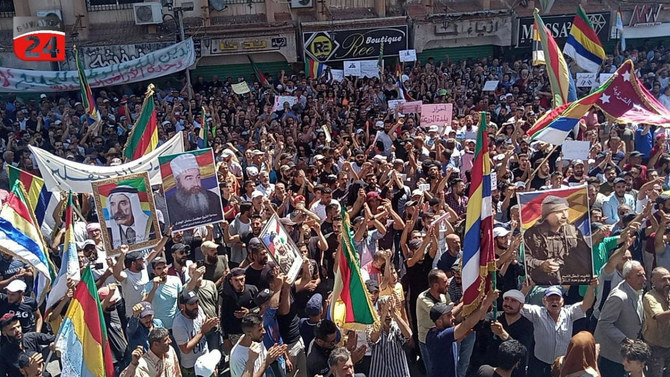
It is the first time protesters have been injured since demonstrations began last month in Sweida province, the heartland of Syria’s Druze minority, after the government lifted fuel subsidies.
The move dealt a heavy blow to Syrians reeling from war and economic woes.
“They fired at protesters who were trying to shut a Baath office, leaving three wounded,” an activist in Sweida told AFP.
Local media outlet Suwayda24 said in a post on X, formerly known as Twitter, that Baath party members who had been guarding the building fired at protesters, wounding three.
The outlet, which is run by citizen journalists, shared a video on X saying it showed “guards of the Baath command building... firing to disperse a group of protesters who were trying to close off the building.”
In recent weeks, demonstrators have welded the doors of offices of the Baath party shut in an act of defiance, while others have removed photos of President Bashar Assad in the city.
Suwayda24 said dozens of protesters took to the streets of Sweida on Tuesday. Such demonstrations have occurred daily in recent weeks, with larger numbers attending on Fridays.
Protests against deteriorating economic conditions have erupted sporadically in Sweida since 2020.
Smaller, sporadic protests have also taken place in neighboring Daraa province, the cradle of Syria’s 2011 uprising, which Assad bloodily suppressed.
The Druze, who follow an offshoot of Shiite Islam, made up less than three percent of Syria’s pre-war population. They have largely kept out of the conflict.
Sweida has been mostly spared from the fighting, and has only faced sporadic jihadist attacks, which were repelled.
Syrian security services have a limited presence in the province, and Damascus has turned a blind eye to Druze men refusing to undertake compulsory military service.
Syria’s war began after the government repressed peaceful protests in 2011 and quickly escalated into a deadly conflict that pulled in jihadists and foreign powers.
The conflict has killed more than 500,000 people, displaced millions and battered the country’s infrastructure and industry.


![]()

Three anti-government protesters wounded in Syria: activists
Short Url
https://arab.news/rzhbn
Three anti-government protesters wounded in Syria: activists
- It is the first time protesters have been injured since demonstrations began last month in Sweida province
- The move dealt a heavy blow to Syrians reeling from war and economic woes


Latest updates


© 2026 SAUDI RESEARCH & PUBLISHING COMPANY, All Rights Reserved And subject to Terms of Use Agreement.