

UN head of mission to Sudan resigns

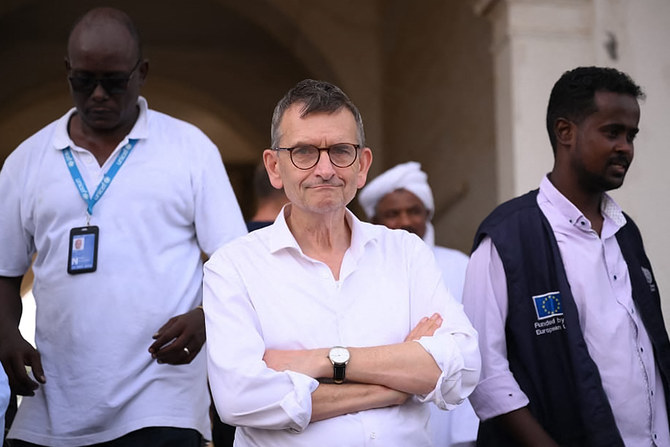
Volker Perthes, Special Representative of the UN Secretary-General for Sudan and Head of the UN Integrated Transition Assistance Mission in Sudan, has resigned. (File/AFP)
Short Url
Updated 13 September 2023
Follow

UN head of mission to Sudan resigns

  • Volker Perthes urges military leaders to ‘negotiate and implement cessation of hostilities’
  • Sudan’s military leader Gen. Abdel Fattah Burhan reportedly accused the envoy of ‘being partisan’

LONDON: Volker Perthes, UN head of mission to Sudan, has resigned three months after being declared “persona non grata” by the government with the country edging closer to full-scale civil war.

Perthes told a meeting of the UN Security Council on Wednesday that it would be his “last briefing in this function” as he urged the military leaders, whom he previously unanimously blamed the conflict on, to “negotiate and implement a cessation of hostilities.”

Perthes told the 15-member council: “I have had the privilege to serve as the UN secretary-general’s special representative for Sudan for more than two and a half years.

“I am grateful to the secretary-general for that opportunity and for his confidence in me, but I have asked him to relieve me of this duty. This will therefore be my last briefing in this function. I wish to thank UN staff in Sudan for their ceaseless engagement and support.”

In May, UN Secretary-General Antonio Guterres rejected a request from Sudan’s military leader Gen. Abdel Fattah Burhan to remove Perthes.

Burhan, who threatened to expel Perthes from the country, reportedly accused the envoy of “being partisan,” claiming his strategy in pre-war talks between the generals and the pro-democracy movement had only aggravated the conflict.

However, having previously rejected Perthes’ request to resign, Guterres recognized Perthes’ “very strong reasons to resign,” stating today that he had to “accept his resignation.”

Members of the council, including the UAE, US, and Malta, regretted Perthes’ departure but applauded his “professionalism and tireless efforts” in the role, with Malta noting that it remained “firm in belief that blaming UN officials does not help.”

US Ambassador to the UN Linda Thomas-Greenfield added: “The threats are unacceptable. Nobody should be allowed to threaten (the) council’s work for peace and stability.”

In summing up the state of conflict, Perthes said that “what started as a conflict between two military formations could be morphing into a full-blown civil war,” expressing particular concern over the mobilization of former regime elements “advocating a continuation of the war.”

He added that “both sides’ military leaders are needed to negotiate and implement cessation of hostilities, but military leaders should not continue to rule the country.”

Some 7,500 people have been killed since the conflict between Burhan loyalists and fighters of the paramilitary Rapid Military Support Forces led by his former deputy Mohamed Hamdan Dagalo erupted on April 15.

James Kariuki, deputy permanent representative of the UK mission to the UN, urged Burhan and Dagalo to “find peace,” adding that the UK was committed to the Sudanese people.

Speaking after Perthes, Edem Wosornu, director of operations and advocacy at the UN Office for Coordination of Humanitarian Affairs, told the council that the number of displaced people had risen to 5 million, with more than 20 million experiencing food insecurity.

Although 3.2 million had received some form of humanitarian support in the last three months, 18 million had been left wanting as bureaucracy hampered aid efforts, Wosornu noted.

She added: “We call on Sudanese authorities to facilitate aid by removing bureaucratic hurdles. We have been in continuous dialogue with them and are thankful for the 70 visas (issued) in the last two weeks alone but have 240 pending.

“The conflict is expanding, the death toll has increased, and sexual violence raised to exceptional levels. This could be a harbinger of a return to horrors seen in the past.”

Lana Zaki Nusseibeh, the UAE’s permanent representative to the UN, told the council that her country remained steadfast in its support for regional efforts to end the conflict and urged the warring factions to abide by international humanitarian law.

Nusseibeh’s call came amid worrying claims of both sides not only arbitrarily detaining and arresting civilians but also executing them.

“It has been half a year since the outbreak of hostilities and the conditions on the ground and displacement of millions underscores the need to address this situation, and we must explore and coordinate to achieve tangible impact on the ground,” she added.

“The need of Sudanese people must reign above all other considerations. We must act to stop the tearing apart of Sudanese social fabric.”

Even amid the chaos, Nusseibeh pointed to rays of optimism, noting that the UAE had been encouraged by humanitarian efforts undertaken by Sudan’s neighbors, and expressed appreciation for the role of the UN mission in Sudan as she encouraged it to continue coordinating humanitarian efforts.

Pointing to the Sudanese people’s “indomitable spirit,” Perthes stressed that the country must not be left to “endure the ghosts of this war indefinitely.”


Washington presses Syria to shift from Chinese telecom systems

Updated 26 February 2026
Follow

Washington presses Syria to shift from Chinese telecom systems

  • Syria is exploring the possibility of procuring Chinese technology
  • It was unclear whether the United States ⁠pledged financial or logistical support to Syria to do so

DAMASCUS: The United States has warned Syria against relying on Chinese technology in its telecommunications sector, arguing it conflicts with US interests and threatens US national security, according to three sources familiar with the matter.
The message was conveyed during an unreported meeting between a US State Department team and Syrian Communications Minister Abdulsalam Haykal in San Francisco on Tuesday. Washington has been coordinating closely with Damascus since 2024, when Syria’s now President Ahmed Al-Sharaa ousted longtime leader Bashar Assad, who had a strategic partnership with China.
Syria is exploring the possibility of procuring Chinese technology to support its telecommunications towers and the infrastructure of local Internet service providers, according to a Syrian businessman involved in the procurement talks.
“The US side asked for clarity on the ministry’s plans regarding Chinese telecom equipment,” said ⁠another source briefed on ⁠the talks.
But Syrian officials said infrastructure development projects were time-critical and that Damascus was seeking greater vendor diversity, the source added.
SYRIAN OFFICIALS CITE US EXPORT CONTROLS AS TELECOMS BARRIER
Syria is open to partnering with US firms but the matter was urgent and export controls and “over-compliance” remained an issue, according to person familiar with the meeting in San Francisco.
A US diplomat familiar with the discussions told Reuters that the US State Department “clearly urged Syrians to use American technology or technology from allied countries in the telecoms sector.”
It was unclear whether the United States ⁠pledged financial or logistical support to Syria to do so.
Responding to Reuters questions, a US State Department spokesperson said: “We urge countries to prioritize national security and privacy over lower-priced equipment and services in all critical infrastructure procurement. If it seems too good to be true, it probably is.”
The spokesperson added that Chinese intelligence and security services “can legally compel Chinese citizens and companies to share sensitive data or grant unauthorized access to their customers’ systems” and promises by Chinese companies to protect customers’ privacy were “entirely inconsistent with China’s own laws and well-established practices.”
China has repeatedly rejected allegations of it using technology for spying purposes.
The Syrian Ministry of telecommunications told Reuters any decisions related to equipment and infrastructure are made “in accordance with national technical and security standards, ensuring data protection and service continuity.”
The ministry said it is also prioritizing the diversification of partnerships and technology sources to ⁠serve the national interest.
Syria’s telecom ⁠infrastructure has relied heavily on Chinese technology due to US sanctions imposed on successive Assad governments over the civil war that grew from a crackdown on anti-government protests in 2011.
Huawei technology accounts for more than 50 percent of the infrastructure of Syriatel and MTN, the country’s only telecom operators, according to a senior source at one of the companies and documents reviewed by Reuters. Huawei did not immediately respond to a request for comment.
Syria is seeking to develop its private telecommunications sector, devastated by 14 years of war, by attracting foreign investment.
In early February, Saudi Arabia’s largest telecom operator, STC, announced it would invest $800 million to “strengthen telecommunications infrastructure and connect Syria regionally and internationally through a fiber-optic network extending over 4,500 kilometers.”
The ministry of telecommunications says that US restrictions “hinder the availability of many American technologies and services in the Syrian market,” emphasizing that it welcomes expanding cooperation with US companies when these restrictions are lifted.
Syria has inadequate telecommunications infrastructure, with network coverage weak outside city centers and connection speeds in many areas barely exceeding a few kilobits per second.