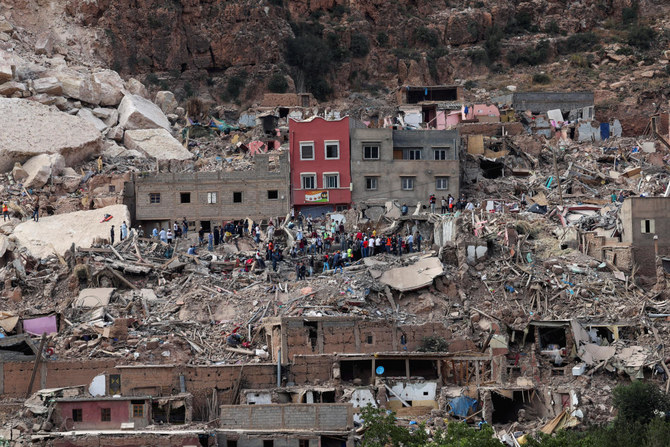
IMI N'TALA, Morocco: The stench of death wafted through the village of Imi N’Tala high up in Morocco’s Atlas Mountains four days after a deadly earthquake struck, slicing off a chunk of mountain, killing residents and razing the hamlet to the ground.
Bulldozers, rescue crews and Moroccan first responders work around the clock trying to dig through the wreckage to unearth the eight to ten corpses still underneath.
"The mountain was split in half and started falling. Houses were fully destroyed," Ait Ougadir Al Houcine said as rescuers worked on recovering bodies, including his sister's. “Some people lost all their cattle. We have nothing but the clothes we’re wearing. Everything is gone.”
The scene in Imi N'Tala, which mainly houses herders and famers and where 96 residents perished in Friday's earthquake, mirrors that of dozens of places situated along the treacherous mountain roads south of Marrakech: Men in donated djellabas neatly arrange rugs atop dust and rocks to pray after looking for open space and solid ground. Donkeys bray as they pass by people covering their noses to block the smell of decomposing bodies.
The death and injury counts continue to rise as more remote villages are reached, bodies get dug up and people sent to hospitals. Moroccan authorities reported 2,901 deaths as of Tuesday. The United Nations has estimated that 300,000 people were affected by Friday night’s magnitude 6.8 quake.
But things look different than in the hours and days immediately after the temblor.
About 38 miles (62 kilometers) north in Marrakech, King Mohammed VI is visiting a hospital and donating blood. And in Imi N'Tala — as well as in nearby Anougal, Imi N'Isli and Igourdane — aid has finally arrived. White and yellow tents line partially paved roads. Pyramids of water bottles and milk cartons are stacked nearby. Moroccans who've come to the region from the country's larger cities hand clay tagine pots and neatly packed bags full of food aid off of the backs of trucks.
Camera crews from France, Spain and Qatar's Al Jazeera set up as Moroccan emergency responders — along with crews from Qatar, Spain and international NGOs — jackhammer through rocks to recover a woman's body from under a crumbling house that looks like it could fall at any moment.
She's likely dead because — unlike the buildings that fell in Turkey and Syria's earthquake earlier this year — the mud bricks used to build homes in Imi N'Tala left little space for air needed to keep people alive, said Patrick Villadry of the French rescue crew, ULIS.
“When we dig, we look for someone alive. From there, we don’t ask ourselves questions. If they’re alive, great. If they’re dead, it’s a shame,” he said, noting that recovering the dead was important for Moroccan families.
Morocco has limited the amount of aid allowed into the country in response to the earthquake and green-lit crews from only four countries — Spain, the United Kingdom, the United Arab Emirates and Qatar — and non-governmental organizations. Villadry's five-person, four-dog crew from Nice was among the few French NGOs to have made it to the disaster site. It arrived Saturday, he said.
Though the government has cautioned that poorly coordinated aid “would be counterproductive," the explanation has prompted skepticism among Moroccans like Brahim Ait Blasri, who watched as they tried recovery attempts.
“It's not true. It's politics,” he said, referring to Morocco's decision not to accept aid from countries such as the United States and France. “We have to set aside our pride. This is too much.”


International crews in Morocco to recover bodies days after deadly 6.8 earthquake struck
https://arab.news/pqmwn
International crews in Morocco to recover bodies days after deadly 6.8 earthquake struck

- Bulldozers, rescue crews and Moroccan first responders work around the clock trying to dig through the wreckage to unearth the eight to ten corpses still underneath
- "The mountain was split in half and started falling. Houses were fully destroyed," Ait Ougadir Al Houcine said


Gaza death toll surges to 71,548 as Israeli aggression continues
- The administration of President Donald Trump earlier in the week said the US-drafted ceasefire plan for Gaza was now moving into its challenging second phase, which includes the new Palestinian committee in Gaza
GAZA: The death toll from Israeli attacks has risen to 71,548 Palestinians, with 171,353 reported wounded, since the beginning of the offensive on Oct. 7, 2023, according to medical sources.
One new fatality was reported at a Gaza hospital in the past 24 hours, along with six new injuries, sources said.
Several victims remain trapped under rubble or lying in the streets, with ambulance and civil defense crews unable to reach them due to the widespread destruction and lack of supplies.
Since the ceasefire came into effect on Oct. 11, the number of fatalities has increased to 464 along with 1,275 injuries, while 712 bodies have been recovered from beneath the rubble.
Earlier on Saturday, a 27-day-old baby died because of severe cold, bringing the number of child deaths caused by extreme winter conditions since the start of the season to eight.
The administration of President Donald Trump earlier in the week said the US-drafted ceasefire plan for Gaza was now moving into its challenging second phase, which includes the new Palestinian committee in Gaza, deployment of an international security force, disarmament of Hamas, and reconstruction of the war-battered territory.
But Israel’s government is objecting to the White House announcement of leaders who will play a role in overseeing the next steps in Gaza.
Israel says the Gaza executive committee “was not coordinated with Israel and is contrary to its policy,” without details.
Saturday’s statement also said Prime Minister Benjamin Netanyahu has told the Foreign Ministry to contact Secretary of State Marco Rubio.
The White House-announced committee announced on Friday includes no Israeli official but does include an Israeli businessman.
Other members announced so far include two of US President Donald Trump’s closest confidants, a former British prime minister, an American general, and a collection of top officials from Middle Eastern governments.
The White House has said the executive committee will carry out the vision of a Trump-led “Board of Peace,” whose members have not yet been named.
The White House also announced the members of a new Palestinian committee to run Gaza’s day-to-day affairs, with oversight from the executive committee.
The committee’s members include US Secretary of State Marco Rubio, Trump envoy Steve Witkoff, Trump’s son-in-law Jared Kushner, former British Prime Minister Tony Blair, Apollo Global Management CEO Marc Rowan, World Bank President Ajay Banga, and Trump’s deputy national security adviser Robert Gabriel.