

Pakistan national and provincial governments say only election regulator authorized to announce polling date

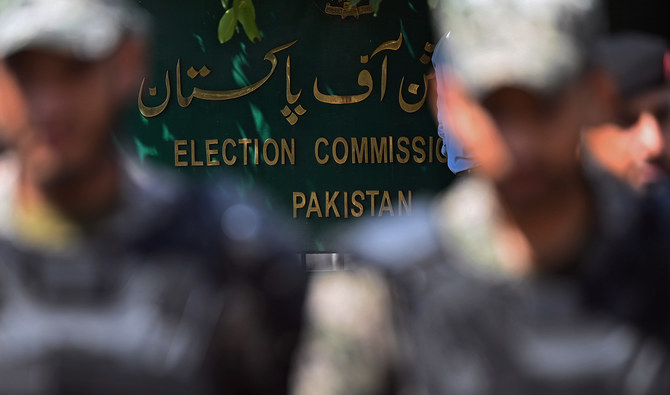
Paramilitary soldiers stand guard outside the Pakistan’s election commission building in Islamabad on August 2, 2022. (AFP/File)
Short Url
Updated 13 September 2023
Follow

Pakistan national and provincial governments say only election regulator authorized to announce polling date

  • Federal and provincial law ministers meet amid rumors President Alvi planning to announce election date unilaterally
  • Law ministers agree general elections for national and provincial assemblies must be held on the same day

ISLAMABAD: Pakistani federal and provincial law ministers on Wednesday unanimously urged all organs of the state to respect the authority of the Election Commission of Pakistan (ECP) to set an election schedule amid widespread speculation the date for polls would be unilaterally announced by President Dr. Arif Alvi.

Under the amended Elections Act, 2017, passed by parliament in June, the regulator can announce election dates without consulting the president or any other state institution or official.

“It is the responsibility of all organs of the State to respect autonomy of the Election Commission and its authority in carrying out delimitation of constituencies and determining the election schedule,” said a statement issued by the law ministry after a meeting between federal and provincial representatives.

“As per the Constitution, the conduct of general elections and announcement of elections date is the sole competence of the Election Commission of Pakistan.”

The law ministers also agreed that general elections for both national and provincial seats must be held on the same day to avoid unnecessary waste of resources.

“The Provincial Law Ministers emphasized that in order to strengthen the Federation, to ensure harmony among all federating units and to avoid unnecessary financial burden on the national exchequer incurred owing to provision of security arrangements on different election dates, the general elections to the National and the four Provincial Assemblies must be held on same day,” the statement said.

The president dissolved the country’s national legislature on the recommendation of former prime minister Shehbaz Sharif on August 9, making general elections mandatory within 90 days, or in November, according to Pakistan’s constitution.

However, the outgoing Sharif government’s move to approve the results of a new census a few days before they quit threw the upcoming polls into uncertainty as the ECP was now bound under the constitution to draw new constituency boundaries as per the results of the latest population count. That process could take up to late December, the ECP has said, meaning polling day would be pushed back to as far as March.

Fears persist about the prolonged running of the day-to-day state business in the absence of an elected government, while analysts say any delay in polls could fuel public anger and consolidate the power of the military, which already has an outsized role in Pakistani politics. The army says it no longer interferes in political affairs.


Pakistan, global crypto exchange discuss modernizing digital payments, creating job prospects 

Updated 05 December 2025
Follow

Pakistan, global crypto exchange discuss modernizing digital payments, creating job prospects 

  • Pakistani officials, Binance team discuss coordination between Islamabad, local banks and global exchanges
  • Pakistan has attempted to tap into growing crypto market to curb illicit transactions, improve oversight

ISLAMABAD: Pakistan’s finance officials and the team of a global cryptocurrency exchange on Friday held discussions aimed at modernizing the country’s digital payments system and building local talent pipelines to meet rising demand for blockchain and Web3 skills, the finance ministry said.

The development took place during a high-level meeting between Finance Minister Muhammad Aurangzeb, Pakistan Virtual Assets Regulatory Authority (PVARA) Chairman Bilal bin Saqib, domestic bank presidents and a Binance team led by Global CEO Richard Teng. The meeting was held to advance work on Pakistan’s National Digital Asset Framework, a regulatory setup to govern Pakistan’s digital assets.

Pakistan has been moving to regulate its fast-growing crypto and digital assets market by bringing virtual asset service providers (VASPs) under a formal licensing regime. Officials say the push is aimed at curbing illicit transactions, improving oversight, and encouraging innovation in blockchain-based financial services.

“Participants reviewed opportunities to modernize Pakistan’s digital payments landscape, noting that blockchain-based systems could significantly reduce costs from the country’s $38 billion annual remittance flows,” the finance ministry said in a statement. 

“Discussions also emphasized building local talent pipelines to meet rising global demand for blockchain and Web3 skills, creating high-value employment prospects for Pakistani youth.”

Blockchain is a type of digital database that is shared, transparent and tamper-resistant. Instead of being stored on one computer, the data is kept on a distributed network of computers, making it very hard to alter or hack.

Web3 refers to the next generation of the Internet built using blockchain, focusing on giving users more control over their data, identity and digital assets rather than big tech companies controlling it.

Participants of the meeting also discussed sovereign debt tokenization, which is the process of converting a country’s debt such as government bonds, into digital tokens on a blockchain, the ministry said. 

Aurangzeb called for close coordination between the government, domestic banks and global exchanges to modernize Pakistan’s payment landscape.

Participants of the meeting also discussed considering a “time-bound amnesty” to encourage users to move assets onto regulated platforms, stressing the need for stronger verifications and a risk-mitigation system.

Pakistan has attempted in recent months to tap into the country’s growing crypto market, crack down on money laundering and terror financing, and promote responsible innovation — a move analysts say could bring an estimated $25 billion in virtual assets into the tax net.

In September, Islamabad invited international crypto exchanges and other VASPs to apply for licenses to operate in the country, a step aimed at formalizing and regulating its fast-growing digital market.