

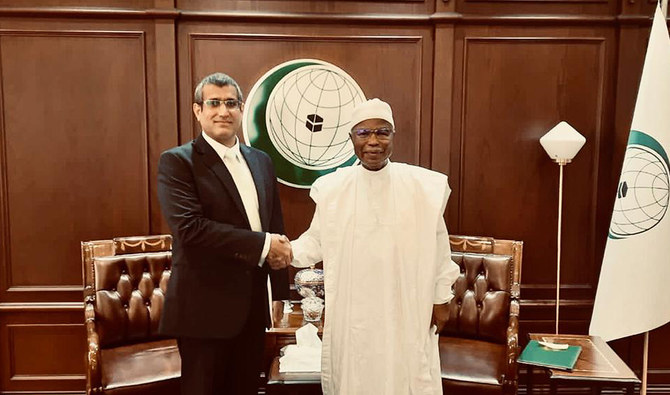
Pakistani envoy, OIC chief discuss Islamophobia ahead of annual coordination meeting on Sept 21 

Permanent Representative of Pakistan to the Organization of Islamic Cooperation (OIC), Ambassador Syed Mohammad Fawad Sher (left) shakes hands with the OIC Secretary General, H.E. Hissein Brahim Taha at the OIC General Secretariat in Jeddah, Saudi Arabia on September 12, 2023. (Photo courtesy: Foreign Office)
Short Url
Updated 13 September 2023
Follow

Pakistani envoy, OIC chief discuss Islamophobia ahead of annual coordination meeting on Sept 21 

  • Ambassador Fawad Sher reiterates Pakistan’s strong condemnation of Qur’an burnings, other Islamophobic acts 
  • OIC secretary-general appreciates Pakistan’s effective participation in addressing challenges faced by Muslim world 

ISLAMABAD: Pakistan’s permanent representative to the Organization of Islamic Cooperation (OIC), Ambassador Syed Mohammad Fawad Sher, on Tuesday called on the OIC Secretary-General Hissein Brahim Taha at the OIC General Secretariat in Jeddah, where the two figures discussed Islamophobia and a wide range of issues facing the Muslim world, the Pakistani consulate in Jeddah said. 

The development came days ahead of the OIC’s annual coordination meeting on September 21, which would be held on the sidelines of the 78th United Nations General Assembly (UNGA) session in New York. 

The annual meeting will be attended by foreign ministers of the OIC member states and feature other events on the sidelines, including the meeting of the OIC Contact Group on Jammu and Kashmir. 

“Ambassador and the Secretary General exchanged views on issues slated for discussion during the forthcoming OIC Annual Coordination Meeting (ACM) and the Islamic Summit including, inter alia, the Jammu and Kashmir dispute, Palestine, Afghanistan, Islamophobia incidents of desecration of the Holy Qur’an and COMSTECH Islamabad (OIC’s Ministerial Standing Committee on Scientific and Technological Cooperation),” the Pakistani consulate said in a statement. 

“Ambassador Fawad Sher noted that Pakistan maintained a firm position and has traditionally played an active role in steering OIC’s response to all important issues. On Islamophobia and the repeated incidents of desecration of the Holy Qur’an, he reiterated Pakistan’s strong condemnation of these despicable incidents.” 

The Pakistani envoy thanked Secretary General Taha for the OIC’s unwavering support to the Jammu and Kashmir cause and urged for the complete implementation of the OIC plan of action on Jammu and Kashmir, adopted by the 48th session of the Council of Foreign Ministers (CFM) in Islamabad. 

Participating countries discussed a wide range of issues and adopted 140 resolutions, including the Islamabad Declaration, at the 48th session of the OIC CFM held in the Pakistani capital in March last year. 

The declaration highlighted the desire of OIC member states to promote and protect their common interests, support “just causes” such as the Palestine and Kashmir issues, uphold the rights and interests of Muslim minorities in non-OIC countries, and pursue a shared vision for greater social, economic, scientific and technological development and integration within the Muslim world. 

The Muslim-majority Himalayan region has been a bone of contention between Pakistan and India since their independence from the British rule in 1947. Both neighbors rule parts of the Himalayan territory, but claim it in full and have fought two of their three wars over the disputed region. 

During Tuesday’s meeting in Jeddah, the OIC secretary general appreciated Pakistan’s robust engagement with the OIC and its effective participation in addressing challenges confronting the Muslim world, according to the Pakistani consulate. 

He stated that the OIC highly valued Pakistan’s contributions on issues of collective concern to the Ummah. 

The OIC is the second-largest intergovernmental organization in the world, after the UN. It consists of 57 Muslim member states spread across four continents. It is considered the collective voice of Muslim countries around the world and aims to promote the interests of its member states. 


Pakistan consumer confidence rises by 4 percentage points in two years, survey shows

Updated 6 sec ago
Follow

Pakistan consumer confidence rises by 4 percentage points in two years, survey shows

  • Four in 10 Pakistanis believed the country is on the right track, with optimism higher among men
  • Economic concerns remained most worrying, but their quantum fell drastically across all issues

ISLAMABAD: Consumer confidence in Pakistan has risen by 4 percentage points from 31.5 to 35.5 over the last two years, which highlights improving public optimism under the government’s tenure, Ipsos market research firm said in a recent survey.

The survey was conducted through computer-assisted telephonic interviews (CATI) and included more than a thousand participants from all provinces and Azad Kashmir and Gilgit Baltistan regions on Feb. 2-14.

It comes at a time when Pakistan has undergone a difficult period of stabilization, though international rating agencies have acknowledged improvements after Islamabad began implementing structural reforms as part of its $7 billion International Monetary Fund (IMF) program.

The Ipsos survey revealed a “measurable” improvement in Pakistan’s economic sentiment, marked by a decline in inflation alongside notable reductions in poverty and unemployment, since the current government took charge two years ago.

“These findings point to a clear two-year transformation in the Consumer Confidence Index, demonstrating the perceived impact of consistent governance and policy measures,” read the key takeout in the survey.

“Sustained performance, coupled with transparent communication of achievements, will be essential to maintain momentum, reinforce optimism, and support further improvements in economic confidence.”

Four in 10 Pakistanis believed the country is on the right track, with optimism higher among men, while confidence in the country’s direction being right increased more than three times, from 12 percent to 40 percent, since the government came to power, according to the survey.

Economic concerns remained most worrying, but their quantum fell drastically across all issues since the first quarter of 2024. Inflation has dropped by 23 percent, unemployment by 10 percent, poverty by 20 percent, electricity prices by 34 percent and the burden of additional taxes was reduced by 18 percent in Q1 2026 as compared to Q1 2024.

“One in 3 Pakistanis expect the economy to strengthen,” the survey read. “Confidence to invest has grown steadily over two years, rising from 11 percent to 16 percent, with even stronger optimism among urban residents.”