KARACHI: AsiaPak Investments, a private investment firm with operational assets in Pakistan and Hong Kong, will invest in the transformation of Jamshoro Power Plant from imported to locally-sourced Thar coal to ensure cheaper power generation, the company said on Monday.
The project, situated in the Pakistani province of Sindh in Jamshoro district some 150 kilometers away from the port city of Karachi, is financed by Asian Development Bank (ADB). The supercritical coal fired project, designed on imported coal, is 95 percent complete at the cost of around $545 million.
The plant is ready for power generation but remains non-operational mainly due to increasing costs of energy imports, including coal.
“The government, encouraged by K-Electric and by us, AsiaPak Investments, is now focused on converting this plant to Thar coal so that for the next 30-year life of this project consumes only Thar coal and not imported coal,” Shehryar Chishti, CEO of AsiaPak Investments, told a group of journalists during the visit to the plant on Saturday.
“This is designed as a 2x660 megawatt coal project at highest environmental standards and financed by the Asian Development Bank and of the two units, one unit is almost complete.”
Chisti said his company would invest in the conversion of the plant, enabling power generation through local coal sourced from Thar at low cost.
“We have submitted our plan to the government and soon after approval we will execute our investment plan,” he said, adding that the plant would be ready by next year for power generation through local coal.
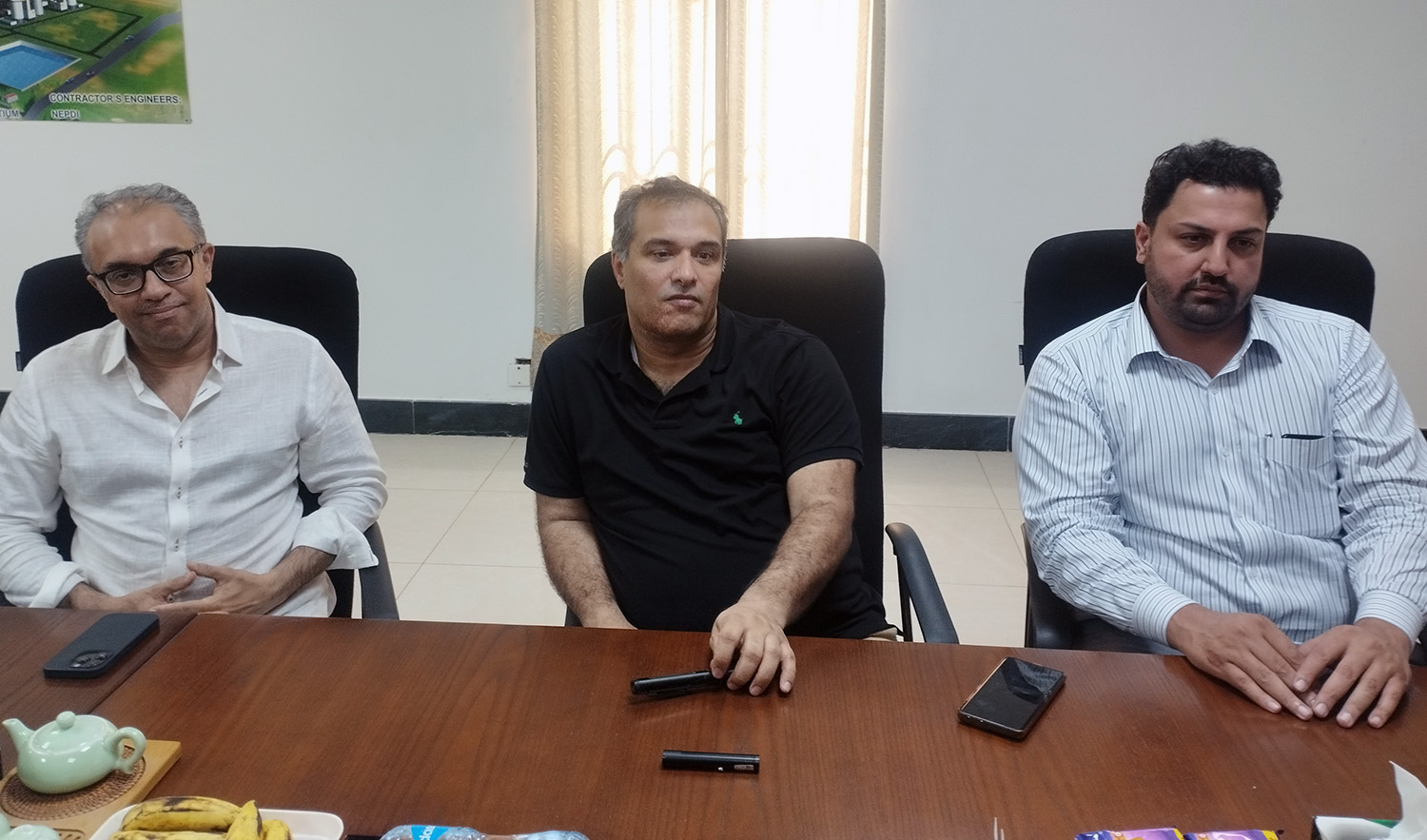
CEO of AsiaPak Investments Shehryar Chishti, center, is briefing visiting journalists about the conversion of Jamshoro power generation plant from imported coal to local coal in Karachi, Pakistan on September 9, 2023. (AN photo)
The AsiaPak chief estimated the cost of conversion for local coal operation would be around $50 million but it was not yet finalized.
Chisti said his company, which is also one of the investors in Block-1 of Thar coal mining, would arrange the supply of around 3.1 million tons per year of coal for the plant.
Pakistan sits on 186 billion tons of coal deposits, of which 94 percent or 175 billion tons, are in the remote Thar region of Sindh province. The coal deposits are equivalent to 50 billion tons of oil, more than Saudi Arabia and Iranian oil reserves combined. The reserves are equal to 2,000 trillion cubic feet (TCF) of gas which is 68 times higher than Pakistan’s total gas reserves, according to the CPEC Energy Planning Report.
Potential coal reserves in Pakistan may generate 100,000 MW of power for 350 years, according to an ADB document.
Chisti said at full capacity, the power plant would produce about 5 billion kilowatt hours per year, which is approximately 25 percent of Karachi’s current requirement.
“It’s unacceptable that Karachi has expensive electricity when it is sitting next to one of the biggest reservoirs of coal in the world and when it’s sitting next to one of the biggest wind and solar corridors in the world,” Chisti said, referring to the current high cost of electricity.
Chisti said the process of conversion would take at least 10 months and electricity generated through local coal would be fed into the national grid. He hoped that power generation through local sources would reduce the country’s energy import bill.
Pakistan’s energy import bill for the outgoing fiscal year, FY23, was $17 billion, 27 percent lower than the previous year, according to the Pakistan Bureau of Statistics.