

Morocco earthquake toll passes 2,800 as rescuers search for survivors

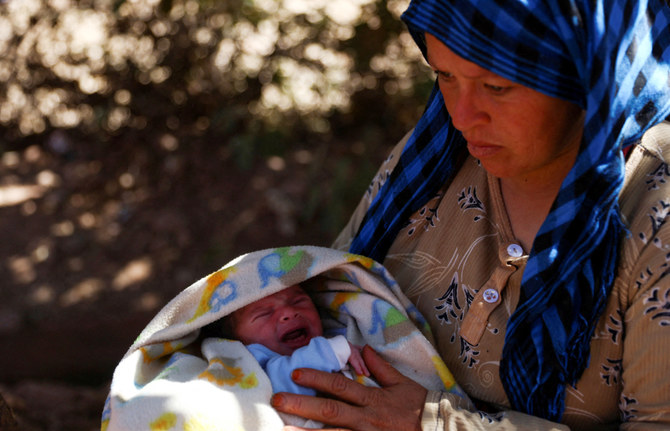
Kiltom Aitbrahimoblla holds her 15-day-old child Salah Achariy, who survived the deadly earthquake, in Tinmel, Morocco, September 11, 2023. (REUTERS)
Short Url
Updated 12 September 2023
Follow

Morocco earthquake toll passes 2,800 as rescuers search for survivors

  • Among the dead was 7-year-old Suleiman Aytnasr, whose mother had carried him to his bedroom after he fell asleep in the living room of their home in a hamlet outside Talat N’Yaaqoub, in one of the worst-hit areas

TALAT N’YAAQOUB, Morocco: Villagers wept for lost relatives in the rubble of their homes on Monday as the death toll from Morocco’s deadliest earthquake in more than six decades rose to more than 2,800 and rescuers raced against time to find survivors.
Search teams from Spain, Britain and Qatar were joining Moroccan rescue efforts after a 6.8 magnitude quake struck late on Friday in the High Atlas Mountains, with the epicenter 72 km (45 miles) southwest of Marrakech.
State TV reported the death toll had risen to 2,862 with 2,562 people injured. Rescuers said the traditional mud brick houses ubiquitous in the region reduced the chances of finding survivors because they had crumbled.
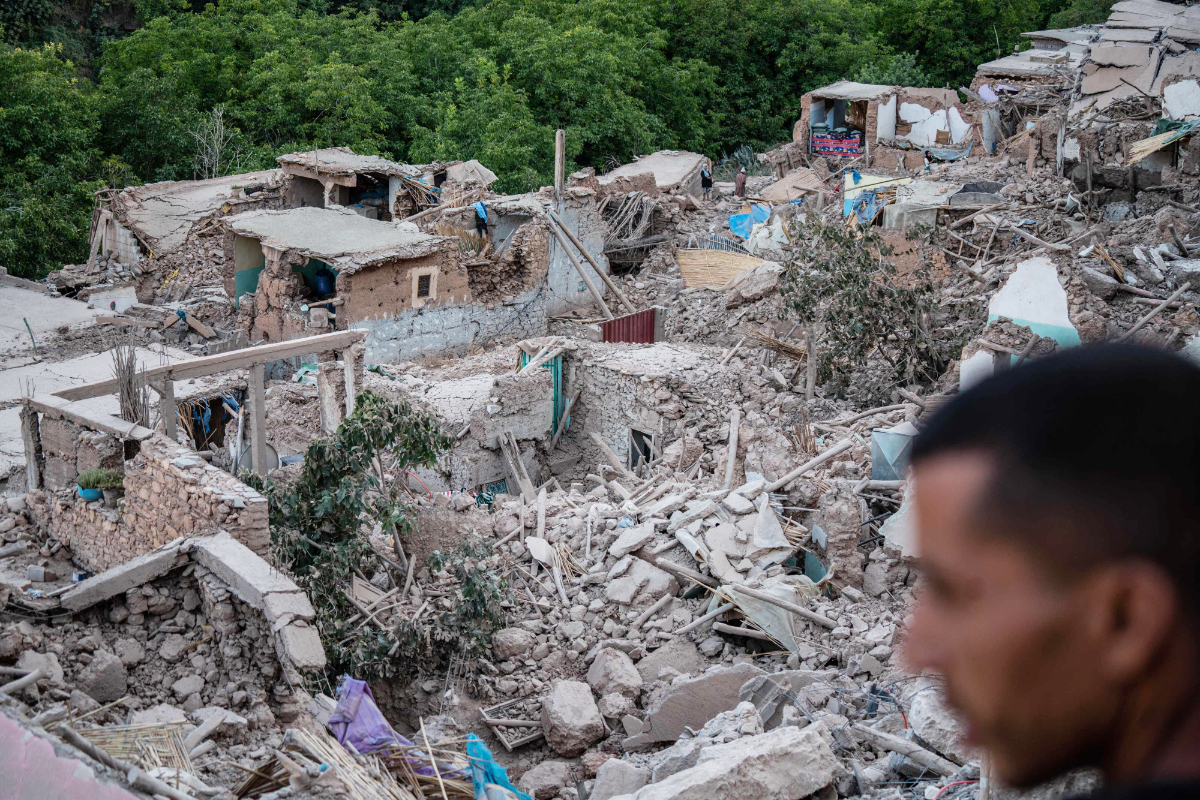


A man looks at the rubble of homes in the mountain village of Imi N'Tala, south of Marrakech, on September 10, 2023. (AFP)

Among the dead was 7-year-old Suleiman Aytnasr, whose mother had carried him to his bedroom after he fell asleep in the living room of their home in a hamlet outside Talat N’Yaaqoub, in one of the worst-hit areas. He had been about to start a new school year.
“As she came back, the earthquake happened and the ceiling was destroyed and fell on him,” said Suleiman’s father, Brahim Aytnasr, whose eyes were red from crying. He had spent Monday trying to salvage items from the debris of his house.
In the village of Tagadirte, where few buildings had been left standing, 66-year-old Mohamed Ouchen described how residents pulled 25 people alive from the rubble in the immediate aftermath of the quake.
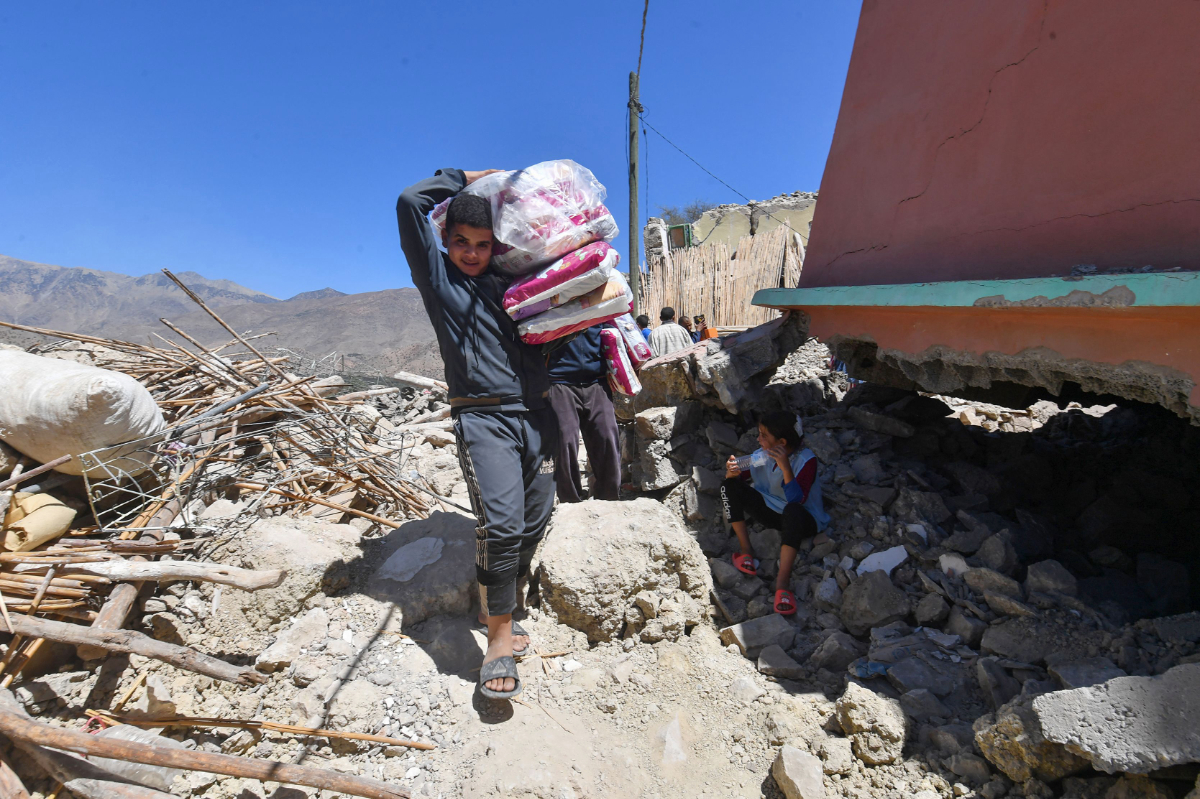


A youth carries sanitary supplies to the destroyed Imoulas village in the Taroudant province, one of the most devastated in quake-hit Morocco, on September 11, 2023.

One of those rescued was his own sister.
“We were busy rescuing, because we didn’t have tools, we used our hands,” he said. “Her head was visible and we kept digging by hand.”
Footage from the remote village of Imi N’Tala, filmed by Spanish rescuer Antonio Nogales of the aid group Bomberos Unidos Sin Fronteras (United Firefighters Without Borders), showed men and dogs clambering over steep slopes covered in rubble.
“The level of destruction is ... absolute,” said Nogales, struggling to find the right word to describe what he was seeing. “Not a single house has stayed upright.”
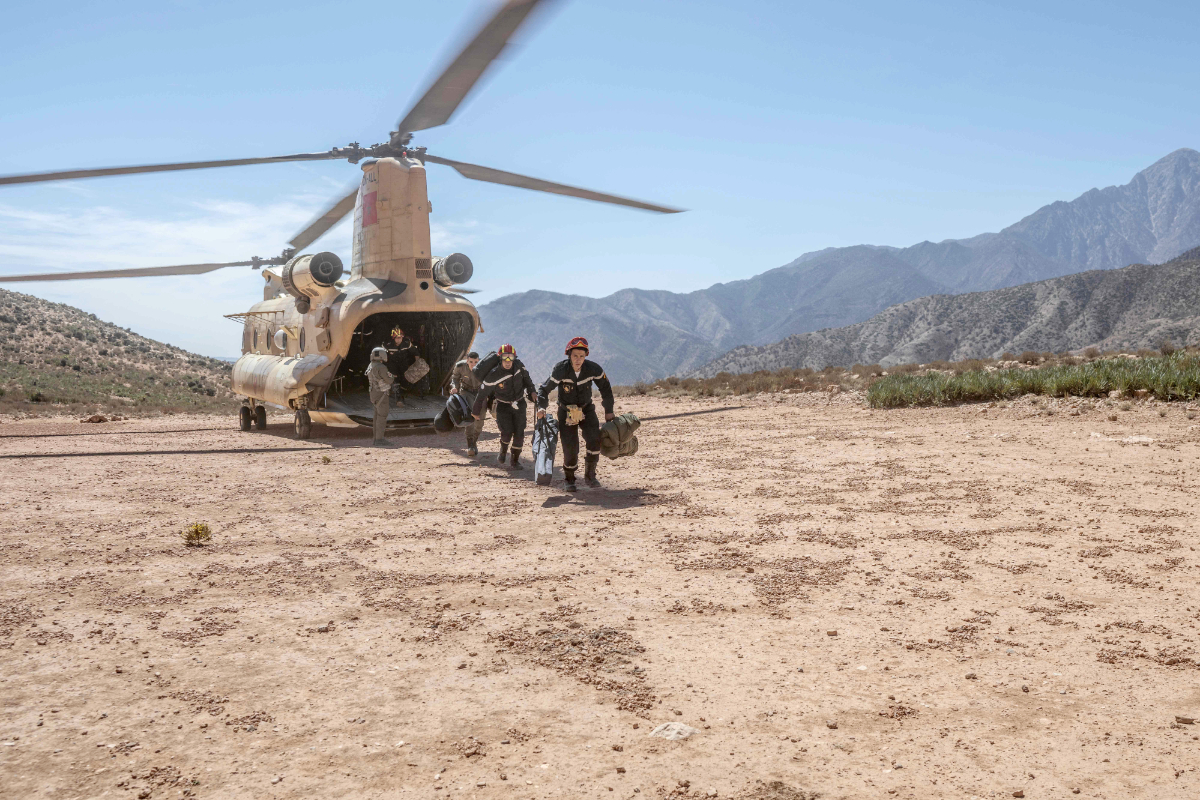


Emergency personnel disembark from a helicopter to support rescue operations in the mountainous area of Tizi N'Test, in the Taroudant province, one of the most devastated in quake-hit Morocco, on September 11, 2023. (AFP)

Despite the scale of the damage, he said rescuers searching with dogs still hoped to find survivors.
“I am sure that in the coming days there will be some rescues, we think that there may still be people in the collapsed structures, that there may have been pockets of air, and as I say, we never give up hope,” he said.

DAMAGE TO HERITAGE
After an initial response that was described as too slow by some survivors, search and rescue efforts appeared to be speeding up on Monday, with tent camps appearing in some locations where people were preparing for a fourth night outdoors.
A video filmed by Moroccan outlet 2M showed a military helicopter flying over an area close to the epicenter, dropping sacks of essential supplies to isolated families.
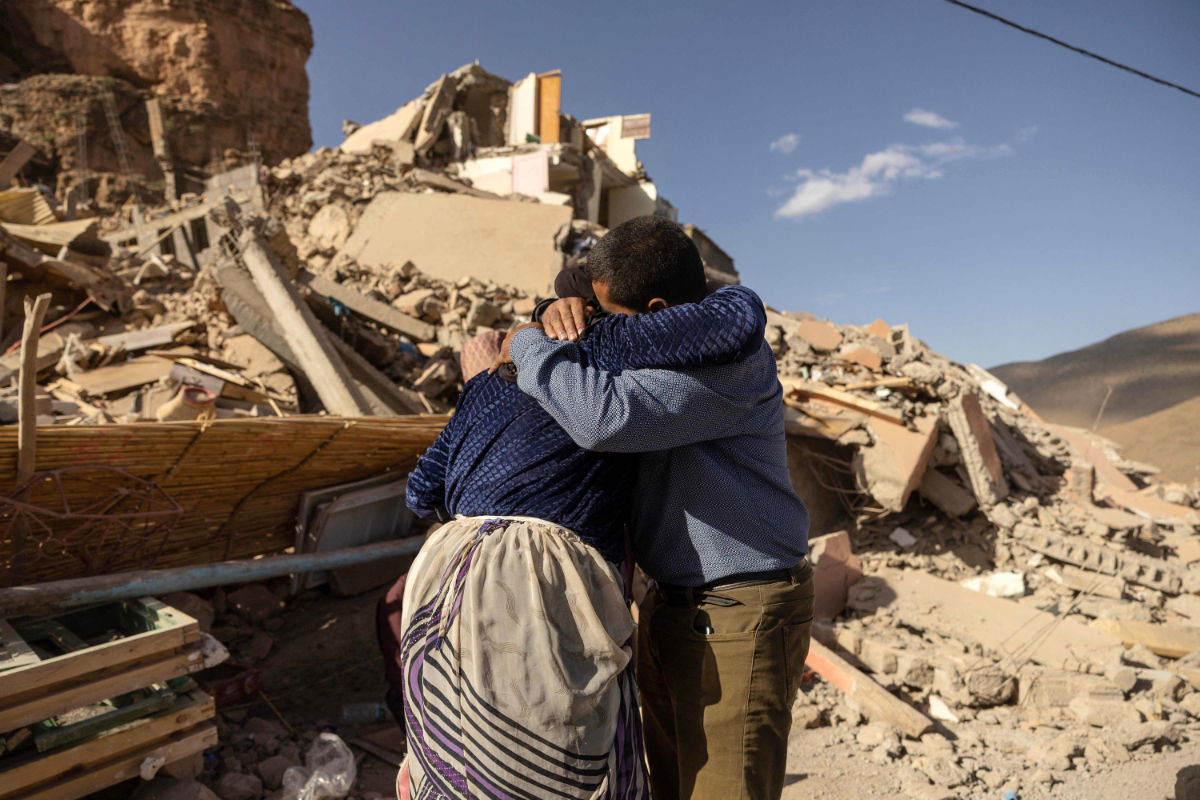


Family members react near the rubble of collapsed buildings in the village of Imi N'Tala near Amizmiz in central Morocco after the deadly 6.8-magnitude September 8 earthquake, on September 10, 2023.

With much of the quake zone in hard-to-reach areas, the authorities have not issued any estimates for the number of people missing.
The harm done to Morocco’s cultural heritage has been emerging gradually. Buildings in Marrakech old city, a UNESCO World Heritage Site, were damaged. The quake also did major damage to the historically significant 12th-century Tinmel Mosque.
Residents in Tinmel, a remote village close to the epicenter where 15 people were killed, said they had been sharing food, water and medicine, but desperately needed tents and blankets to shelter from the cold mountain nights.

AID EFFORT
It was the North African country’s deadliest earthquake since 1960, when a tremor was estimated to have killed at least 12,000 people, and the most powerful since at least 1900, according to the US Geological Survey.
In a televised statement on Sunday, government spokesperson Mustapha Baytas defended the government’s response, saying every effort was being made on the ground.
The army said it was reinforcing search-and-rescue teams, providing drinking water and distributing food, tents and blankets.
A major road connecting the High Atlas Mountains to Marrakech was gridlocked on Monday evening as heavy vehicles and volunteers carrying relief supplies headed toward some of the hardest hit communities in remote areas of the mountains.
Moroccan volunteers and civilians, aided by some foreigners, helped direct traffic and clear the road of rock debris.
Prime Minister Aziz Akhannouch told local media the government would compensate victims, but gave few details.
The Moroccan government wants to proceed with International Monetary Fund-World Bank annual meetings scheduled for next month in Marrakech, two sources familiar with the planning said.
Morocco has accepted offers of aid from Spain and Britain, which both sent search-and-rescue specialists with sniffer dogs, and from the United Arab Emirates and Qatar. State TV said the government might accept relief offers from other countries later. ($1 = 0.9323 euro)


Gaza ceasefire enters phase two despite unresolved issues

Updated 16 January 2026
Follow

Gaza ceasefire enters phase two despite unresolved issues

  • Under the second phase, Gaza is to be administered by a 15-member Palestinian technocratic committee operating under the supervision of a so-called “Board of Peace,” to be chaired by Trump

JERUSALEM: A US-backed plan to end the war in Gaza has entered its second phase despite unresolved disputes between Israel and Hamas over alleged ceasefire violations and issues unaddressed in the first stage.
The most contentious questions remain Hamas’s refusal to publicly commit to full disarmament, a non-negotiable demand from Israel, and Israel’s lack of clarity over whether it will fully withdraw its forces from Gaza.
The creation of a Palestinian technocratic committee, announced on Wednesday, is intended to manage day-to-day governance in post-war Gaza, but it leaves unresolved broader political and security questions.
Below is a breakdown of developments from phase one to the newly launched second stage.

Gains and gaps in phase one

The first phase of the plan, part of a 20-point proposal unveiled by US President Donald Trump, began on October 10 and aimed primarily to stop the fighting in the Gaza Strip, allow in aid and secure the return of all remaining living and deceased hostages held by Hamas and allied Palestinian militant groups.
All hostages have since been returned, except for the remains of one Israeli, Ran Gvili.
Israel has accused Hamas of delaying the handover of Gvili’s body, while Hamas has said widespread destruction in Gaza made locating the remains difficult.
Gvili’s family had urged mediators to delay the transition to phase two.
“Moving on breaks my heart. Have we given up? Ran did not give up on anyone,” his sister, Shira Gvili, said after mediators announced the move.
Israeli Prime Minister Benjamin Netanyahu said efforts to recover Gvili’s remains would continue but has not publicly commented on the launch of phase two.
Hamas has accused Israel of repeated ceasefire violations, including air strikes, firing on civilians and advancing the so-called “Yellow Line,” an informal boundary separating areas under Israeli military control from those under Hamas authority.
Gaza’s Hamas-run health ministry said Israeli forces had killed 451 people since the ceasefire took effect.
Israel’s military said it had targeted suspected militants who crossed into restricted zones near the Yellow Line, adding that three Israeli soldiers were also killed by militants during the same period.
Aid agencies say Israel has not allowed the volume of humanitarian assistance envisaged under phase one, a claim Israel rejects.
Gaza, whose borders and access points remain under Israeli control, continues to face severe shortages of food, clean water, medicine and fuel.
Israel and the United Nations have repeatedly disputed figures on the number of aid trucks permitted to enter the Palestinian territory.

Disarmament, governance in phase two

Under the second phase, Gaza is to be administered by a 15-member Palestinian technocratic committee operating under the supervision of a so-called “Board of Peace,” to be chaired by Trump.
“The ball is now in the court of the mediators, the American guarantor and the international community to empower the committee,” Bassem Naim, a senior Hamas leader, said in a statement on Thursday.
Trump on Thursday announced the board of peace had been formed and its members would be announced “shortly.”
Mediators Egypt, Turkiye and Qatar said Ali Shaath, a former deputy minister in the Ramallah-based Palestinian Authority, had been appointed to lead the committee.
Later on Thursday, Egyptian state television reported that all members of the committee had “arrived in Egypt and begun their meetings in preparation for entering the territory.”
Al-Qahera News, which is close to Egypt’s state intelligence services, said the members’ arrival followed US Middle East envoy Steve Witkoff’s announcement on Wednesday “of the start of the second phase and what was agreed upon at the meeting of Palestinian factions in Cairo yesterday.”
Shaath, in a recent interview, said the committee would rely on “brains rather than weapons” and would not coordinate with armed groups.
On Wednesday, Witkoff said phase two aims for the “full demilitarization and reconstruction of Gaza,” including the disarmament of all unauthorized armed factions.
Witkoff said Washington expected Hamas to fulfil its remaining obligations, including the return of Gvili’s body, warning that failure to do so would bring “serious consequences.”
The plan also calls for the deployment of an International Stabilization Force to help secure Gaza and train vetted Palestinian police units.
For Palestinians, the central issue remains Israel’s full military withdrawal from Gaza — a step included in the framework but for which no detailed timetable has been announced.
With fundamental disagreements persisting over disarmament, withdrawal and governance, diplomats say the success of phase two will depend on sustained pressure from mediators and whether both sides are willing — or able — to move beyond long-standing red lines.