

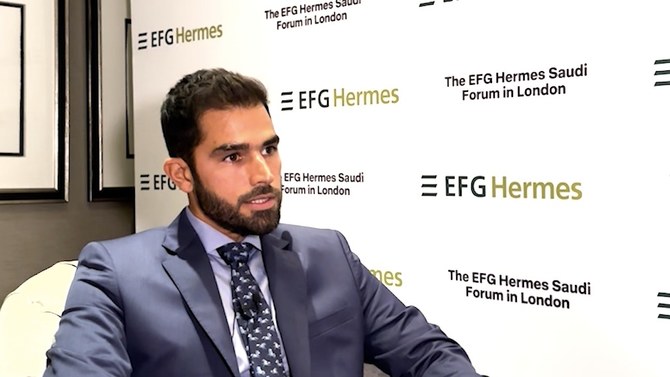

LONDON: International investors only need to look at the rise of the Saudi football league to see the opportunities available for them in the Kingdom, according to a top executive of financial services company EFG Hermes.
Speaking to Arab News at the firm’s Saudi Forum in London, Saud Altassan insisted that venture capitalists should be looking at every sector in the Kingdom as the Vision 2030 initiative continues to deliver reforms — with the Saudi Pro League the most eye-catching.
Altassan — the CEO of the company’s Saudi division — credited the plan as delivering a “complete overhaul” of the Kingdom’s economy, making it easier for firms like his to attract investors.
The executive also told Arab News that EFG Hermes was looking to expand its operations in the Kingdom, including moving department heads to the Saudi capital.
Reflecting on the increased attention paid to Saudi Arabia thanks to several high-profile football transfers — including Cristiano Ronaldo and Karim Benzema – Altassan said: “Maybe a few years ago, nobody would have thought the Saudi football league would be that relevant. Now, it’s extremely relevant.
“But I would think the same for other markets. Maybe some things may not be interesting now, but I assure you there are a lot of plans to actually enhance it that are being worked on behind the scenes, and so I wouldn’t overlook any market or sector in Saudi Arabia.”
The two-day forum is being held under the theme “Looking for Sustainable Growth,” with more than 375 participants.
There will also be representatives from around 50 Saudi companies, as well as delegates from the Saudi Capital Market Authority and the Public Investment Fund.
Altassan believes that the Vision 2030 initiative — which seeks to diversify the Kingdom’s economy away from a reliance on oil revenues — has transformed the marketability of Saudi Arabia when it comes to speaking to investors.
“It is literally a complete overhaul, and I think from a regulatory standpoint they’re trying to remove all kinds of hurdles and trying to entice investors,” he said, adding that the Saudi leadership have carried out a “full diagnostics” on what changes the economy needed.
He added: “But I think maybe the most impressive change that I’ve seen since then is the change in the mentality of Saudi individuals.
“Saudis now are more ambitious than they’ve ever been and full of optimism, and I think everything that you see in Saudi Arabia, including the performance of the stock market since the announcement of Vision 2030 in 2016, is a reflection of that.”
Altassan was keen to stress that every area of the Saudi economy was primed for investment and growth, with Vision 2030 representing “one of the most ambitious transformations for any economy.”
He added: “I wouldn't limit the way I think about what kind of potential changes need to happen, because I think everything that needs to happen is being discussed right now and is in the process of being changed.
“And so again, I would say we’re just at the beginning. So hopefully, there's a lot more to look forward to.”
Asked about his own company’s plans for expansion in Saudi Arabia, he said EFG Hermes had “huge ambitions” in the Kingdom as it is the firm’s “priority market” in the region.
“We’re expanding the team. We already have a sizeable team that a lot of people aren't aware of, but we are building out this team. We’re moving to a much bigger office, we’re moving some of their heads of some of the key divisions, including research to be based in Saudi ... they are based in Egypt right now, we're actually moving them to Saudi Arabia,” Altassan said.


