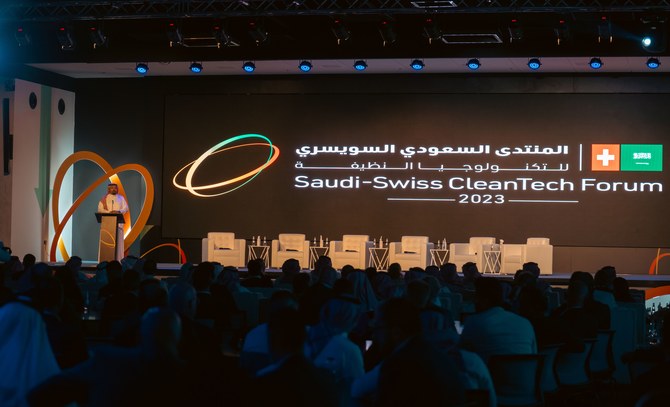

RIYADH: Saudi Arabia hosted the inaugural Saudi-Swiss CleanTech Forum 2023, bringing together Swiss companies and small and medium enterprises showcasing innovative solutions to address global challenges, combat climate change, and promote sustainability.
The event, a partnership between the Embassy of Switzerland in Saudi Arabia, the Research, Development and Innovation Authority, and King Abdulaziz City of Science and Technology, aimed to boost international trade and economic ties between the two nations. Discussions also revolved around the benefits of Saudi Arabia’s Vision 2030, striving to become a major industrial power and a global logistics hub.
The forum’s keynote speech was delivered by Saudi Arabia’s Minister of Economy and Planning, Faisal bin Fadel Al-Ibrahim. “There are two reasons why this gathering is important. First, the challenges that face our environment are far from being resolved. Second, is the uniqueness of the partnership between Saudi Arabia and Switzerland,” he said.
Al-Ibrahim stated that Saudi Arabia is a leading country in the Middle East for private sector investment, with around $5.5 billion invested in 2022.
He also mentioned significant projects, including the NEOM green hydrogen projects and a carbon capture facility.
“The NEOM green hydrogen projects, which can be commissioned in 2026, is another example, and it will be the world’s largest green energy facility and will be powered entirely by renewable energy.
“We’re also building a CCUS (carbon capture, utilization, and storage) facility with the capacity to capture 9 million tons annually of carbon emissions and we are targeting a capacity of 44 million by 2035 using multiple facilities,” the minister added.
Switzerland, known for its innovation, utilizes a “bottom-up” approach, with the government focusing on education and fundamental research to support companies.
“That’s why we call ourselves a bottom-up country where the government is tasked to sort of, you know, do the strategic framework conditions right, make sure that also our companies have access to markets abroad such as Saudi Arabia,” Helene Budliger Artieda, Swiss State Secretary for Economic Affairs, told Arab News in an interview.
Artieda explained that, in this model, the government's primary role is centered on funding a robust education system and supporting fundamental research at universities.
She added, “Transitioning to a greener world is a key priority for both the Kingdom and Switzerland, and our companies have been working hard in recent years. So, I think we have many solutions that we can bring to Saudi Arabia.”
She highlighted Switzerland’s expertise in areas such as railways and water treatment and management.
“We're the water castle of Europe. So, from hydropower to wastewater treatment, wastewater management, or water management, I think that will be a key opportunity for us,” Artieda explained.
She highlighted that there are various investment opportunities that Switzerland might be interested in, such as the Kingdom's vast areas, abundant solar parks, and green hydrogen initiatives.
Artieda emphasized the presence of numerous niche opportunities in the Kingdom, including investments in sustainable Saudi fashion. She noted that Switzerland has a well-established textile industry.
Furthermore, she expressed interest in the significant developments occurring in the global fashion industry, implying that Saudi Arabia is eager to align with global trends and standards, particularly those related to sustainability.
“I’ve learned how much the Kingdom is investing in sustainable fashion. We are a country that many people may not know has a long-standing textile industry,” she commented.
“The Kingdom is heavily investing in green hydrogen and then takes it to synthetic fuels. This is definitely something that we’re also interested in.”
On Sunday, Artieda held a meeting with the minister of economy and planning to discuss ways to expand economic relationships, explore the potential for trade and investment collaboration between their respective countries, and review topics of mutual interest.
“I think my job as a government representative will be to create that framework together with my counterparts here in Saudi Arabia, and I could really see that we are very much like-minded,” Artieda told Arab News.
She emphasized the significance of establishing a robust framework to facilitate this cooperation.
Moreover, she noted that Saudi Arabia and Switzerland have already made substantial progress in this regard, as evidenced by existing arrangements like the free trade agreement and the investment protection treaty.
Furthermore, Saudi Arabia’s National Industrial Development and Logistics Program organized a Saudi-Swiss symposium in Riyadh, as reported by the Saudi Press Agency on Sunday.
The event had several objectives, including shedding light on the Kingdom’s economic transformation and exploring investment opportunities between Saudi Arabia and Switzerland to unlock new capabilities and promising prospects.
Additionally, it discussed the role played by NIDLP in facilitating interactions between investors, companies, and ministries in Saudi Arabia to mitigate investment risks and increase returns in a sustainable manner.
Saudi Arabia’s non-oil exports to Switzerland are valued at around SR3.5 billion ($0.93 billion), while total imports from Switzerland into the Kingdom stand at approximately SR8 billion.