

Saudi manufacturing activity rises 8.7% in July: GASTAT

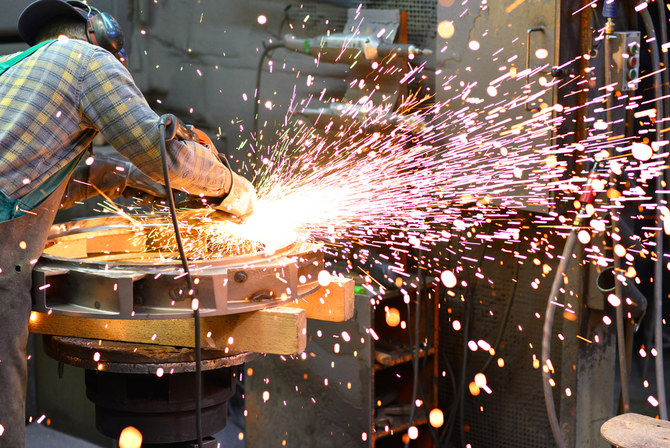
The activity of the manufacturing industry and electricity and gas supply in Saudi Arabia continued to rise in July, while mining and quarrying declined. Shutterstock
Short Url
Updated 11 September 2023
Follow

Saudi manufacturing activity rises 8.7% in July: GASTAT

RIYADH: Saudi Arabia’s manufacturing activity surged by 8.7 percent in July compared to the same period the previous year, as indicated by the latest report from the General Authority for Statistics. 

The report highlighted a 21 percent increase in electricity and supplies for July year-on-year. 

However, the Industrial Production Index witnessed a 9.5 percent decline in July 2023 compared to July 2022 when it had posted a 17.7 percent gain. 

“Although the activity of the manufacturing industry and the activity of electricity and gas supply continued to rise, the decline in the mining and quarrying activity during July 2023 led to the decrease in the general index, given its high weight in the index,” stated the report.  

The IPI’s trajectory has been declining since May, when it registered a 1.2 percent decrease, marking the first drop of the year. In contrast, it began the year on a positive note with a 6.8 percent rise in January. 

Compared to the annual IPI growth recorded in 2022, which saw an impressive 26.7 percent increase in April, this year’s overall performance has been less impressive. The IPI is largely influenced by the trends in the mining and quarrying, manufacturing, and electricity and gas supply sectors, with respective weights of 74.5 percent, 22.6 percent, and 2.9 percent. 

“Thus, the trend of the industrial production index in the mining and quarrying sector dominates the trend in the general IPI,” added the report.  

As a result, the decline in these activities has had a significant impact on industrial growth, leading to the index’s downturn since May.  

Additionally, Saudi Arabia’s reduction in oil production to 9 million barrels per day in July resulted in a 16.7 percent drop in mining and quarrying activities compared to the same period the previous year. 

Compared to June, the overall IPI decreased by 6.5 percent. This decline was primarily driven by significant drops in the mining and quarrying sector, which decreased by 9.5 percent, and the manufacturing sector, which saw a 1 percent decline.  

On the other hand, electricity and gas supplies increased by 11 percent, but due to their lower weight in the index, their impact remained limited. 


Emerging markets should depend less on external funding, says Nigeria finance minister

Updated 5 sec ago
Follow

Emerging markets should depend less on external funding, says Nigeria finance minister

RIYADH: Developing economies must rely less on external financing as high global interest rates and geopolitical tensions continue to strain public finances, Nigeria’s finance minister told Al-Eqtisadiah.

Asked how Nigeria is responding to rising global interest rates and conflicts between major powers such as the US and China, Wale Edun said that current conditions require developing countries to rethink traditional financing models.

“I think what it means for countries like Nigeria, other African countries, and even other developing countries is that we have to rely less on others and more on our own resources, on our own devices,” he said on the sidelines of the AlUla Conference for Emerging Market Economies.

He added: “We have to trade more with each other, we have to cooperate and invest in each other.” 

Edun emphasized the importance of mobilizing domestic resources, particularly savings, to support investment and long-term economic development.

According to Edun, rising debt servicing costs are placing an increasing burden on developing economies, limiting their ability to fund growth and social programs.

“In an environment where developing countries as a whole — what we are paying in debt service, what we are paying in terms of interest costs and repayments of our debt — is more than we are receiving in what we call overseas development assistance, and it is more than even investments by wealthy countries in our economies,” he said.

Edun added that countries in the Global South are increasingly recognizing the need for deeper regional integration.

His comments reflect growing concern among developing nations that elevated borrowing costs and global instability are reshaping development finance, accelerating a shift toward domestic resource mobilization and stronger economic ties among emerging markets.