


Morocco earthquake: A look at the world’s deadliest temblors over the past 25 years

1 / 5
Emergency workers carry a dead body, in the aftermath of a deadly earthquake, in Amizmiz, Morocco, on September 10, 2023. (REUTERS)
2 / 5
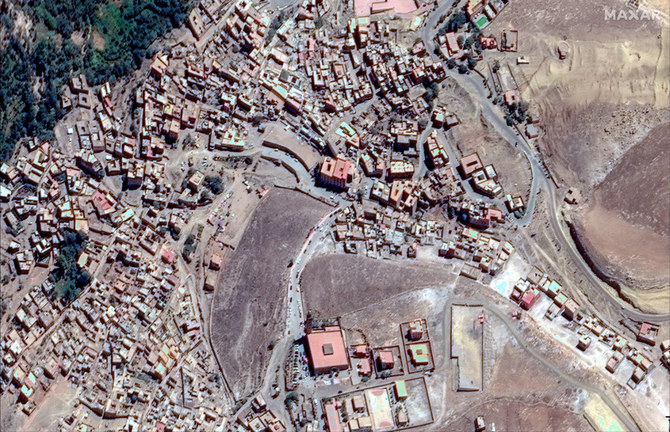
A satellite image shows collapsed buildings in Moulay Brahim, Morocco on September 10, 2023, two days after a powerful earthquake struck the North African country. (Maxar Technologies/Handout via REUTERS)
3 / 5
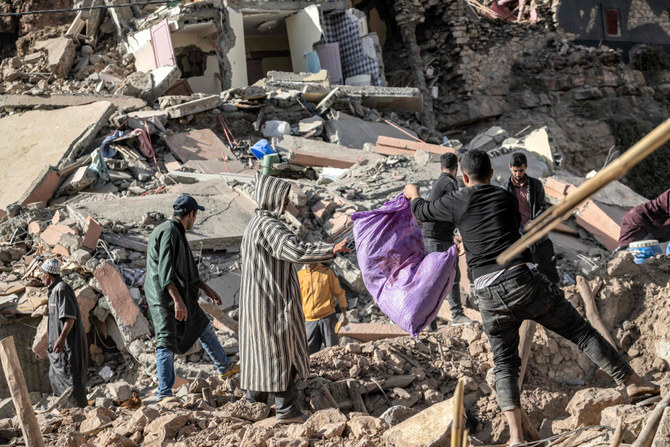
Using heavy equipment and even their bare hands, rescuers in Morocco on September 10 stepped up efforts to find survivors of a devastating earthquake that killed more than 2,100 people and flattened villages. (AFP)
4 / 5
Rescuers in Morocco were scrambling on September 9 to reach people trapped under the rubble after a powerful earthquake that killed more than 2,100 people and decimated entire villages. (AFP)
5 / 5
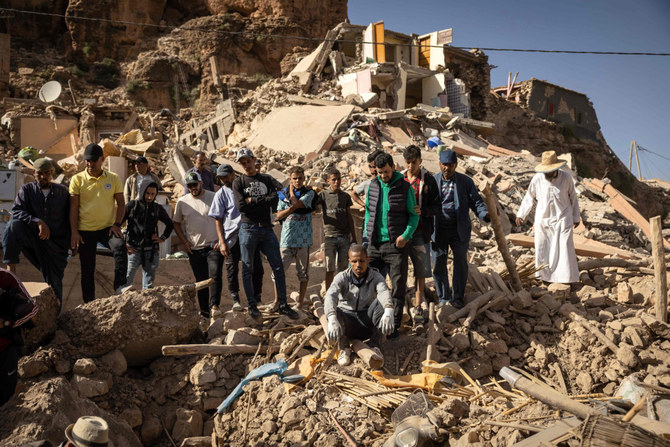
People survey the rubble of collapsed houses in the village of Imi N'Tala near Amizmiz in central Morocco on September 10, 2023, two days after the deadly 6.8-magnitude September 8 earthquake. (AFP)
Short Url
Updated 11 September 2023
Follow

Morocco earthquake: A look at the world’s deadliest temblors over the past 25 years

The earthquake that struck Morocco late Friday has killed more than 2,100 people, with the death toll expected to increase as rescuers reach hard-hit remote mountain areas.

Here’s a look at the deadliest earthquakes over the past 25 years:

  • Sept. 8, 2023: In Morocco, a magnitude 6.8 temblor kills more than 2,100 people.
  • Feb. 6, 2023: In Turkiye and Syria, a magnitude 7.8 earthquake kills more than 55,000 people.
  • April 25, 2015: In Nepal, more than 8,800 people are killed by a magnitude 7.8 earthquake.
  • March 11, 2011: A magnitude 9.0 quake off the northeast coast of Japan triggers a tsunami, killing more than 18,400 people.
  • Jan. 12, 2010: In Haiti, over 100,000 people are killed by a magnitude 7.0 quake. The government estimated a staggering 316,000 dead, but the scale of the destruction made an accurate count impossible.
  • May 12, 2008: A magnitude 7.9 quake strikes eastern Sichuan in China, resulting in over 87,500 deaths.
  • May 27, 2006: More than 5,700 people die when a magnitude 6.3 quake hits Indonesia’s Java island.
  • Oct. 8, 2005: A magnitude 7.6 earthquake kills over 80,000 people in Pakistan’s Kashmir region.
  • Dec. 26, 2004: A magnitude 9.1 quake in Indonesia triggers an Indian Ocean tsunami, killing about 230,000 people in a dozen countries.
  • Dec. 26, 2003: A magnitude 6.6 earthquake hits southeastern Iran, causing more than 20,000 deaths.
  • Jan. 26, 2001: A magnitude 7.6 quake strikes Gujarat in India, killing as many as 20,000 people.
  • Aug. 17, 1999: A magnitude 7.6 earthquake hits Izmit, Turkiye, killing about 18,000 people.

Source: AP archives, local governments, US Geological Survey


Drone strike kills 10, including 7 children, in Sudan’s El-Obeid: medical source

Updated 06 January 2026
Follow

Drone strike kills 10, including 7 children, in Sudan’s El-Obeid: medical source

  • An eyewitness said the strike hit a house in the center of the army-controlled capital of North Kordofan

PORT SUDAN, Sudan: A drone strike on the Sudanese city of El-Obeid killed 10 people including seven children on Monday, a medical source told AFP.
An eyewitness said the strike hit a house in the center of the army-controlled capital of North Kordofan, which the rival paramilitary Rapid Support Forces have sought to encircle for months.
Since April 2023, Sudan has been gripped by a war between the army and the RSF, with some of the worst violence currently unfolding in Sudan’s strategic southern Kordofan region.
El-Obeid, the region’s main city, lies on a key crossroads connecting the capital Khartoum with the vast western Darfur region — where the army lost its last major position in October.
Following its victory in Darfur, the RSF has pushed through Kordofan, seeking to recapture Sudan’s central corridor and tightening its siege with its local allies around several army-held cities.
Hundreds of thousands face mass starvation across the region.
Last year, the army broke a paramilitary siege on El-Obeid, which the RSF has sought to encircle since.
Drone strikes on Sunday caused a power outage in the city but left no reports of casualties.
Last week, a coalition of armed groups allied with the army said they had retaken several towns south of El-Obeid, which according to a military source could “open up the road between El-Obeid and Dilling” — one of South Kordofan’s besieged cities.
Since it began, the war has killed tens of thousands of people and forced more than 11 million people to flee internally and across borders.
It has also created the world’s largest hunger and displacement crises, and been described as a “war of atrocities” by the United Nations.