

Morocco quake not in most active area but expect aftershocks: Expert

1 / 3
2 / 3
3 / 3
Short Url
Updated 10 September 2023
Follow

Morocco quake not in most active area but expect aftershocks: Expert

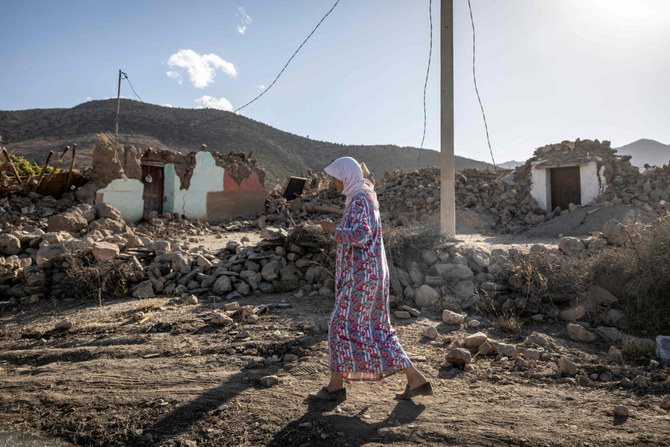
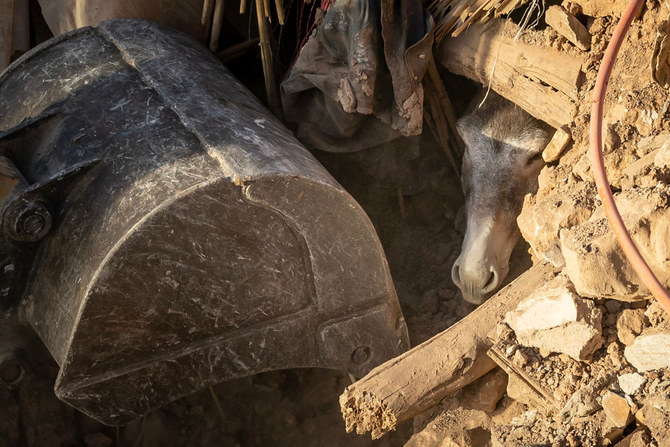
PARIS: The powerful earthquake that struck Morocco, killing more than 2,000 people, didn’t hit in the most active seismological region, said one French expert. But aftershocks can be expected, he warned.
Philippe Vernant — a specialist in active tectonics, particularly in Morocco, at the University of Montpellier — answered AFP’s question’s on the devastating quake.

Morocco is one of those countries where the question is not whether there will be earthquakes.

The Agadir earthquake (magnitude 5.7 in 1960) destroyed the entire city and killed almost 15,000 people, and more recently there was the Al Hoecima earthquake (magnitude 6.4 in 2004), further out on the Mediterranean.
Looking further back in history, there were earthquakes in the 18th century, probably around magnitude 7 in the Fez region.
The epicenter of the recent quake is not in the most active area of Morocco. But there are the High Atlas mountains... This type of earthquake is what leads to the rise of the High Atlas range.

In Turkiye, we had horizontal movement, because Turkiye is shifting to the West, moving toward Greece. There was a horizontal sliding of the (tectonic) plates.
Here, we’re seeing more of a convergence between Africa and Eurasia or Iberia, the Spanish part, and overlapping faults... But we are still dealing with plate boundaries.

We need to see what magnitude the earthquake will be. We’re talking about 6.8 or 6.9, which is quite strong.
This corresponds roughly to an average displacement on the fault line of around one meter in a few seconds, over several kilometers.
Obviously, this shakes the region enormously.

Then there’s the depth: at first it was estimated to be at around 25-30 kilometers, but it seems to be going back up, closer to 10 kilometers.
The closer you get to the surface, the greater the effect of the rupture.
This is what happened in France in 2019 in the Teil region in the (southern) Ardeche region. It was a “small” earthquake, but as it occurred at a depth of just one kilometer, it shook things up a lot.

Aftershocks are bound to occur.

Even if they are less strong, they can lead to the collapse of buildings already weakened by the earthquake.
Traditionally, we tend to say that aftershocks diminish in intensity...
But in Turkiye, one earthquake triggered another. The first tear can lead to the rupture of another fault through a cascade effect, which is why there is sometimes a risk of a stronger earthquake after the first one.

Unfortunately, we can’t predict anything.
We try to estimate recurrence periods according to the different magnitudes of the earthquakes, but then the behavior can be chaotic, with two strong earthquakes over a short period and then nothing for a very long time.


Indonesia’s first woman president awarded honorary doctorate by Princess Nourah University

Updated 10 February 2026
Follow

Indonesia’s first woman president awarded honorary doctorate by Princess Nourah University

  • Megawati was recognized for her leadership and contributions to social, legal affairs
  • She has received 10 other honorary degrees from Indonesian and foreign institutions

JAKARTA: Megawati Sukarnoputri, who served as Indonesia’s fifth president and was the country’s only female head of state to date, has been awarded an honorary doctorate by Princess Nourah bint Abdulrahman University in Riyadh, becoming the first foreign national to receive the title.

Megawati, the eldest daughter of Indonesia’s first President Sukarno and chairwoman of the country’s largest political party, the PDIP, served as president from 2001 to 2004.

The 79-year-old was awarded an honorary doctorate in organizational and legal affairs in Riyadh on Monday during a ceremony overseen by Princess Nourah University’s acting president, Dr. Fawzia bint Sulaiman Al-Amro.

“This recognition was given in appreciation of her efforts during her presidency, her significant contributions to social, organizational, and legal fields, and her role in strengthening institutional leadership in Indonesia,” the university said in a statement.

This is Megawati’s 11th honorary doctorate. She has received similar degrees from Indonesian and foreign universities, including the Moscow State Institute of International Relations in 2003 and the Soka University of Japan in 2020.

She has also been awarded the title of honorary professor by several institutions, including by the Seoul Institute of the Arts in 2022.

“We gather at the Princess Nourah bint Abdulrahman University, a university that stands as a symbol of women’s progress in education, knowledge and public service … To see so many intelligent women, I feel very proud,” Megawati said in her acceptance speech.

“Women’s empowerment is not a threat to any values, culture or tradition. It is actually a condition for nations that believe in their future … A great nation is one that is able to harness all of its human potential. A strong nation is one that does not allow half of its social power to be left on the sidelines of history.”

Megawati is the longest-serving political leader in Indonesia. Indonesia’s first direct presidential elections took place during her presidency, consolidating the country’s transition to democracy after the downfall of its longtime dictator Suharto in 1998.