

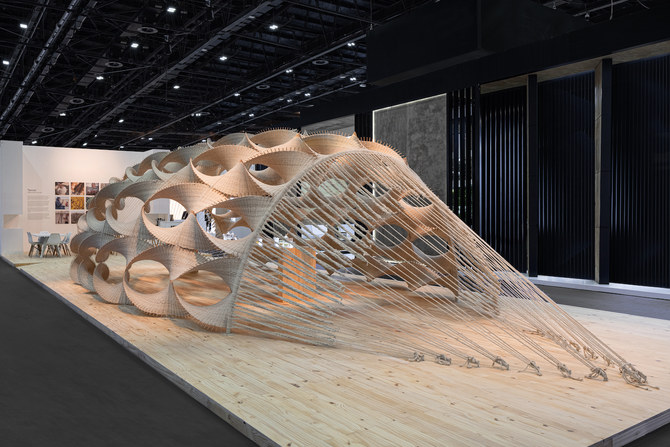

LONDON: Over the past five years, Jordanian Palestinian architect, artist and cultural producer Abeer Seikaly has been working closely with Bedouin women of the Howeitat tribe in Al-Jafr within Jordan’s Badia desert landscape to incorporate their knowledge of ancient styles of weaving into her designs.
She has described the women as the “silent architects” behind “Beit Al-Sha’ar” — literally “House of Hair” or Bedouin tent — and regards the gradual loss of their traditional craftsmanship knowledge and heritage as a “waste of valuable economic potential.”

Terroir Textiles Rolled for Transportation, Abeer Seikaly. (Supplied)
She used the yarns woven on their traditional ground looms to create a structure that has a modern aesthetic with clear cultural and historical ties to the region. The mobile pavilion, named “Terroir” which translates as “land” or “earth,” celebrates Bedouin heritage and lineage. It is rollable, easy to set up, dismantle and transport and ideal as a place for respite or community events.
She noted: “Technologies of handcraft, merged with the digital processes of today, can bring fluidity to contemporary architectural and design practices. This combination can create intricate connections among systems and deepen our understanding of how material, geometry, and structural form interact and influence each other, as well as how they adapt to the environment.”
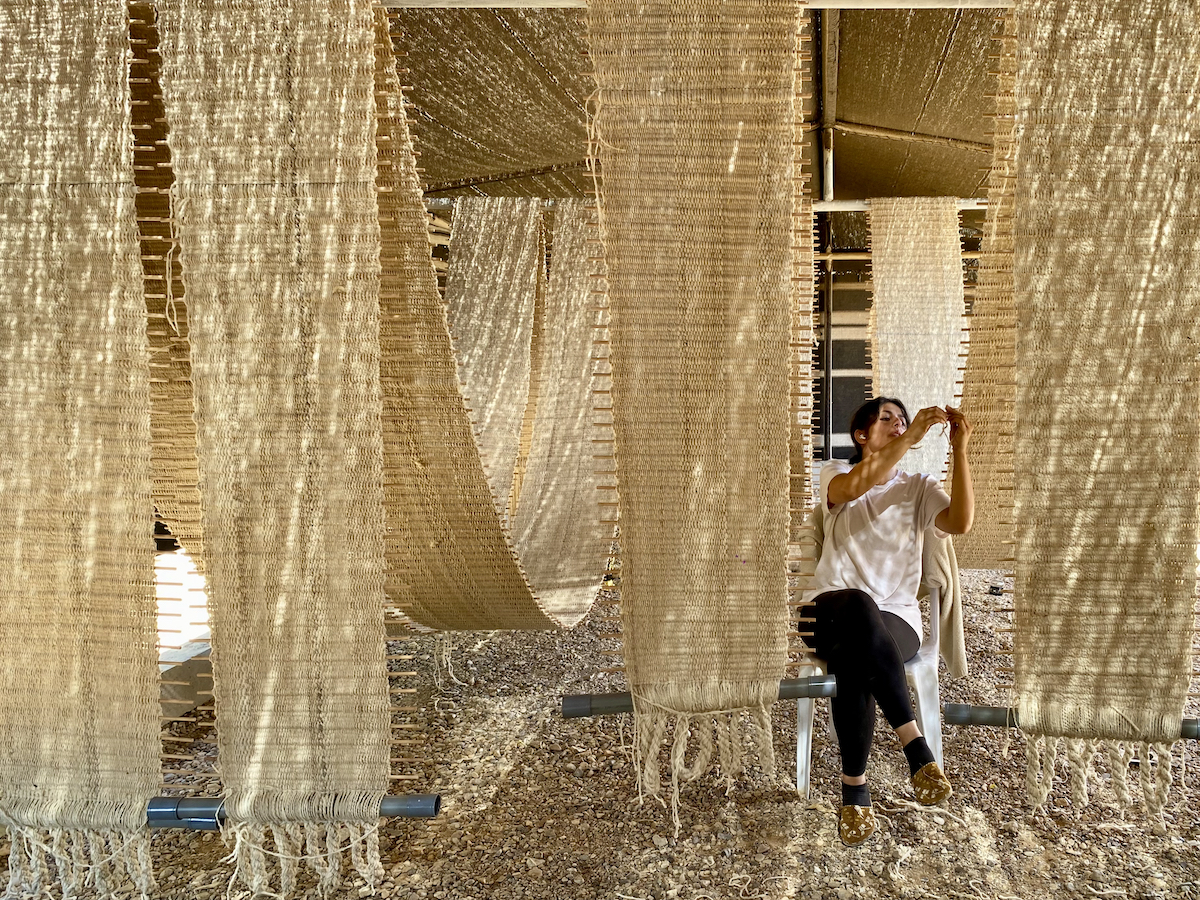
Abeer finishing her Woven Textiles. (Supplied)
For Seikaly the link with her heritage goes deep. One of her most treasured possessions is a Bedouin rug handwoven by her great-grandmother which is characteristic — through its colors and pattern — of the town of Madaba in Jordan.
She explained to Arab News that increasingly she asks herself in relation to her work: “How do you use shelter as a catalyst in order to allow communities to thrive?” The project, she said, has been beneficial in terms of providing the women with a source of income and showing how ancient crafts and techniques can work within contemporary design.

Seikaly’s great grandmother, Eideh-Shuwayhat. (Supplied)
Alongside her collaboration with the Bedouin collective, Seikaly is also continuing to work on an innovative refugee shelter. The lightweight structure is “able to withstand varying climatic conditions, integrate water collection, harness renewable energy (the structure absorbs solar energy, transforming it into electric energy stored in special batteries) and allows for controlled ventilation, providing many of the comforts of a dignified contemporary life,” she said.
She has just been granted a patent in the UK where many of the engineers she works with are based and has also applied for a patent in the US.
She wants to bring fresh thinking to what is an increasingly severe global humanitarian crisis. The goal is to find approaches that work in harmony with natural resources, long-established ways of living and the industrialized world.


