KARACHI: Pakistan awaits International Monetary Fund’s (IMF) nod before announcing any relief for electricity consumers paying excessively high bills amid mounting public discontent, confirmed a senior official privy to the ongoing negotiations between the two sides on Friday.
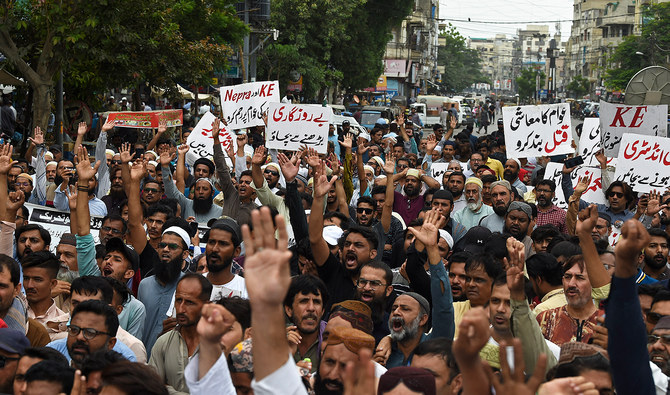
The government approached the international lender in recent weeks to secure concessions for electricity consumers who received inflated bills for the month of July which sparked popular protests across Pakistan where many people torched copies of the official payment notices.
Subsequently, the country sought relief from the IMF, which approved a $3 billion bailout program in July after Pakistan agreed to implement stringent economic reforms, to help people consuming up to 400 units of electricity.
However, it has still not received the required permission.
“Pakistan has shared various options with the IMF on how to provide relief to power consumers, but its response is still awaited,” a finance division official told Arab News on condition of anonymity due to the sensitive nature of the issue.
He added that the fund was more interested in reviewing the country’s overall financial progress under the bailout agreement which is expected to take place somewhere in the last two months of the year.
Power tariff surged by about 27 percent along with a proportionate increase in various taxes after Pakistan’s National Electric Power Regulatory Authority (NEPRA) announced Rs4.96 increase per unit in June.
Since the coalition administration of former prime minister Shehbaz Sharif failed to implement the rates immediately, electricity consumers started receiving inflated bills in August.
This delay in the implementation resulted in up to 60 percent higher bills that led to countrywide protests and prompted Caretaker Prime Minister Anwaar-ul-Haq Kakar to initiate talks with the IMF to secure relief for the consumers.
Pakistani officials proposed to address the concerns of some 80 percent consumers who utilized 400 units, though they said they were even willing to reduce the threshold to 200 units during their conversations with the IMF.
“Relief means that a certain portion of the payable amount will be received in later months,” the financial division official said. “It does not mean that it will be completely waived off.”
He noted that any mechanism to facilitate the consumers will ultimately depend on the IMF approval.
Pakistan’s caretaker information minister Murtaza Solangi also maintained the same thing on Thursday, saying the government could not announce a relief plan without getting a nod from the international lender.
Solangi could not be approached despite repeated attempts to comment on the latest progress in the country’s conversation with the IMF.
An independent Pakistani financial expert privy to these developments said the government’s proposals had not moved the IMF until yesterday.
“As per our background check, the fund had turned down the proposals sent to them by the authorities,” Dr. Vaqar Ahmed, Joint Executive Director at Sustainable Development Policy Institute (SDPI), told Arab News. “They were insisting on discussing the upcoming review of the bailout program.”
“To get the relief from the fund,” he continued, “the prime minister will have to personally speak with the IMF managing director like the former premier Shahbaz Sharif did.”
Sharif had met the top IMF official, Kristalina Georgieva, three time which helped his administration secure the current $3 billion loan facility for nine months.
“The new prime minister will have to pull up his socks and meet the IMF managing director himself,” Ahmed added. “This is not something you can leave to your economic team.”
He also maintained the caretaker government should knock the door of its allies and friendly countries, including the United States and Saudi Arabia, to seek their help in persuading the IMF.
The SDPI official said the Kakar administration would need to convince the fund on technical grounds and share the progress made to fulfil the requirements of upcoming review.


![]()

Pakistan awaits IMF’s decision to alleviate electricity consumer burden — official
Short Url
https://arab.news/nj7ub
Pakistan awaits IMF’s decision to alleviate electricity consumer burden — official
- Pakistani power consumers received inflated bills in August which led to sporadic but widespread protests
- Independent expert says the interim PM should speak to the top IMF official to extract a favorable response
Latest updates







© 2026 SAUDI RESEARCH & PUBLISHING COMPANY, All Rights Reserved And subject to Terms of Use Agreement.