

Pakistan opens doors for private sector wheat imports to tackle staple food shortage

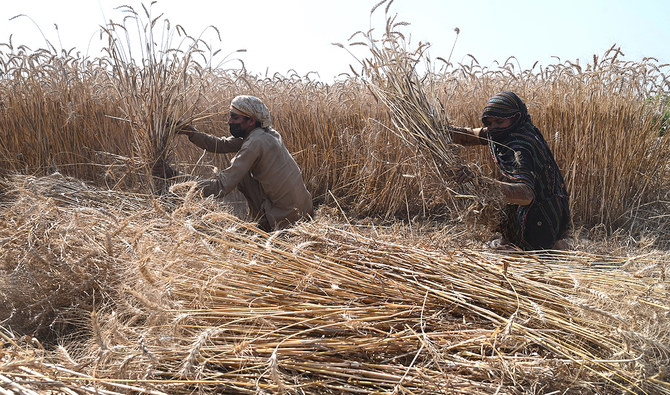
Farmers harvest wheat crop in a field on the outskirts of Lahore on April 14, 2022. (AFP/File)
Short Url
Updated 08 September 2023
Follow

Pakistan opens doors for private sector wheat imports to tackle staple food shortage

  • Traders have booked 0.7 million metric tons of wheat, with first shipment of 55,000 tons expected on September 17
  • Food ministry says the government allowed wheat import to overcome shortage, bring down prices in local market

ISLAMABAD: The government has allowed wheat import to the country’s private sector to overcome the shortage of the commodity in open market, officials said on Friday, while hoping it would help address the hoarding issue and bring down wheat prices in the local market to benefit consumers.

Wheat is a staple food in Pakistan and its shortage can lead to political unrest and protests against governments. The South Asian nation of 241 million is currently facing a shortfall of 2.45 million metric tons of the commodity and has allowed the import to fill the gap amid deteriorating macroeconomic situation.

The country has been importing the grain from Russia and Ukraine for the last three years due to low domestic yield and growing consumption spurred by an increase in population. The country’s total wheat production was recorded at 27.5 million metric tons this year, leaving a gap of over 3 million metric tons to meet the domestic needs.

“The government has allowed the private sector to import the wheat to help overcome the shortage and bring down its prices in the local market,” Dr. Syed Waseem ul Hassan, Food Security Commissioner at the Ministry of National Food Security and Research, told Arab News.

He said this was “the best time” for wheat import since its prices were down in the international market.

“It is a good thing that the private sector has come forward to bridge the gap through import,” he continued.

Traders have finalized 12 deals for the import of 0.7 million metric tons of wheat at $282-295 per metric ton and the first shipment of 55,000 tons is expected to reach Pakistan on September 17, as per the chairman of the Cereal Association of Pakistan, Muzammil Chappal.

“We have come forward to serve the nation at a time when inflation is skyrocketing and it is becoming increasingly difficult for a chunk of our population to have two square meals a day,” he told Arab News.

Chappal said the commodity’s price in the local market was expected to come down by Rs20-25 per kilogram with the arrival of the imported wheat.

“The government has allowed us to import wheat until March 2024 and we have requested the food ministry to issue an official notification in this regard for traders’ confidence,” he said.

“The wheat import will definitely bring stability in flour prices, benefiting consumers at large,” he added.

Food security experts have advised the government to announce wheat support price by mid-October to encourage farmers and ensure timely provision of fertilizers and pesticides to get maximum yield.

“The quality wheat seeds have been developed over the years and are easily available to farmers which give eighty to ninety maunds per acre yield,” Dr. Javed Ahmad, director wheat at Ayub Agricultural Research Institute in Faisalabad, told Arab News. One maund is equal to forty kilograms.

Ahmad said the wheat per acre yield recorded a six percent increase last year due to the quality seed varieties that made agriculture a profitable business for farmers.

“Timely availability of fertilizers and pesticides to farmers on competitive rates can help further improve our wheat yield and get rid of imports to fulfil the domestic needs,” he said, suggesting the government to try to increase the wheat cultivation area from nine million hectares to 10 million hectares to help farmers ensure early harvest of cotton, rice and sugarcane.

“Farmers can ensure balanced use of fertilizers in their wheat crop and proper weed control to get the maximum yield,” he suggested.


Pakistan saw 73% increase in combat-related deaths in 2025— think tank

Updated 28 December 2025
Follow

Pakistan saw 73% increase in combat-related deaths in 2025— think tank

  • Pakistan reported 3,387 deaths thus year, among them 2,115 militants and 664 security forces personnel, says think tank
  • Civilian deaths increased by 24% to 580 in 2025, compared to 468 in 2024, as Pakistan saw 1,063 militant attacks in 2025

ISLAMABAD: Combat-related deaths in Pakistan this year increased by 73%, with both security forces and militants suffering casualties in large numbers, a report published by an Islamabad-based think tank said on Sunday.

As per statistics released by the Pakistan Institute for Conflict and Security Studies (PICSS), combat-related deaths in 2025 rose 73% to 3,387, compared with 1,950 in 2024. These deaths included 2,115 militants, 664 security forces personnel, 580 civilians and 28 members of pro-government peace committees (combatants), the think tank said in a press release. 

“Militants accounted for about 62% of total combat-related deaths, and their 2,115 fatalities represented the highest annual militant death toll since 2015, when 2,322 militants were killed,” PICSS said. 

Compared to last year, militant deaths recorded a steep increase by 122% as the PICSS reported that 951 militants had been killed in 2024.

The think tank, however, said this year was also particularly bloody for Pakistani security forces. PICSS recorded 664 security personnel deaths in 2025, a 26% rise from 528 in 2024, and the highest annual figure since 2011, when 677 security forces personnel lost their lives. 

Civilian deaths also increased by 24% to 580 in 2025, compared with 468 in 2024, marking the highest annual civilian toll since 2015, when 642 civilians were killed. 

As per the PICSS report, at least 1,063 militant attacks took place in 2025, a 17% increase compared with 908 in 2024 and the highest annual total since 2014, when 1,609 militant attacks were recorded. 

The report also noted a 53 percent increase in suicide attacks this year, with 26 such incidents reported in 2025 compared with 17 in 2024. 

“PICSS noted an expanding trend in the use of small drones, including quadcopters, with 33 such incidents recorded during 2025, alongside increased use of unmanned aerial vehicles by security forces,” the report said. 

The report noted an 83% rise in arrests of suspected militants, with 497 arrested in 2025 compared to 272 in 2024. 

This 2025 figure is the highest annual total of suspected militants arrested since 2017, when 1,781 militants were either arrested or laid down their weapons.

“PICSS noted that most violence remained concentrated in Pashtun-majority districts of Khyber Pakhtunkhwa, including the tribal districts (erstwhile FATA), and in Balochistan,” it said. 

Pakistan has been grappling with a surge in militant attacks in its western provinces of Khyber Pakhtunkhwa and Balochistan, both bordering Afghanistan, this year. 

Islamabad blames Afghanistan for providing sanctuaries to militants it alleges use Afghan soil to carry out attacks against Pakistan. Kabul denies the charges.