

Durra gas field belongs to Saudi Arabia and Kuwait, say GCC ministers

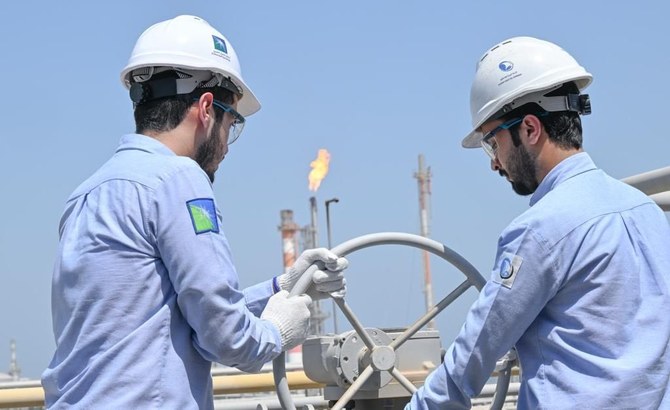
Joint Al-Khafji Joint Operations said that work had resumed at the site. (KJO)
Short Url
Updated 08 September 2023
Follow

Durra gas field belongs to Saudi Arabia and Kuwait, say GCC ministers

RIYADH: Al-Durra gas field is exclusively owned by Saudi Arabia and Kuwait, and they alone have the right to its natural resources, Gulf ministers said on Thursday.

The Gulf Cooperation Council foreign ministers gathering in Riyadh also rejected “any claims that any other party has rights in this field or the submerged area adjacent to the area divided by its designated borders between the Kingdom of Saudi Arabia and the State of Kuwait,” in a statement issued by the bloc.

In July, Iran’s oil minister said his country will “pursue its rights and interests regarding exploitation and exploration” of the field, which Saudi Arabia and Kuwait have criticized.  

The Saudi Foreign Minister Prince Faisal bin Farhan called on Iran to engage in negotiations to demarcate the eastern border of the area. Saad Al-Barrak, Kuwait’s oil minister, said he was surprised by the Iranian plan and added that the move from Tehran contradicts the basic principles of international relations.  

“The ownership of the natural resources in the submerged area adjacent to the Saudi-Kuwaiti divided zone, including the entire Al Durra field, is joint ownership between the Kingdom of Saudi Arabia and the State of Kuwait only, and they alone have full rights to exploit the wealth in that area,” the GCC statement said.

The Joint Al-Khafji Joint Operations, which comprises Kuwait Gulf Oil Company and Aramco for Gulf Operations, said on Thursday that production at the divided zone had resumed on Tuesday after the first phase after the completion of maintenance. In December both entities signed a memorandum of understanding to develop the field, which is expected to produce about one billion cubic feet of natural gas per day, along with 84,000 barrels of liquefied gas.

The Al-Durra gas field is a common submerged area between Saudi Arabia and Kuwait located in the Arabian Gulf. It is situated within the Al-Ahsa governorate, which is a part of the Eastern province of Saudi Arabia.

The discovery of this oil field dates back to the 1960s, which coincided with the commencement of the demarcation process for the maritime borders between Saudi Arabia and Kuwait.

The Al-Durra oil field’s strategic importance and the potential wealth it holds have attracted the attention of neighboring countries, particularly Iran.

The dispute over its ownership and exploitation rights arises from differing interpretations of maritime boundaries and conflicting claims by Tehran.

In 2001, Iran began granting contracts for its exploration, which prompted Saudi Arabia and Kuwait to finalize the demarcation of their maritime borders, which included the Al-Durra oil field.

GCC ministers also rejected Iranian occupation of the three UAE Islands of Greater Tunb, Lesser Tunb, and Abu Musa, calling on Tehran to consider Emirati efforts to resolve the issue through dialogue.

They stressed “support for the sovereignty of the United Arab Emirates over its three islands, territorial waters, airspace, continental shelf, and economic zone, as an indivisible part from the territory of the United Arab Emirates, and considering that any practices or actions carried out by Iran on the three islands are null, void and have no effect on the right of the sovereignty of the United Arab Emirates over its three islands.”

UN expert on Palestinian territories denounces ‘toxic’ attacks against her

Updated 3 sec ago
Follow

UN expert on Palestinian territories denounces ‘toxic’ attacks against her

  • Francesca Albanese: ‘I can tell you how toxic and personally damaging for me and for my family these past days, weeks and months have been’
  • Albanese’s family sued US President Donald Trump’s administration, saying sanctions are ‘effectively debanking her and making it nearly impossible to meet the needs of her daily life’
GENEVA: The UN expert on the Palestinian territories, Francesca Albanese, denounced on Thursday what she described as “toxic” attacks impacting her personal life and work, after a number ​of European states called for her resignation.
In recent weeks Germany, France, Italy and others have called for Albanese to step down over her criticism of Israel. Albanese, an Italian lawyer, said the remarks were taken out of context and misconstrued.
“I can tell you how toxic and personally damaging for me and for my family these past days, weeks and months have been,” Albanese, Special Rapporteur on human rights in the occupied Palestinian territories, told reporters via video link from Jordan.
A letter seen by Reuters, sent by ‌the permanent mission ‌of Israel in Geneva to the Council’s president on 15 ​February, stated ‌that ⁠she ​had flagrantly ⁠violated the UN’s code of conduct.
“As long as she holds a UN mandate, she fundamentally undermines the credibility and moral authority of the United Nations,” the letter stated, adding that Albanese had repeatedly shared antisemitic tropes — allegations that Albanese has previously denied.
On Tuesday the ambassador to the French mission to the UN in Geneva reiterated concerns by the French foreign minister of “extremely problematic statements” by a United Nations Special Rapporteur — in an apparent reference to Albanese, ⁠without mentioning her by name.
“All those who speak under the ‌auspices of the United Nations — including Special Rapporteurs — must ‌exercise the restraint, moderation, and discretion required by their mandate,” Céline ​Jurgensen told delegates at the UN ‌Human Rights Council.
Albanese described sanctions imposed on her by the United States in July ‌as being part of a broader strategy by the current US administration to weaken international accountability mechanisms.
The US sanctioned Albanese for what it described as “illegitimate and shameful efforts to prompt (International Criminal Court) action against US and Israeli officials, companies, and executives” in a report to the Human Rights Council.
“These smears, ‌the sanctions, the continuous attacks from all over, from those very states who should use that energy as stamina to go ⁠after those who ⁠are accused by the highest court in the world of war crimes, crimes against humanity and genocide,” Albanese stated.
Albanese’s family sued US President Donald Trump’s administration on Wednesday, saying those sanctions are “effectively debanking her and making it nearly impossible to meet the needs of her daily life.”
The US State Department did not immediately respond to a request for comment on the lawsuit, which was filed in federal court in Washington.
Israel has strongly denied and dismissed allegations of genocide. In September Israeli ambassador Daniel Meron said a UN report which said top Israeli officials had incited genocide during the war in Gaza was “scandalous” and “fake.”
The president of the UN Human Rights Council, Sidharto Reza Suryodipuro, on Monday expressed concern ​and regret at personal attacks directed “against certain ​mandate holders” at the Council and reiterated his support for them.
“Their independence and protection remains essential to the effectiveness, credibility and legitimacy of the council’s collective action.”