

Pakistan invites US to join projects under Special Investment Facilitation Council

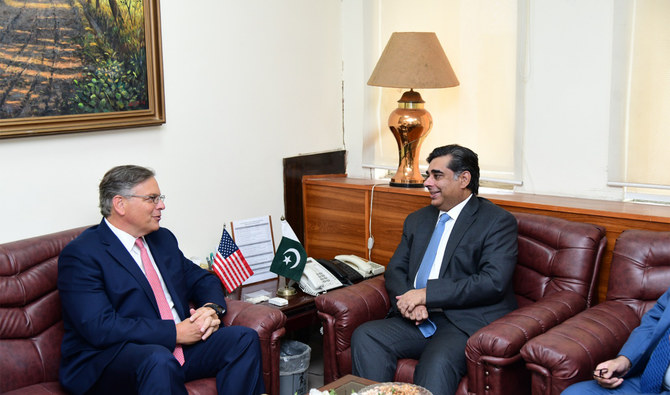
Pakistani caretaker minister for commerce, Dr. Gohar Ejaz (right), meets US Ambassador Donald Blome in Islamabad, Pakistan on September 7, 2023. (Photo courtesy: Government of Pakistan Ministry of Commerce Industries and Production)
Short Url
Updated 07 September 2023
Follow

Pakistan invites US to join projects under Special Investment Facilitation Council

  • SIFC, a civil-military hybrid body, was formed in June to attract investments from GCC and other foreign nations
  • US envoy, commerce minister discuss trade in textiles, value-added food products, mangos, dates, soybean, beef

ISLAMABAD: Pakistani caretaker minister for commerce, Dr. Gohar Ejaz, met US Ambassador Donald Blome on Thursday and invited Washington to explore opportunities under a Special Investment Facilitation Council (SIFC) formed in June to attract foreign investment.

SIFC is a hybrid civil-military forum aimed to fast-track decision making and promote investment from foreign nations, particularly Gulf countries. 

“Ejaz informed [US envoy] that the Government of Pakistan has formed a Special Investment Facilitation Council aimed at attracting investments in various sectors such as Mines and Minerals, Agriculture, Information Technology, and Energy and he invited that more US companies could explore the options to invest in these sectors,” the ministry of commerce said in a statement.

“The Minister elaborated on the government’s efforts for economic revival plan with the Ambassador underscoring the importance of economic growth of Pakistan’s future and appreciated the US government for their continued support.”

Among key highlights of the meeting was a discussion on potential opportunities for boosting trade in various sectors, including textiles, value-added food products, fresh mangos, dates, soybean and beef.

A notification dated June 17 from then Prime Minister Shehbaz Sharif’s Office said SIFC would seek investments in the energy, IT, minerals, mining, defense, and agriculture sectors from GCC countries. 

The body, which has the army chief and other military leaders in key roles, aims to take a “unified approach” to steer the country out of economic crisis.

Pakistan has reportedly approved 20 projects to pitch for multibillion-dollar investments from Gulf and other states under the SIFC umbrella.

The identified projects include the Saudi Aramco Refinery, TAPI Gas Pipeline, Thar Coal Rail Connectivity, hydropower projects of 245 MW in Gilgit-Baltistan, handing over of 85,000 acres of land to a single investor, the establishment of cloud infrastructure, and telecom infrastructure deployment.

On Monday, caretaker Prime Minister Anwaar-ul-Haq Kakar confirmed Pakistan would get $25 billion each from Saudi Arabia and the UAE for investments in IT, mining, minerals and agriculture. Riyadh and Abu Dhabi have not yet commented on the PM’s statement. 


Pakistan reports current account surplus in Jan. owing to improved trade, remittances

Updated 17 February 2026
Follow

Pakistan reports current account surplus in Jan. owing to improved trade, remittances

  • Pakistan’s exports crossed the $3 billion mark in Jan. as the country received $3.5 billion in remittances
  • Last month, IMF urged Pakistan to accelerate pace of structural reforms to strengthen economic growth

ISLAMABAD: Pakistan recorded a current account surplus of more than $120 million in January, the country’s finance adviser said on Tuesday, attributing it to improved trade balance and remittance inflows.

Pakistan’s exports rebounded in January 2026 after five months of weak performance, rising 3.73 percent year on year and surging 34.96 percent month on month, according to data released by the country’s statistics bureau.

Exports crossed the $3 billion mark for the first time in January to reach $3.061 billion, compared to $2.27 billion in Dec. 2025. The country received $3.5 billion in foreign remittances in Jan. 2026.

Khurram Schehzad, an adviser to the finance minister, said Pakistan reported a current account surplus of $121 million in Jan., compared to a current account deficit of $393 million in the same month last year.

“Improved trade balance in January 2026, strong remittance inflows, and sustained momentum in services exports (IT/Tech) continue to reinforce the country’s external account position,” he said on X.

Pakistan has undergone a difficult period of stabilization, marked by inflation, currency depreciation and financing gaps, and international rating agencies have acknowledged improvements after Islamabad began implementing reforms such as privatizing loss-making, state-owned enterprises (SOEs) and ending subsidies as part of a $7 billion International Monetary Fund (IMF) loan program.

Late last month, the IMF urged Pakistan to accelerate the pace of these structural reforms to strengthen economic growth.

Responding to questions from Arab News at a virtual media roundtable on emerging markets’ resilience, IMF’s director of the Middle East and Central Asia Jihad Azour said Islamabad’s implementation of the IMF requirements had been “strong” despite devastating floods that killed more than 1,000 people and devastated farmland, forcing the government to revise its 4.2 percent growth target to 3.9 percent.

“What is important going forward in order to strengthen growth and to maintain the level of macroeconomic stability is to accelerate the structural reforms,” he said at the meeting.

Azour underlined Pakistan’s plans to privatize some of the SOEs and improve financial management of important public entities, particularly power companies, as an important way for the country to boost its capacity to cater to the economy for additional exports.

“This comes in addition to the effort that the authorities have made in order to reform their tariffs, which will allow the private sector of Pakistan to become more competitive,” the IMF official said.