

Pakistan eyes $50 billion trade potential with Central Asia amid economic crisis

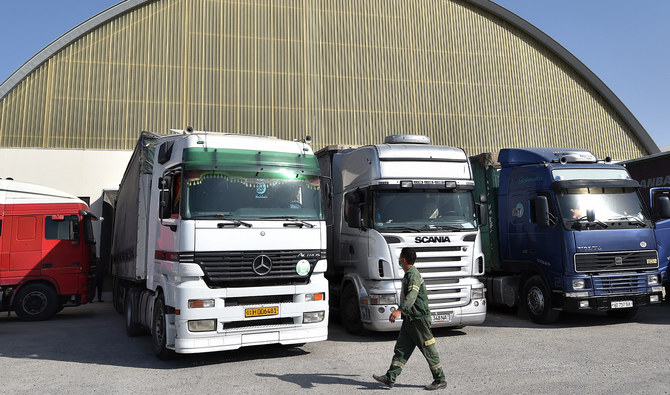
A driver walks near trucks in Termez Cargo Centre near the city of Termez, some 800 kms from Uzbekistan capital Tashkent, on October 18, 2021. (Photo courtesy: AFP/File)
Short Url
Updated 07 September 2023
Follow

Pakistan eyes $50 billion trade potential with Central Asia amid economic crisis

  • Pakistan’s caretaker commerce minister pledges to enhance bilateral trade with Uzbekistan to $1 billion this year
  • Army chief also visited Uzbekistan this week in a trip widely believed to be aimed at generating foreign investment

ISLAMABAD: Pakistani caretaker commerce minister, Dr. Gohar Ejaz, this week highlighted the country’s potential to enhance trade with Central Asian to $50 billion, as the cash-strapped South Asian country looks to bolster trade relations and foreign investments.

Pakistan has been desperately seeking foreign investment as it reels from an economic crisis that has seen its national currency depreciate to historic lows against the US dollar and its foreign exchange reserves plummet to critically low levels. The last few weeks have been marred by nationwide protests and strikes over record fuel and electricity bills. 

As part of its recovery plan, Pakistan set up a hybrid civil-military investment council in June to attract international investments particularly in agriculture, mining, minerals, and other sectors. Caretaker Prime Minister Anwaar-ul-Haq Kakar confirmed on Monday Islamabad was expecting investments to the tune of $25 billion each from Saudi Arabia and the UAE within the next two to five years.

“Federal Minister for Commerce, Dr. Gohar Ejaz Unveils $50 Billion Trade Potential with Central Asia on Independence Day Celebration of Uzbekistan,” Pakistan’s Ministry of Commerce said in a statement earlier this week. 

Ijaz pledged to enhance Pakistan’s bilateral trade with Uzbekistan to $1 billion within the current year, the ministry said, adding that Pakistan and Uzbekistan had made “substantial progress” in bilateral trade, increasing it from $27 million in 2019-20 to $126.05 million in 2022-23.

“A roadmap has already been signed to boost bilateral trade and facilitate investment by eliminating non-tariff trade barriers,” the statement added.

Islamabad and Tashkent have taken steps to bolster bilateral trade this year including signing a $1 billion trade agreement in February to encourage the exchange of goods and services between the two countries. The agreement was followed by the arrival in Pakistan of a convoy of trucks carrying liquefied petroleum gas (LPG) from Uzbekistan via Afghanistan in June.

Pakistan’s army chief General Syed Asim Munir also visited Uzbekistan this week in what was widely believed to be a trip to generate appetite for foreign investments, and enhance military-to-military cooperation and defense collaboration.



Pakistan to sell excess gas in international markets from Jan.1— petroleum minister

Updated 24 min 6 sec ago
Follow

Pakistan to sell excess gas in international markets from Jan.1— petroleum minister

  • Pakistan was reportedly exploring ways to reduce $378 million in annual losses from supply glut caused by excess fuel imports 
  • Move to sell excess LNG in international markets will limit $3.56 billion losses caused since 2018-19, says petroleum minister

ISLAMABAD: Pakistan will sell its excess liquefied natural gas (LNG) in international markets from Jan. 1, Petroleum Minister Ali Pervaiz Malik said, revealing the move would limit losses caused from a years-long supply glut. 

Local and international media outlets had reported in July that Pakistan was exploring ways to sell excess LNG cargoes amid a gas supply glut that government officials said was costing domestic producers $378 million in annual losses. News reports had said Pakistan had at least three LNG cargoes in excess that it imported from Qatar and has no immediate use for.

Speaking to reporters during a press conference on Sunday, Malik said there was an excess of imported gas in Pakistan as the use of this fuel for power generation had reduced in the country during the past few months. He said Islamabad had been forced to sell the gas to local consumers, due to which the circular debt in the gas sector from 2018 till now had ballooned to around Rs1,000 billion [$3.56 billion]. 

“From Jan. 1 we will sell this excess fuel in international markets to reduce our burden and limit our losses of this Rs1,000 billion [$3.56 billion],” Malik said. 

He said this move would also allow Pakistan’s state-owned enterprises in the sector to operate on their full capacity and generate profits and employment. 

Malik also spoke of foreign oil companies that were ready to invest millions in the country in the near future. 

The minister cited the recent visit of Turkish energy minister to Pakistan which had resulted in the state-owned Turkish Petroleum signing deals to carry out onshore and offshore drilling activities in Pakistan. 

“Turkish Petroleum will also open its office in Islamabad, where 10 to 15 Turkish nationals will be working,” Malik said. 

He also said that a delegation of the State Oil Company of Azerbaijan Republic (SOCAR) visit Pakistan this week, adding that it was also expected to collaborate with local companies for oil and gas exploration.

The minister said SOCAR was also opening its office in Pakistan. 

“It will also invest millions of dollars in the construction of an oil pipeline from Machike to Thalian in collaboration with the PSO (Pakistan State Oil) and FWO (Frontier Works Organization),” Malik said.