

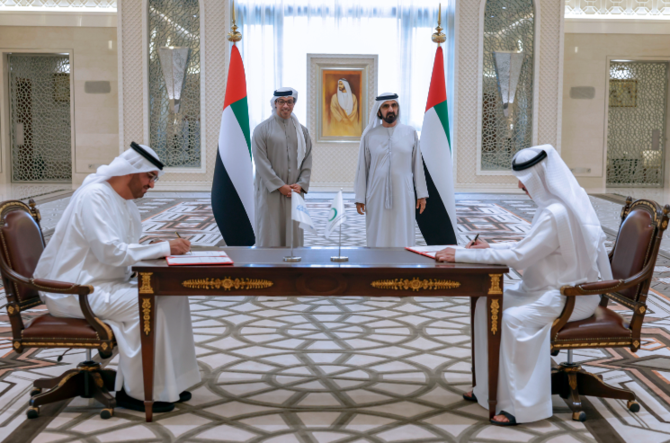
Masdar wins $1.5bn contract for Mohammed bin Rashid Al Maktoum Solar Park construction

The agreement was signed by Ahmed bin Ahmed Al-Jaber, UAE’s minister of industry and advanced technology, and Saeed Mohammed Al-Tayer, managing director and CEO of DEWA. (Govt. of Dubai Media Office)
Short Url
Updated 07 September 2023
Follow

Masdar wins $1.5bn contract for Mohammed bin Rashid Al Maktoum Solar Park construction

RIYADH: Dubai Electricity and Water Authority has awarded a contract worth 5.5 billion dirhams ($1.5 billion) to Abu Dhabi-based Masdar to construct the sixth phase of the 1,800 megawatt Mohammed bin Rashid Al Maktoum Solar Park.  

At least 23 international companies participated in the bidding process, but Masdar was given the contract as it offered a levelized cost of energy of $1.621 cents per kilowatt hour, the lowest of any of DEWA’s solar independent power producer model projects to date, according to a press statement.  

The agreement was signed by Ahmed bin Ahmed Al-Jaber, UAE’s minister of industry and advanced technology, and Saeed Mohammed Al-Tayer, managing director and CEO of DEWA.  

“Being awarded this landmark renewable energy project on the world’s largest single-site solar park is another significant milestone for Masdar. It is a testament to Masdar’s track record in pioneering clean energy projects as we continue to support the UAE’s net zero by 2050 strategic initiative,” said Al-Jaber, who is also the chairman of Masdar.  

He added: “Ahead of our nation hosting COP28 later this year, it is vital that the world triples global renewable energy capacity by 2030 to keep the ambition of 1.5 degrees within reach. This landmark project demonstrates definitive action in our shared journey toward a cleaner, greener future.”  

Upon completion, the sixth phase of the project is expected to provide clean energy to approximately 540,000 residences and reduce 2.36 million tons of carbon emissions annually.  

“This latest award once again shows that Masdar is a global leader in clean energy as we move forward from 20 GW (gigawatts) capacity today to reach 100 GW of clean energy capacity by 2030 driving decarbonization at home and abroad,” said Mohammed Jameel Al-Ramahi, CEO of Masdar.  

The sixth phase will become operational in stages starting from the fourth quarter of 2024, the statement added.  

“We are committed to achieving a balance between development and environmental sustainability across social, economic and environmental plans. This underscores the UAE’s prominent status as one of the world’s largest investors in clean and renewable energy projects,” added Al-Tayer.  


First EU–Saudi roundtable on critical raw materials reflects shared policy commitment

Updated 16 January 2026
Follow

First EU–Saudi roundtable on critical raw materials reflects shared policy commitment

RIYADH: The EU–Saudi Arabia Business and Investment Dialogue on Advancing Critical Raw Materials Value Chains, held in Riyadh as part of the Future Minerals Forum, brought together senior policymakers, industry leaders, and investors to advance strategic cooperation across critical raw materials value chains.

Organized under a Team Europe approach by the EU–GCC Cooperation on Green Transition Project, in coordination with the EU Delegation to Saudi Arabia, the European Chamber of Commerce in the Kingdom and in close cooperation with FMF, the dialogue provided a high-level platform to explore European actions under the EU Critical Raw Materials Act and ResourceEU alongside the Kingdom’s aspirations for minerals, industrial, and investment priorities.

This is in line with Saudi Vision 2030 and broader regional ambitions across the GCC, MENA, and Africa.

ResourceEU is the EU’s new strategic action plan, launched in late 2025, to secure a reliable supply of critical raw materials like lithium, rare earths, and cobalt, reducing dependency on single suppliers, such as China, by boosting domestic extraction, processing, recycling, stockpiling, and strategic partnerships with resource-rich nations.

The first ever EU–Saudi roundtable on critical raw materials was opened by the bloc’s Ambassador to the Kingdom, Christophe Farnaud, together with Saudi Deputy Minister for Mining Development Turki Al-Babtain, turning policy alignment into concrete cooperation.

Farnaud underlined the central role of international cooperation in the implementation of the EU’s critical raw materials policy framework.

“As the European Union advances the implementation of its Critical Raw Materials policy, international cooperation is indispensable to building secure, diversified, and sustainable value chains. Saudi Arabia is a key partner in this effort. This dialogue reflects our shared commitment to translate policy alignment into concrete business and investment cooperation that supports the green and digital transitions,” said the ambassador.

Discussions focused on strengthening resilient, diversified, and responsible CRM supply chains that are essential to the green and digital transitions.

Participants explored concrete opportunities for EU–Saudi cooperation across the full value chain, including exploration, mining, and processing and refining, as well as recycling, downstream manufacturing, and the mobilization of private investment and sustainable finance, underpinned by high environmental, social, and governance standards.

From the Saudi side, the dialogue was framed as a key contribution to the Kingdom’s industrial transformation and long-term economic diversification agenda under Vision 2030, with a strong focus on responsible resource development and global market integration.

“Developing globally competitive mineral hubs and sustainable value chains is a central pillar of Saudi Vision 2030 and the Kingdom’s industrial transformation. Our engagement with the European Union through this dialogue to strengthen upstream and downstream integration, attract high-quality investment, and advance responsible mining and processing. Enhanced cooperation with the EU, capitalizing on the demand dynamics of the EU Critical Raw Materials Act, will be key to delivering long-term value for both sides,” said Al-Babtain.

Valere Moutarlier, deputy director-general for European industry decarbonization, and directorate-general for the internal market, industry, entrepreneurship and SMEs at European Commission, said the EU Critical Raw Materials Act and ResourceEU provided a clear framework to strengthen Europe’s resilience while deepening its cooperation with international partners.

“Cooperation with Saudi Arabia is essential to advancing secure, sustainable, and diversified critical raw materials value chains. Dialogues such as this play a key role in translating policy ambitions into concrete industrial and investment cooperation,” she added.